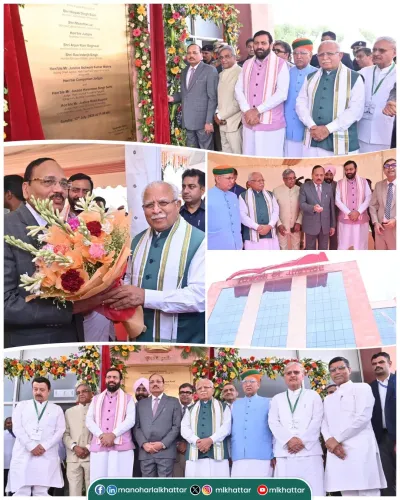
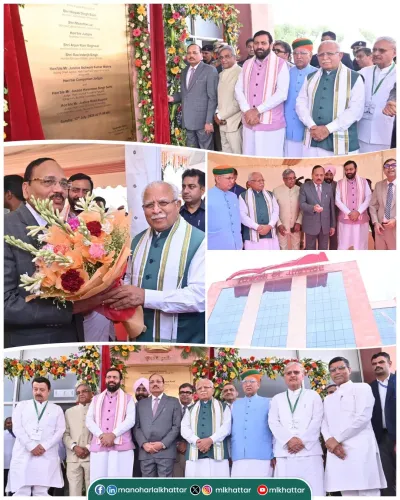
CM Saini Inaugurates Tower of Justice in Gurugram

Synopsis
Haryana Chief Minister Nayab Singh Saini inaugurated the Tower of Justice in Gurugram on 13 July 2026, adding a dedicated judicial complex to one of India's busiest commercial cities and advancing the state's long-running push to modernise district court infrastructure under the national e-Courts Mission Mode Project.
Key Takeaways
Haryana CM Nayab Singh Saini inaugurated the Tower of Justice in Gurugram on 13 July 2026 .
The complex is a dedicated judicial facility designed to consolidate court services for one of Haryana's most litigation-intensive cities.
The project aligns with Haryana's court modernisation drive running since 2015 under the national e-Courts Mission Mode Project .
Funding for such complexes typically comes from a mix of state budgets and central grants via the Department of Justice .
Key stakeholders include Gurugram litigants, the local bar, and the Haryana judiciary , all of whom stand to benefit from improved infrastructure.
Operational timelines and potential parallel digitisation announcements will be closely watched in the coming weeks.
Haryana Chief Minister Nayab Singh Saini on Sunday, 13 July 2026, inaugurated the Tower of Justice in Gurugram, marking a significant addition to the city's judicial infrastructure and signalling the state government's push to modernise court facilities in one of India's fastest-growing urban centres.
Context
The Tower of Justice is a dedicated judicial complex designed to consolidate court services and related legal facilities under one roof in Gurugram. Chief Minister Saini described the inauguration — 'Tower of Justice ka lokarpan' (inauguration of the Tower of Justice) — as a step toward strengthening the delivery of justice for citizens in the region. Gurugram, as a major commercial and IT hub adjacent to Delhi, carries one of the highest volumes of commercial and civil litigation in Haryana.
The complex is expected to serve litigants, lawyers, and judicial officers who have long contended with infrastructure constraints in the district's existing court premises. The inauguration reflects a broader state-level commitment to making justice delivery more accessible and efficient.
Policy Backdrop
The project aligns with Haryana's phased modernisation of district court infrastructure, an effort that has been ongoing since 2015 under the national e-Courts Mission Mode Project. This centrally-backed programme has provided a framework for both physical upgrades and digital transformation of court systems across Indian states.
Across India, states have accelerated construction of dedicated court towers and judicial complexes in high-growth urban centres, with the explicit aim of reducing case pendency and improving conditions for litigants and legal professionals alike. Such facilities are typically funded through a combination of state budget allocations and central grants channelled through the Department of Justice. Haryana's initiative fits squarely within this national pattern, with the BJP-led state government prioritising visible, capital-intensive justice-sector projects alongside digital reforms.
Stakeholders and Impact
The primary beneficiaries of the Tower of Justice are the litigants of Gurugram and the surrounding districts, who will gain access to modern, consolidated court facilities. The local bar association and practising lawyers are also direct stakeholders, as improved infrastructure reduces logistical burdens and can contribute to faster case processing.
The Haryana judiciary stands to benefit from better-equipped courtrooms and ancillary services, which can support efforts to address the significant backlog of pending cases that affects courts across the country. For the Saini government, the inauguration also carries political significance — delivering a tangible public asset in Gurugram, a constituency that is home to a large professional and business community with a direct stake in efficient legal processes.
What's Next
Attention will now turn to the operational handover timelines for the new complex and whether the government announces parallel measures on court digitisation — such as e-filing systems or virtual hearing facilities — to complement the physical infrastructure. Observers will also watch for any additional district-level judicial projects that may be announced as part of the 2026-27 Haryana budget cycle.
The inauguration of the Tower of Justice sets a benchmark for other high-growth districts in Haryana, and the state's ability to operationalise the complex swiftly will determine how quickly the promised improvements to justice delivery materialise for ordinary citizens.
Point of View
Where high-visibility judicial infrastructure projects are used to signal governance delivery in economically significant urban centres. For CM Saini, who took charge in early 2024, completing and inaugurating a dedicated court complex in Gurugram — a city synonymous with India's corporate and IT economy — carries both administrative and political weight. The move also slots into the broader national agenda of reducing court pendency through physical and digital infrastructure investment, giving the state government a concrete metric to point to. Whether the complex is followed by meaningful digitisation measures will determine its long-term impact on access to justice.
NationPress
11 Oct 2026
Frequently Asked Questions
What is the Tower of Justice in Gurugram?
The Tower of Justice is a newly inaugurated dedicated judicial complex in Gurugram, Haryana, designed to house courts and related legal services under one roof, improving infrastructure for litigants, lawyers, and judicial officers in the city.
Who inaugurated the Tower of Justice?
Haryana Chief Minister Nayab Singh Saini inaugurated the Tower of Justice in Gurugram on 13 July 2026.
Why was the Tower of Justice built in Gurugram?
Gurugram is one of Haryana's most commercially active cities and carries a high volume of civil and commercial litigation, making a dedicated, modern judicial complex essential to handle case load and reduce infrastructure constraints.
How is Haryana funding its court modernisation projects?
Court infrastructure projects in Haryana are typically funded through a combination of state budget allocations and central grants provided under the Department of Justice, often within the framework of the national e-Courts Mission Mode Project.
What is the e-Courts Mission Mode Project?
The e-Courts Mission Mode Project is a centrally-backed national programme that supports both physical upgrades and digital transformation of court systems across Indian states, under which Haryana has been modernising its district court infrastructure since 2015.