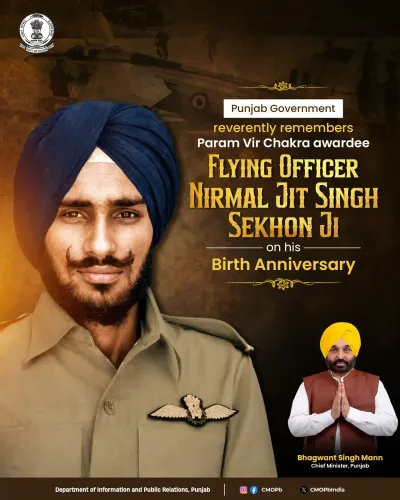
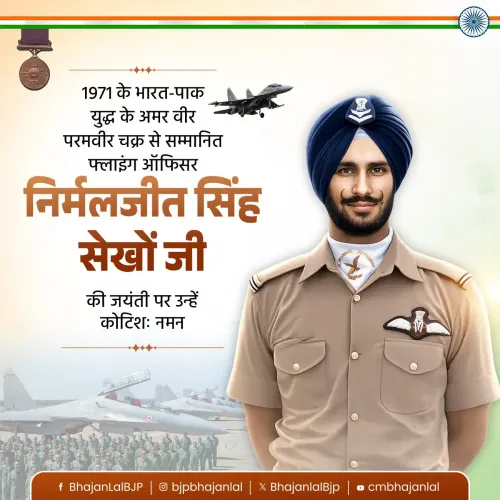
Khattar pays tribute to PVC hero Flying Officer Sekhon on birth anniversary
Synopsis
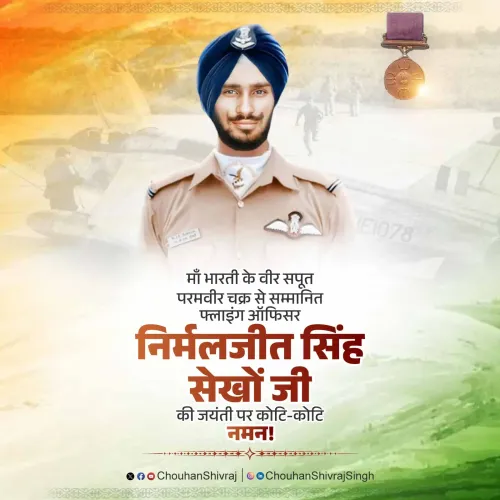
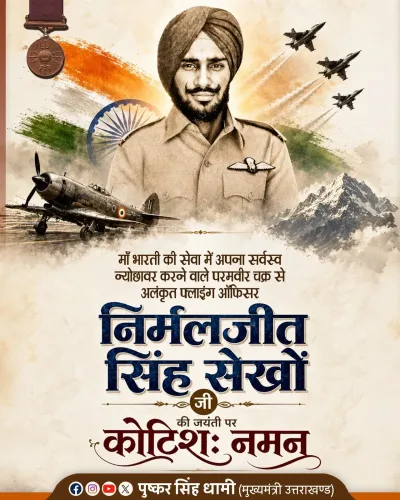
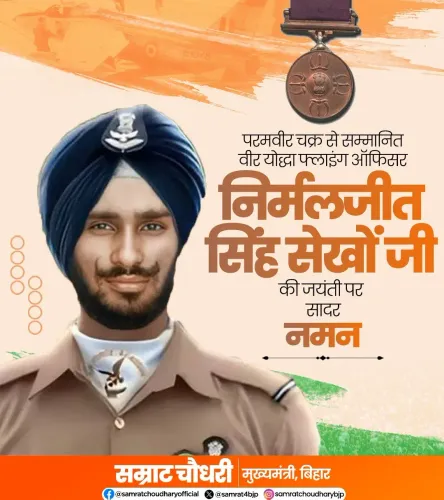
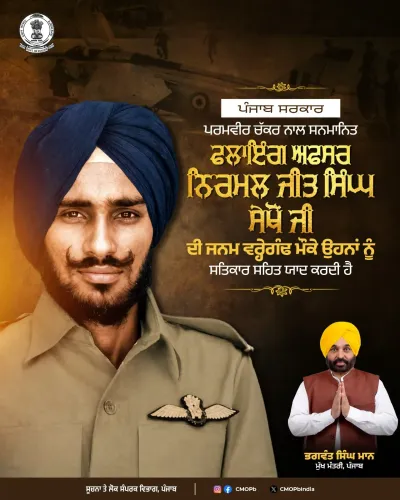
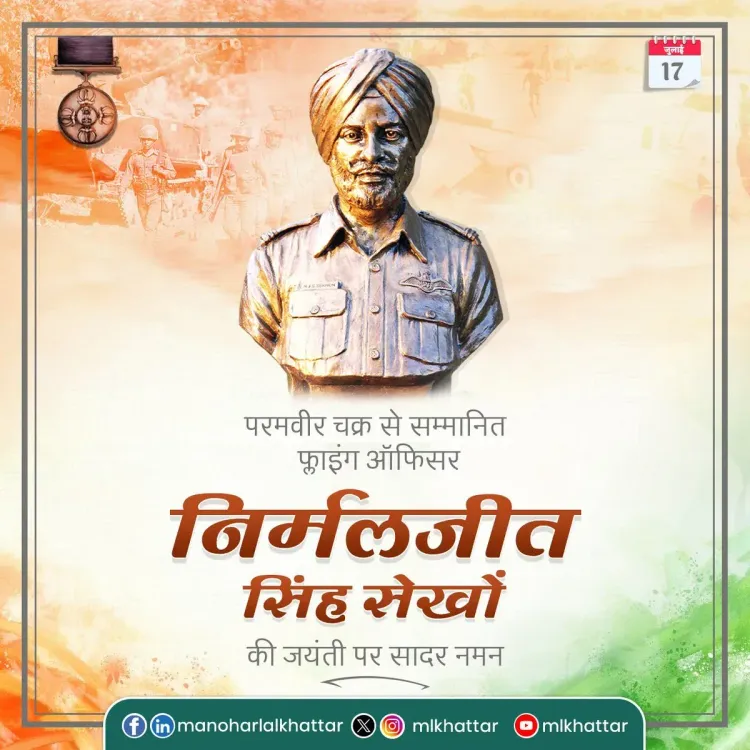
Union Power Minister Manohar Lal Khattar marked the birth anniversary of Flying Officer Nirmaljit Singh Sekhon — the Indian Air Force's only Param Vir Chakra awardee — saluting his 1971 aerial sacrifice over Srinagar as an eternal source of national pride.
Key Takeaways
Union Power Minister Manohar Lal Khattar posted a tribute on 17 July 2026 to mark the birth anniversary of Flying Officer Nirmaljit Singh Sekhon .
Sekhon is the only Indian Air Force officer to have been awarded the Param Vir Chakra , India's highest wartime gallantry honour.
He was awarded the decoration posthumously for single-handedly engaging Pakistani F-86 Sabre jets over Srinagar airfield on 14 December 1971 .
The Param Vir Chakra was instituted by the Government of India in 1950 as the apex military decoration for valour against the enemy.
Khattar described Sekhon's legacy as one that 'will continue to make the country proud forever,' situating the tribute within a broader governmental focus on defence history.
Union Power Minister Manohar Lal Khattar on Friday, 17 July 2026, paid tribute to Flying Officer Nirmaljit Singh Sekhon, the only Indian Air Force recipient of the Param Vir Chakra, on the occasion of the war hero's birth anniversary. Khattar saluted Sekhon's supreme sacrifice in the 1971 Indo-Pakistani War, calling his story of valour a source of enduring national pride.
Context
Posting in Hindi on X, Khattar wrote: '1971 ke yudh mein Pakistan ke fighter plane ko dhwast kar maa Bharati ki vijay ka marg prashast karne wale Param Vir Chakra vijeta, Flying Officer Nirmaljit Singh Sekhon ji ki jayanti par sadar naman arpit karta hoon!' — translated: 'I offer my respectful salutations on the birth anniversary of Param Vir Chakra awardee Flying Officer Nirmaljit Singh Sekhon, who destroyed Pakistani fighter planes in the 1971 war and paved the way for Mother India's victory!' He added that the saga of this brave son of the nation, who sacrificed everything for national honour and self-respect, 'will continue to make the country proud forever.'
Policy Backdrop
Flying Officer Nirmaljit Singh Sekhon is the sole member of the Indian Air Force to have received the Param Vir Chakra, India's highest wartime gallantry decoration, which was instituted by the Government of India in 1950. The award was conferred on Sekhon posthumously for extraordinary bravery during aerial combat on 14 December 1971, when he single-handedly engaged a formation of Pakistani F-86 Sabre jets over the Srinagar airfield, defending the base at the cost of his own life. The 1971 war culminated in the creation of Bangladesh and is widely regarded as one of India's most decisive military campaigns.
The Param Vir Chakra occupies the apex of India's military honours system, awarded exclusively for acts of conspicuous gallantry in the face of the enemy. Sekhon remains the only IAF officer to have earned this distinction, making his legacy singular within the armed forces.
Stakeholders and Impact
Ministerial tributes to 1971 war heroes form a recurring thread in official remembrance, particularly among senior leaders of the Bharatiya Janata Party, who frequently invoke the conflict as a symbol of Indian military resolve. Such posts resonate strongly with armed forces veterans, serving personnel, and their families, reinforcing institutional memory around the war's air operations. Khattar, a former Chief Minister of Haryana and now a Union Cabinet minister, lends additional weight to the tribute given his seniority within the government.
Sekhon hailed from Punjab, and commemorations of his birth anniversary hold particular significance in the region, where his memory is kept alive through memorials and institutional naming honours within the Indian Air Force.
What's Next
Official remembrance of 1971 war heroes typically intensifies as Vijay Diwas — observed on 16 December each year — approaches, when the government, armed forces, and political leaders collectively mark India's victory. Khattar's tribute on Sekhon's birth anniversary signals an early note in that broader calendar of national commemoration. Any forthcoming announcements on IAF modernisation or air-defence upgrades in the coming parliamentary session could provide a policy dimension to the renewed focus on India's air combat legacy.
Point of View
Particularly around the 1971 war. By invoking the sole IAF Param Vir Chakra awardee, the post taps into a narrative of air-power sacrifice that carries resonance beyond ceremonial remembrance, subtly reinforcing the government's sustained defence-first messaging. The timing on Sekhon's birth anniversary — ahead of the December Vijay Diwas cycle — keeps the 1971 legacy in public discourse through the year, not just on its formal anniversary. For a minister whose portfolio covers power and urban affairs rather than defence, the tribute also signals the broad political consensus within the ruling establishment around honouring military heroes.
NationPress
17 Jul 2026
Frequently Asked Questions
Who is Flying Officer Nirmaljit Singh Sekhon?
Flying Officer Nirmaljit Singh Sekhon was an Indian Air Force pilot and the only IAF officer to receive the Param Vir Chakra, India's highest wartime gallantry award. He was honoured posthumously for his bravery during the 1971 Indo-Pakistani War.
Why is Nirmaljit Singh Sekhon famous?
Sekhon is celebrated for single-handedly engaging a formation of Pakistani F-86 Sabre jets over Srinagar airfield on 14 December 1971, defending the base at the cost of his life — an act that earned him the Param Vir Chakra.
What is the Param Vir Chakra?
The Param Vir Chakra is India's highest military decoration for gallantry in the face of the enemy, instituted in 1950. It is awarded exclusively for acts of extraordinary bravery during wartime.
Why did Manohar Lal Khattar post a tribute to Sekhon?
Khattar posted the tribute on 17 July 2026 to mark the birth anniversary of Flying Officer Nirmaljit Singh Sekhon, saluting his sacrifice in the 1971 war as a source of enduring national pride.
What role did Sekhon play in the 1971 war?
During the 1971 Indo-Pakistani War, Sekhon defended the Srinagar airfield by engaging Pakistani fighter aircraft alone, destroying enemy planes and preventing damage to the base before losing his life in combat.