Khattar pays tribute to Rani Chennamma on her birth anniversary
Synopsis
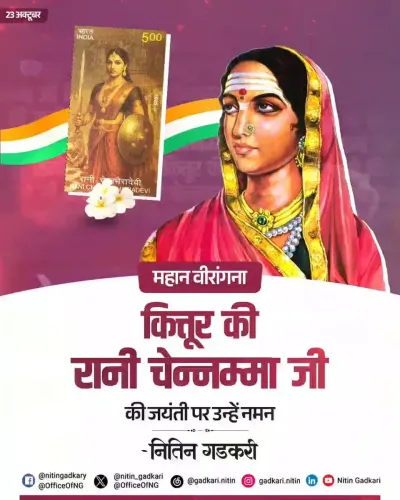
Union Power Minister Manohar Lal Khattar marked the birth anniversary of Rani Chennamma of Kittur on October 23, 2026, saluting the 19th-century queen who led one of India's earliest armed revolts against the British East India Company in 1824.
Key Takeaways
Manohar Lal Khattar , Union Power Minister, paid tribute to Rani Chennamma of Kittur on her birth anniversary on October 23, 2026 .
Rani Chennamma led an armed revolt against the British East India Company in 1824 — one of the earliest in southern India.
She ruled the princely state of Kittur in present-day Karnataka and resisted annexation under the Company's doctrine of lapse.
Captured by British forces, she died in captivity in 1829 and is remembered as a pioneer of women's armed resistance.
Khattar invoked her as a symbol of Nari Shakti , consistent with a broader BJP pattern of honouring pre-1857 regional heroines.
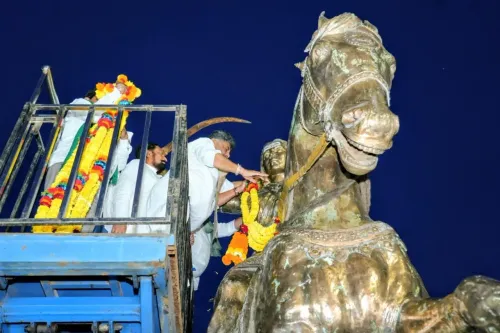
Nearly two centuries after Rani Chennamma of Kittur raised arms against the British East India Company, Union Power Minister Manohar Lal Khattar paused on Friday, October 23, 2026, to salute her memory on her birth anniversary — invoking the warrior queen as an enduring symbol of Nari Shakti (women's power).
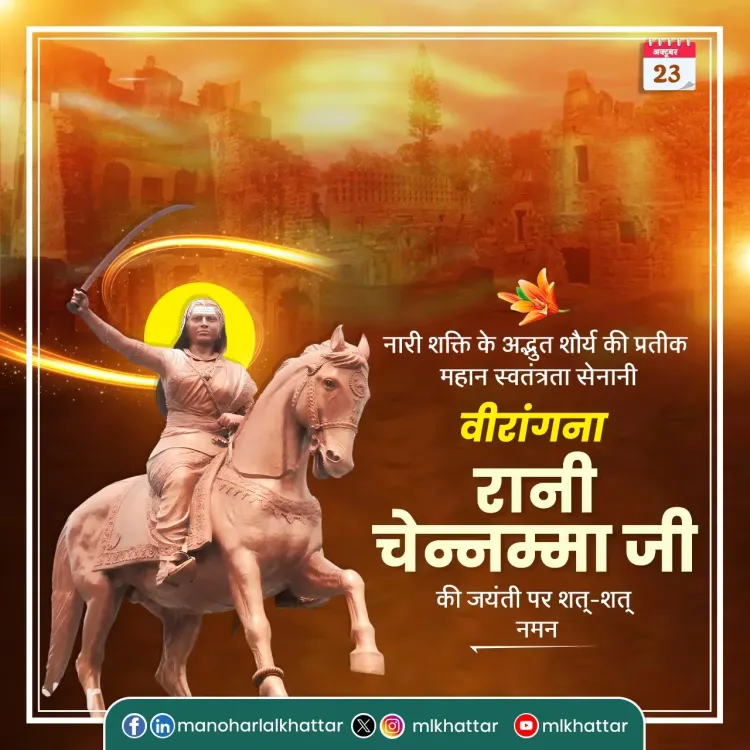
Posting in Hindi on X, Khattar wrote: 'Nari Shakti ke adbhut shaurya ki pratik, Kittur ki Maharani, mahan swatantrata senani Rani Chennamma ji ki jayanti par unhe shraddhapoorn naman!' — 'Reverential salutations to the great freedom fighter Rani Chennamma, Maharani of Kittur, the extraordinary symbol of women's valour, on her birth anniversary.' He added that 'a grateful nation shall forever take pride in the glorious saga of this brave heroine who, through her courage, might, and wisdom, forced the British army to bite the dust.'
The queen who defied the Company in 1824
Rani Chennamma ruled the princely state of Kittur, located in present-day Karnataka, and led one of the earliest armed revolts against British colonial expansion in southern India. In 1824 — more than three decades before the more widely remembered uprising of 1857 — she refused to accept the East India Company's doctrine of lapse, which sought to annex Kittur following a succession dispute. Her forces famously captured a British political officer during the ensuing battle, making her resistance a landmark moment in the pre-1857 history of Indian defiance.
Chennamma was eventually captured and died in British captivity in 1829, but her legend endured — commemorated today in Karnataka and across India as a forerunner to the broader independence movement and a pioneer of women's leadership in armed resistance.
A recurring BJP salute to pre-1857 heroines
Khattar's tribute follows a consistent pattern among senior BJP leaders of publicly honouring regional freedom fighters — particularly women rulers — whose stories predated the 1857 revolt. This emphasis on Nari Shakti and on decentralised, regional acts of resistance forms a deliberate thread in official political communication, weaving pre-colonial and colonial-era heroines into the larger national narrative.
For a minister of Khattar's stature — former Chief Minister of Haryana and now a cabinet minister in the Union government — such jayanti messages carry both symbolic weight and political intent: anchoring the party's identity to a wide, pluralistic roster of Indian heroes drawn from every region and era.
Rani Chennamma's story belongs to Karnataka, yet her appeal cuts across state lines — a queen who made the empire blink. That is precisely the kind of legacy a grateful country does not outgrow.
Point of View
Pre-1857 figures — especially women. By spotlighting Rani Chennamma, the party signals its Karnataka outreach while reinforcing the 'Nari Shakti' brand that has featured prominently in government messaging since the Women's Reservation Act. The tribute also implicitly frames the 1824 Kittur revolt as a precursor to 1857, deepening the historical arc the party uses to assert civilisational continuity. For Khattar personally, the gesture extends his public profile beyond power and urban policy into the broader cultural-nationalist register senior BJP leaders now routinely occupy.
NationPress
23 Oct 2026
Frequently Asked Questions
Who was Rani Chennamma of Kittur?
Rani Chennamma was the queen of the princely state of Kittur in present-day Karnataka who led one of India's earliest armed revolts against the British East India Company in 1824, refusing to accept its doctrine of lapse over a succession dispute. She was captured and died in British captivity in 1829.
Why is Rani Chennamma's birth anniversary celebrated?
Her birth anniversary is observed to honour her role as an early freedom fighter and a symbol of women's courage and leadership in resisting colonial rule, decades before the 1857 uprising.
What did Manohar Lal Khattar post about Rani Chennamma?
Khattar posted a tribute in Hindi on X on October 23, 2026, saluting Rani Chennamma as an extraordinary symbol of 'Nari Shakti' and praising her courage, might, and wisdom in forcing the British army to retreat during the 1824 Kittur revolt.
What was the Kittur revolt of 1824?
The Kittur revolt of 1824 was an armed uprising led by Rani Chennamma against the British East India Company's attempt to annex the Kittur princely state under the doctrine of lapse following a succession dispute. Her forces captured a British political officer, making it one of the most notable early acts of armed resistance to British rule in southern India.
Where is Kittur located?
Kittur is a town in present-day Karnataka, India, historically the seat of the princely state ruled by Rani Chennamma in the early 19th century.