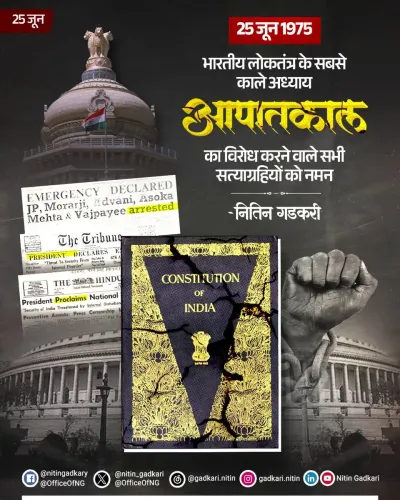
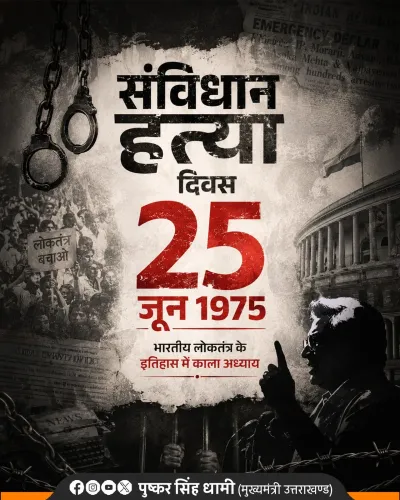
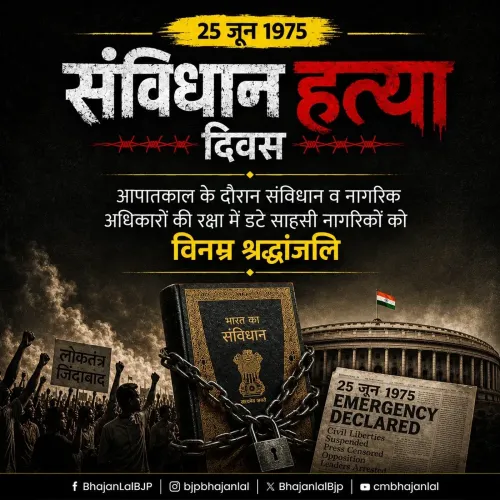
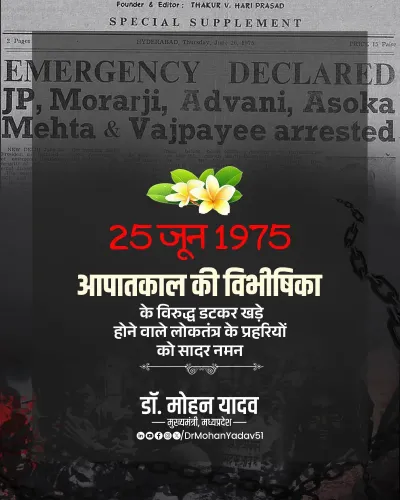
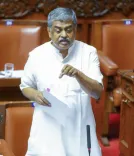
Khattar Marks Emergency Anniversary, Salutes Democracy Fighters
Synopsis
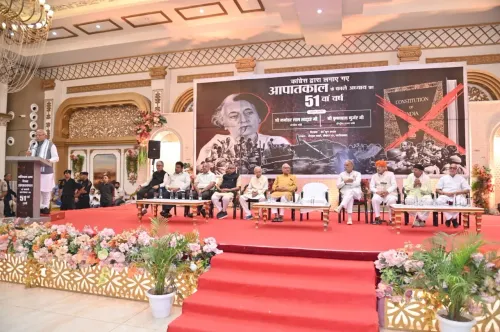
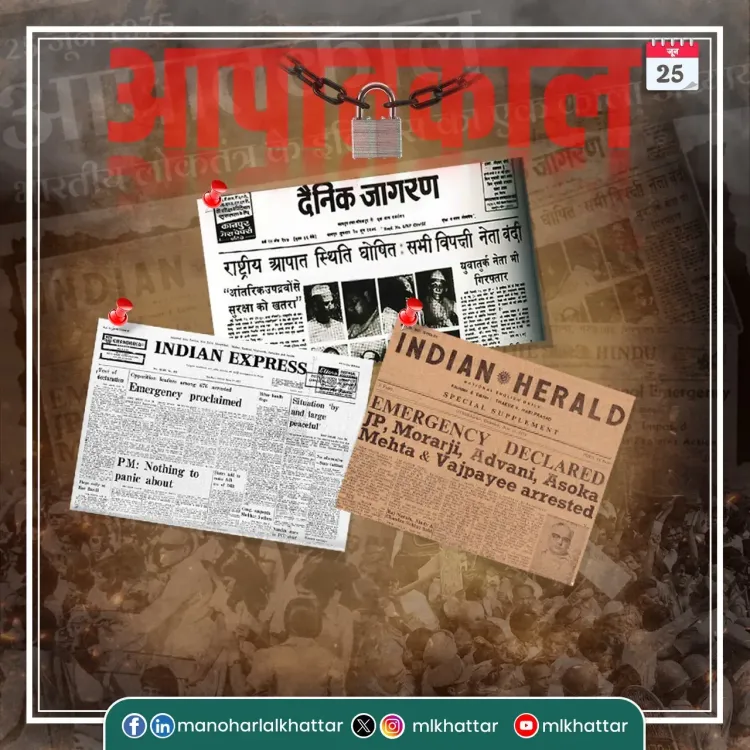
Union Power Minister Manohar Lal Khattar on 25 June 2026 marked the 51st anniversary of the 1975 Emergency, calling it a 'dark chapter,' saluting democracy fighters who resisted Congress-era authoritarian rule, and pledging that such a period must never recur.
Key Takeaways
Union Power Minister Manohar Lal Khattar posted a tribute on 25 June 2026 marking the anniversary of the 1975 Emergency .
He described the Emergency as a 'dark chapter' proving that the Indian National Congress placed power above democracy and the Constitution.
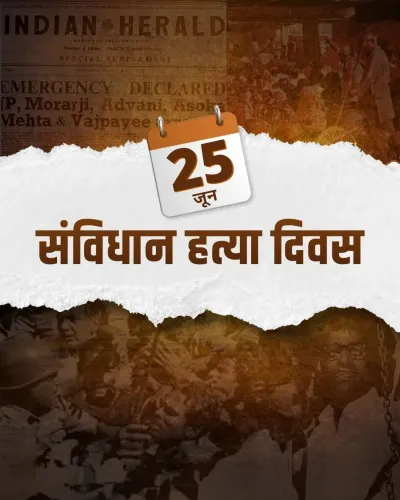
The Emergency was proclaimed on 25 June 1975 under Article 352 and lasted until March 1977 , suspending fundamental rights and imposing press censorship.
Khattar saluted 'loktantra senaniyon' (democracy fighters) who resisted dictatorship and torture during those 21 months .
He called for a 'firm resolve' to defend democracy in every circumstance to prevent any repetition of authoritarian rule.
BJP leaders have annually used the 25 June anniversary to contrast their constitutional commitments with the Congress-era Emergency record.
Union Power Minister Manohar Lal Khattar on Thursday, 25 June 2026 paid tribute to those who resisted the 1975 Emergency, calling the episode a 'dark chapter' in Indian democratic history and renewing a pledge to defend constitutional values against any future authoritarian turn.
Context
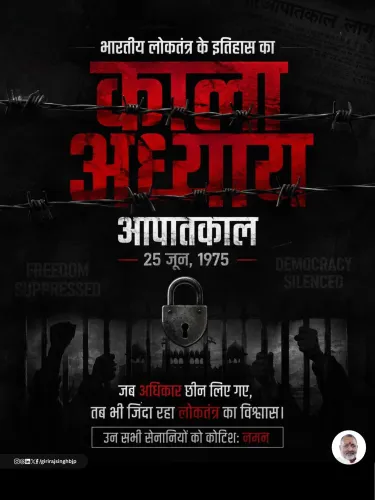
In his post, Khattar wrote in Hindi: '25 जून 1975 भारतीय लोकतंत्र के इतिहास का वो काला अध्याय है, जिसकी विभीषिका को राष्ट्र कभी भुला नहीं सकता' — 'June 25, 1975 is that dark chapter in the history of Indian democracy whose horrors the nation can never forget.' He squarely blamed the Indian National Congress, asserting that by imposing the Emergency overnight, the party proved that 'power is supreme for it, not democracy and the Constitution.'
Khattar reserved his salutations for what he termed 'loktantra senaniyon' — democracy fighters — who, despite 'the Congress government's dictatorship and cruel tortures,' devoted their lives to reviving democratic governance. He called their sacrifice 'an invaluable heritage of this nation.'
Policy Backdrop
On 25 June 1975, then Prime Minister Indira Gandhi advised the President to proclaim a national emergency under Article 352 of the Constitution, citing internal disturbance. The Emergency lasted until March 1977, during which fundamental rights were suspended, press censorship was imposed, and thousands of political opponents were detained without trial.
The episode remains one of the most contested periods in post-Independence Indian politics. Civil liberties groups and constitutional scholars have long documented the suspension of habeas corpus, the muzzling of the press, and the use of state machinery to silence dissent during those 21 months.
Stakeholders and Impact
Senior BJP leaders, including Khattar, have consistently marked 25 June each year as a moment of democratic reckoning, using the anniversary to contrast the party's stated commitment to constitutionalism with what they characterise as Congress-era authoritarianism. The framing is directed at both political opposition and a broader civic audience invested in questions of institutional integrity.
For civil liberties groups and historians, the Emergency anniversary serves as a reference point for evaluating the health of democratic institutions — press freedom, judicial independence, and the right to dissent — in any era. Khattar's call for a 'firm resolve' to stand against dictatorship in 'every circumstance' echoes a recurring rhetorical posture among ruling-party leaders on this date.
What's Next
The 51st anniversary of the Emergency's imposition is likely to generate wider commemorative activity across the political spectrum. Formal events by central ministries, parliamentary references, and publications by cultural or historical bodies may follow in the coming days. The Congress party, for its part, has in recent years defended the Emergency as a response to specific political circumstances of that era — a counter-narrative that typically resurfaces around this date and sharpens the partisan divide over India's democratic memory.
Point of View
The first day of the parliamentary monsoon session build-up period, amplifies the political resonance beyond mere commemoration. By invoking 'cruel tortures' and 'dictatorship' in the same breath as a forward-looking pledge, Khattar is simultaneously performing historical memory and issuing a present-tense political signal. For the Congress, each such anniversary renews a reputational liability that the party has struggled to neutralise across five decades.
NationPress
23 Sept 2026
Frequently Asked Questions
What is the 1975 Emergency that Khattar is referring to?
The 1975 Emergency refers to the national emergency proclaimed by President Fakhruddin Ali Ahmed on the advice of Prime Minister Indira Gandhi on 25 June 1975 under Article 352 of the Constitution. It lasted until March 1977, during which fundamental rights were suspended, press censorship was imposed, and thousands of political opponents were detained.
Why do BJP leaders mark 25 June every year?
BJP leaders mark 25 June annually as the anniversary of the Emergency's imposition to highlight what they describe as Congress-era authoritarianism, contrast it with their own stated commitment to constitutional democracy, and pay tribute to those who resisted the Emergency.
Who are 'loktantra senani' mentioned by Khattar?
'Loktantra senani' literally means 'democracy fighters' in Hindi — a term used for individuals who resisted or were imprisoned during the 1975-77 Emergency. Several states have recognised them with pensions and honours.
What did Manohar Lal Khattar say about the Emergency on 25 June 2026?
Khattar called the Emergency a 'dark chapter' in Indian democratic history, blamed the Congress for prioritising power over democracy and the Constitution, saluted democracy fighters who endured torture and hardship, and called for a firm resolve to prevent any repetition of such authoritarian rule.
Under which article of the Constitution was the 1975 Emergency declared?
The 1975 Emergency was declared under Article 352 of the Indian Constitution, which empowers the President to proclaim a national emergency if the security of India or any part thereof is threatened by war, external aggression, or armed rebellion. At the time, 'internal disturbance' was the cited ground.