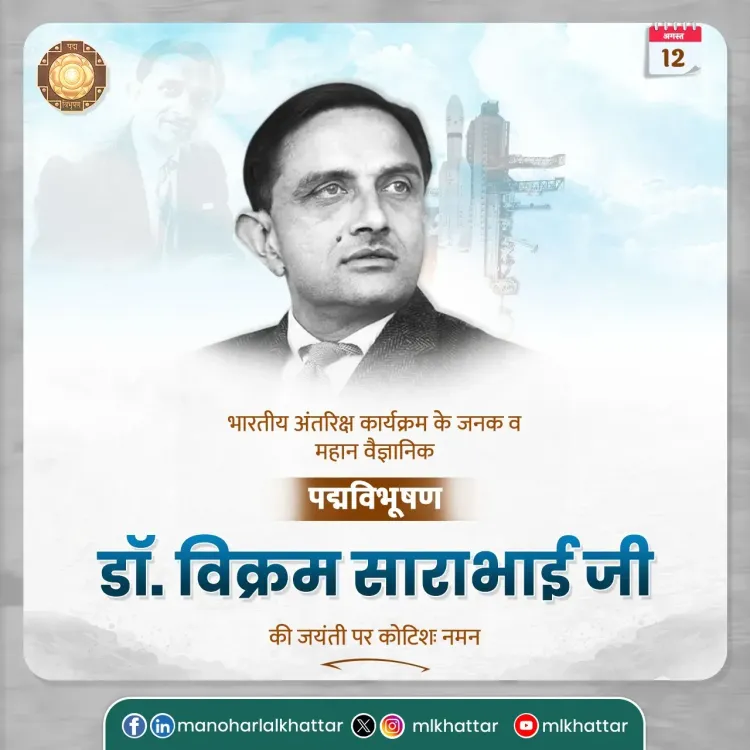
Khattar pays tribute to Vikram Sarabhai on birth anniversary
Synopsis
Union Power Minister Manohar Lal Khattar paid homage to Dr. Vikram Sarabhai on his birth anniversary, honouring the Padma Vibhushan physicist who founded the Physical Research Laboratory and laid the institutional groundwork for ISRO in 1969.
Key Takeaways
Manohar Lal Khattar posted a tribute to Dr.
Vikram Sarabhai on his birth anniversary, 12 August 2026 .
Sarabhai, born 12 August 1919 in Ahmedabad, is regarded as the father of India's space programme.
He founded the Physical Research Laboratory in 1947 and was the driving force behind the creation of ISRO in 1969 .
Sarabhai was awarded the Padma Vibhushan , India's second-highest civilian honour.
He passed away in December 1971 , aged 52, before ISRO achieved its most celebrated milestones.
India's space age began with one man's conviction that a young, newly independent nation could reach the stars. On Wednesday, 12 August 2026, Union Power Minister Manohar Lal Khattar joined the country in honouring Dr. Vikram Sarabhai — physicist, astronomer, and the architect of India's space programme — on his birth anniversary.
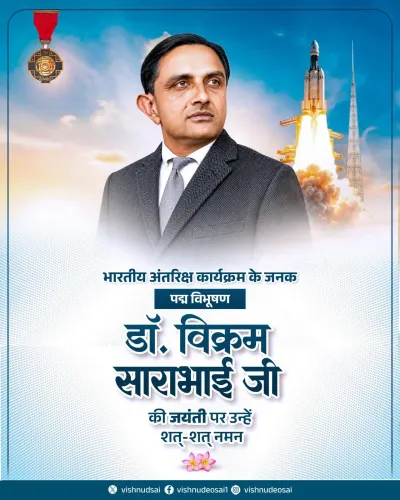
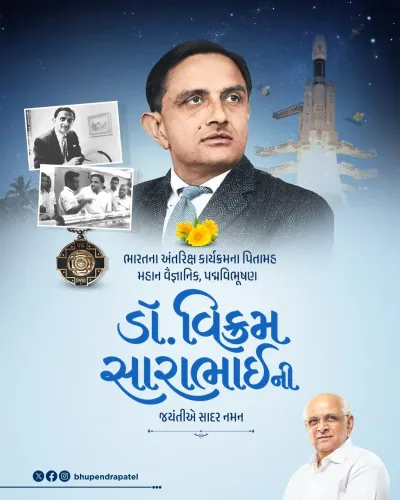
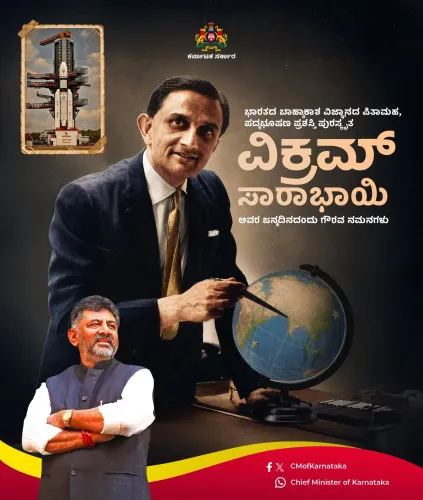
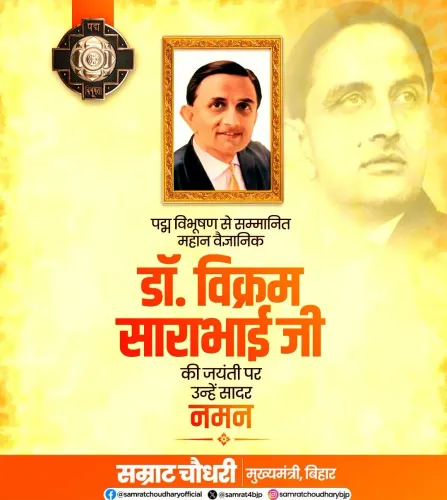
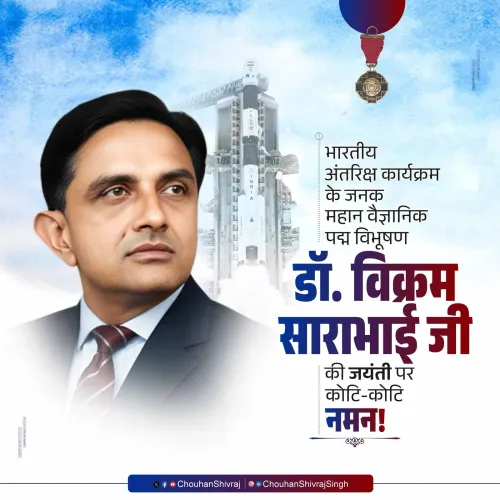
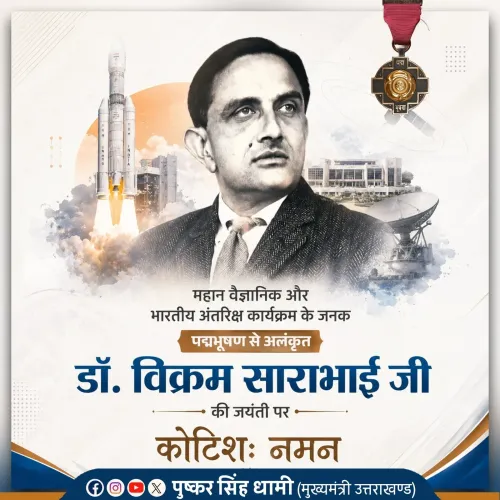
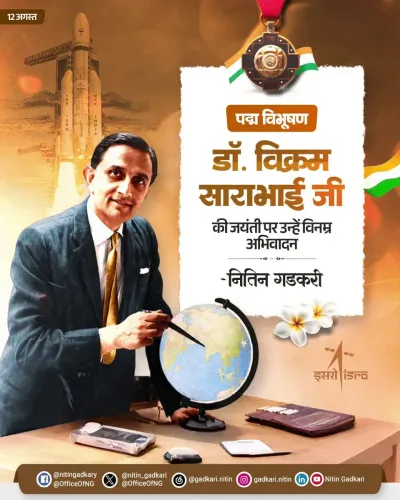
Khattar posted his tribute in Hindi, writing: 'भारतीय अंतरिक्ष कार्यक्रम के जनक व महान वैज्ञानिक, पद्म विभूषण डॉ. विक्रम साराभाई की जयंती पर कोटिशः नमन।' — 'Countless salutations on the birth anniversary of the father of the Indian space programme and great scientist, Padma Vibhushan Dr. Vikram Sarabhai.' He added that Sarabhai's contribution in laying the foundation of space research in India and placing the country on the world stage 'will always remain unparalleled and incomparable.'
The man who gave India its space identity
Dr. Vikram Ambalal Sarabhai was born on 12 August 1919 in Ahmedabad. A student of Cambridge and a pioneer in cosmic-ray research, he returned to India and founded the Physical Research Laboratory (PRL) in 1947 — the same year the country gained independence. That institution became the seedbed for everything that followed. It was Sarabhai who persuaded the government that space was not a luxury for a developing nation but a necessity. He argued that satellites could deliver education, weather forecasts, and communication to every corner of a vast, diverse country. That argument won. ISRO — the Indian Space Research Organisation — was formally established in 1969, the direct institutional expression of his vision. He did not live to see its greatest triumphs; Sarabhai passed away in December 1971, aged 52. He was posthumously remembered through the Padma Vibhushan, India's second-highest civilian honour.A legacy that outlived its author
The organisation Sarabhai built has since placed satellites in orbit, landed a rover on the Moon's south pole, and dispatched a probe to Mars on its first attempt. Every milestone carries his intellectual fingerprint. Indian leaders across party lines mark 12 August each year with tributes — a rare, consistent consensus that his contribution sits above political contest. Khattar's post, coming from a minister who oversees infrastructure and urban development rather than space policy, reflects how thoroughly Sarabhai's legacy has entered national consciousness — honoured not just by scientists, but by the full breadth of public life.Point of View
Defence, and technology — has deep indigenous roots, not just recent political origins. The annual consensus around 12 August also illustrates how space has become one of the few genuinely bipartisan symbols in an otherwise sharply polarised public sphere. As ISRO's mission tempo accelerates, tributes like this one serve to anchor institutional ambition in founding mythology.
NationPress
27 Sept 2026
Frequently Asked Questions
Who was Vikram Sarabhai?
Dr. Vikram Sarabhai was an Indian physicist and astronomer born on 12 August 1919, widely regarded as the father of India's space programme. He founded the Physical Research Laboratory in 1947 and was the principal architect of ISRO, established in 1969.
Why is 12 August significant for India's space history?
12 August is the birth anniversary of Dr. Vikram Sarabhai, the founder of India's space programme. Indian leaders and scientists mark the day each year with tributes to his foundational role in building the country's space research infrastructure.
What award did Vikram Sarabhai receive?
Dr. Vikram Sarabhai was awarded the Padma Vibhushan, India's second-highest civilian honour, in recognition of his extraordinary contributions to science and the establishment of India's space research ecosystem.
What did Manohar Lal Khattar say about Vikram Sarabhai?
Khattar described Sarabhai as the 'father of the Indian space programme' and a 'great scientist,' saying his contribution in laying the foundation of space research and placing India on the world stage 'will always remain unparalleled and incomparable.'
When was ISRO founded and what is its connection to Sarabhai?
ISRO was formally established in 1969, directly implementing the vision of Dr. Vikram Sarabhai, who had argued that space technology was essential for India's development in education, communication, and weather forecasting.