Kishan Reddy shares Modi's Viksit Bharat 2047 vision
Synopsis
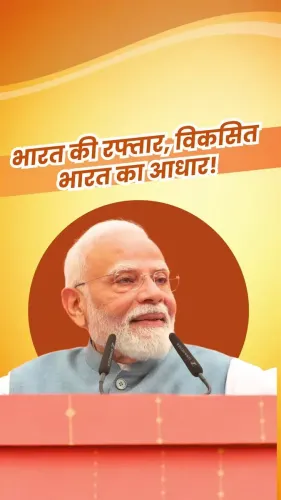
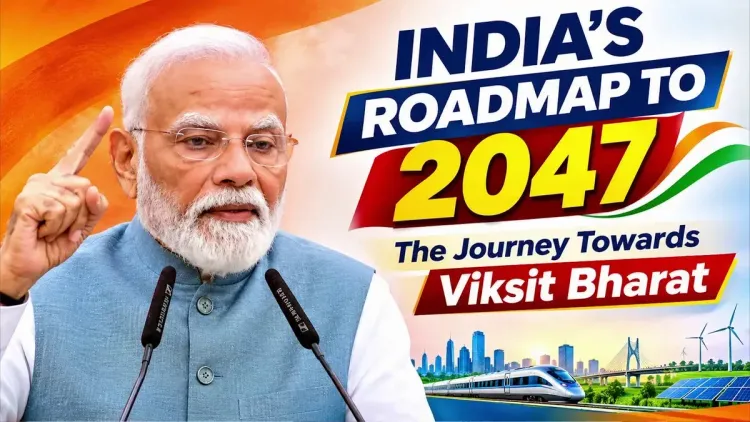
Union Minister G. Kishan Reddy amplified PM Modi's Viksit Bharat 2047 vision, citing Chandrayaan-3, semiconductors, solar energy, and startups as evidence that India's march toward developed-nation status is well underway.
Key Takeaways
Viksit Bharat 2047 is India's national goal to become a developed economy by the centenary of independence, first announced by PM Modi in his 2022 Independence Day speech.
Kishan Reddy shared a quote from PM Modi on 12 November 2026 , linking space, chips, clean energy, and startups to the 2047 deadline.
Chandrayaan-3 's August 2023 lunar south-pole landing made India the fourth country to land on the Moon and the first to reach its southern region.
The India Semiconductor Mission , launched in 2021 , underpins the government's push for domestic chip fabrication capacity.
India's National Solar Mission and Startup India initiative form the economic pillars alongside space and semiconductors in the Viksit Bharat framework.
As BJP Telangana state president and Coal and Mines Minister, Reddy's endorsement bridges legacy energy sectors with India's new-economy ambitions.
From the lunar south pole to silicon wafers, Union Coal and Mines Minister G. Kishan Reddy invoked Prime Minister Narendra Modi's sweeping Viksit Bharat vision on Thursday, 12 November 2026, quoting the PM's rallying call that 'no dream is beyond our reach when the nation moves with determination.'
The 2047 deadline and what it demands
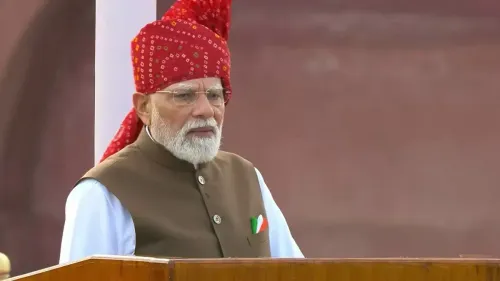
Viksit Bharat 2047 — India's national mission to attain full developed-economy status by the centenary of independence — was first articulated by PM Modi in his 2022 Independence Day address from the Red Fort. The target is not merely symbolic: it frames every major policy decision from defence procurement to digital infrastructure around a single, time-bound finishing line. Reddy's post channels that framing precisely, stacking four distinct proof points — Chandrayaan-3, semiconductors, solar energy, and startups — to argue the trajectory is real, not rhetorical.
Chandrayaan-3 to semiconductors: the evidence chain
Chandrayaan-3's successful soft-landing near the lunar south pole in August 2023 remains the most vivid symbol of India's technological ambition — a mission that made India the fourth nation ever to land on the Moon and the first to reach its southern region. The minister places it alongside the government's semiconductor push, anchored by the India Semiconductor Mission launched in 2021 with an incentive corpus aimed at seeding domestic chip fabrication. These are not isolated achievements; they are presented as nodes in a connected arc of capability-building.
Solar and startups: the economic flanks
India's renewable energy expansion — driven by the National Solar Mission — has seen the country emerge as one of the world's fastest-growing solar markets. Simultaneously, the Startup India initiative has helped birth one of the globe's largest startup ecosystems, with Indian unicorns now spanning fintech, agritech, and deep-tech. Reddy's framing knits these strands together: space science, chips, clean energy, and entrepreneurship as mutually reinforcing pillars of the 2047 project.
Why a Coal and Mines Minister is amplifying this message
The choice of messenger matters. G. Kishan Reddy — who also serves as BJP Telangana state president — oversees sectors that sit at the tension point of India's energy transition: coal remains critical to the grid even as solar scales. His endorsement of the Viksit Bharat framing signals that even ministries managing legacy energy resources see themselves as part of the same modernisation story. It is a deliberate bridging of the old economy and the new.
The scorecard between now and 2047 will be written in semiconductor fab approvals, solar gigawatts commissioned, and startup valuations — and the government is making sure every minister knows their chapter in it.
Point of View
Yet he frames India's future entirely through space, chips, and clean energy — a deliberate signal that the transition story is now party-wide orthodoxy, not just the domain of tech ministries. The Viksit Bharat framing has steadily evolved from an aspirational slogan into a policy organising principle, with individual schemes increasingly benchmarked against the 2047 endpoint. Whether the semiconductor and solar targets can keep pace with that ambition will be the real test of the narrative's credibility.
NationPress
12 Nov 2026
Frequently Asked Questions
What is Viksit Bharat 2047?
Viksit Bharat 2047 is India's national goal to transform the country into a fully developed economy by 2047, the centenary of independence. PM Modi first outlined the vision in his Independence Day address in 2022.
What did G. Kishan Reddy post about Viksit Bharat?
On 12 November 2026, Union Minister G. Kishan Reddy shared a quote attributed to PM Modi stating that India's achievements in space, semiconductors, solar energy, and startups prove 'no dream is beyond our reach' on the road to Viksit Bharat 2047.
What was Chandrayaan-3 and why is it significant?
Chandrayaan-3 was ISRO's lunar mission that successfully soft-landed near the Moon's south pole in August 2023, making India the fourth nation to land on the Moon and the first to reach its southern region.
What is the India Semiconductor Mission?
The India Semiconductor Mission, launched in 2021, is a government programme with an incentive corpus designed to attract semiconductor fabrication investment and build domestic chip manufacturing capacity.
Who is G. Kishan Reddy?
G. Kishan Reddy is India's Union Minister of Coal and Mines and also serves as BJP's Telangana state president. He is a senior BJP leader from Telangana.