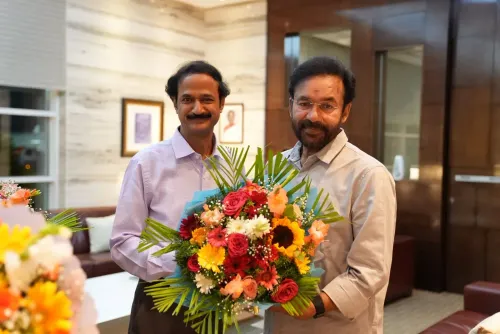
Kishan Reddy at GSI-TI: geological data to go open-access

Synopsis
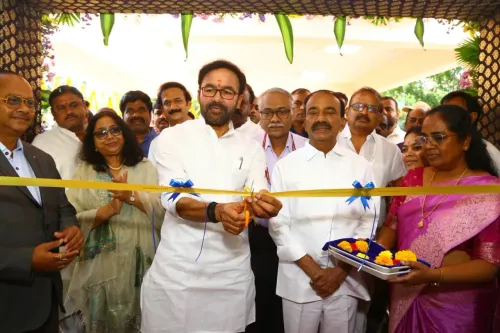
Union Mines Minister G. Kishan Reddy visited the GSI Training Institute in Hyderabad on November 11, 2026, marking GSI's 176-year legacy and reaffirming the government's drive to digitise and open geological exploration data to private firms, researchers and state departments.
Key Takeaways
Kishan Reddy visited the GSI Training Institute, Hyderabad on 11 November 2026 .
The Geological Survey of India was founded in March 1851 , making 2026 its 176th year .
The government is working to make geological exploration data 'open and accessible to all' via the National Geoscience Data Repository (NGDR) .
The MMDR Amendment Act 2021 introduced composite licences and enabled auctions of partially explored mineral blocks.
Open geological data is intended to attract private exploration investment and reduce India's dependence on imported critical minerals .
The next mineral block auctions — using NGDR data — will be a key test of how far these reforms have progressed.
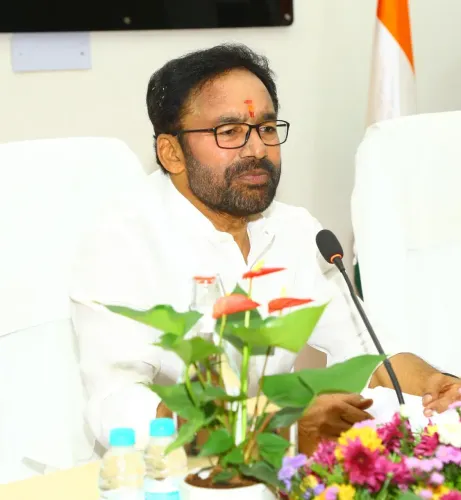
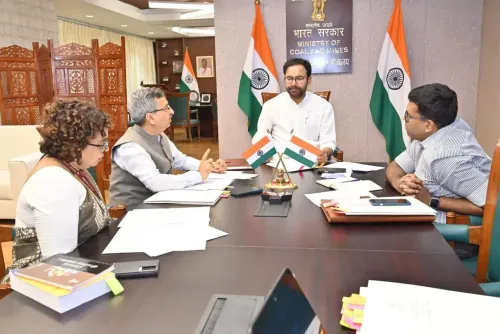
At the Geological Survey of India Training Institute (GSI-TI) in Hyderabad on Wednesday, 11 November 2026, Union Coal and Mines Minister G. Kishan Reddy marked 176 years of GSI's existence — and used the milestone to signal a sharper push to throw the agency's vast geological data open to anyone who wants it.
176 years of GSI — and a data revolution underway
Founded in March 1851, the Geological Survey of India is one of the oldest scientific agencies on the planet, predating even the unification of Italy. For most of that history, the treasure trove of mineral maps, borehole logs and exploration reports it accumulated sat largely locked away from private investors. That asymmetry, reformers have long argued, is a primary reason India's vast mineral belt remains under-explored relative to its geological potential.
Minister Reddy framed the ongoing change in direct terms, saying the government is 'driving key reforms and making crucial geological exploration data open and accessible to all' — guided by Prime Minister Narendra Modi's broader vision for transparency in the resource sector.
The policy scaffolding behind the open-data push
The push did not arrive overnight. The National Mineral Policy 2019 planted the flag for transparency and private participation. The Mines and Minerals (Development and Regulation) Amendment Act, 2021 then created the legal architecture — introducing composite licences and enabling auctions of partially explored blocks, so companies could bid on a prospect without GSI having done all the legwork first.
Running alongside those legislative moves is the National Geoscience Data Repository (NGDR) project, GSI's own initiative to digitise decades of legacy field data and place it on a platform accessible to exploration firms, state mining departments and researchers alike. Reddy's visit to GSI-TI — the agency's Hyderabad-based capacity-building hub — underlines that the government sees training and data infrastructure as inseparable parts of the same reform agenda.
Why open geological data is an economic lever
India is running a critical-mineral deficit that shows up in import bills for lithium, cobalt and nickel — materials central to the clean-energy transition. Reducing that deficit means accelerating domestic discovery. Private exploration firms, however, will not risk capital on blocks where basic geological intelligence is unavailable or prohibitively expensive to obtain. Open data changes that calculus directly.
State mining departments and private exploration companies stand to benefit most immediately — better baseline data means faster block identification, more competitive auctions, and ultimately more mineral blocks in production. The next test of how much real traction these reforms have gained will come at the next round of mineral block auctions, where NGDR data is expected to underpin bidding decisions.
One hundred and seventy-six years after a handful of British geologists set out to map the subcontinent's rocks, India is finally building the digital infrastructure to let those maps do economic work at scale.
Point of View
So this is as much an investment-climate intervention as a governance one. The timing, against a global scramble for critical minerals, gives the initiative strategic weight beyond routine administrative reform. Whether the data quality and accessibility of the NGDR proves sufficient to shift actual exploration behaviour by private firms will determine whether this milestone visit becomes a footnote or a turning point.
NationPress
11 Nov 2026
Frequently Asked Questions
What is the Geological Survey of India and how old is it?
The Geological Survey of India (GSI) is India's premier geoscientific agency, established in March 1851 and now 176 years old . It is responsible for geological mapping, mineral exploration and generation of earth-science data across the country.
What is the National Geoscience Data Repository (NGDR)?
The National Geoscience Data Repository (NGDR) is a GSI project to digitise decades of legacy geological field data — maps, borehole logs, exploration reports — and make it accessible to private firms, researchers and state mining departments, reducing the information barrier to mineral exploration.
What reforms has India made to its mining and exploration laws?
Key reforms include the National Mineral Policy 2019 , which stressed transparency and private participation, and the MMDR Amendment Act 2021 , which introduced composite licences and allowed auctions of partially explored mineral blocks, enabling companies to bid earlier in the exploration cycle.
Why does open geological data matter for India's critical mineral supply?
India imports significant quantities of critical minerals such as lithium, cobalt and nickel, which are essential for clean-energy technology. Opening GSI's exploration data is designed to attract private investment into domestic mineral discovery, potentially reducing costly import dependence over time.
What is the GSI Training Institute in Hyderabad?
The GSI Training Institute (GSI-TI) in Hyderabad is the Geological Survey of India's dedicated capacity-building facility, focused on training geoscientists and exploration professionals in modern survey and data-analysis techniques.