Kishan Reddy Slams Congress Protest Near PM Residence
Synopsis
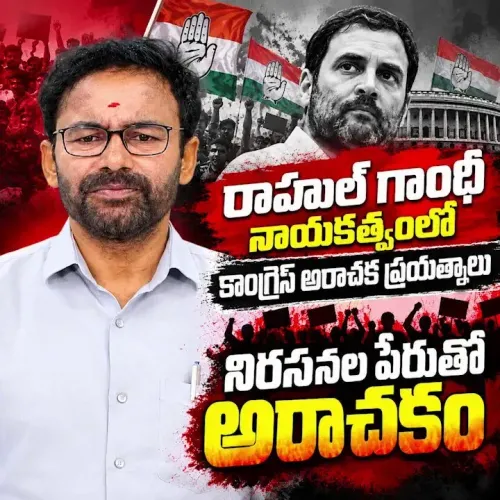
Union Minister G. Kishan Reddy condemned a Congress protest outside the Prime Minister's residence on 21 July 2026 as 'political theatre,' urging the opposition to debate inside Parliament instead of staging street demonstrations while the session is under way.
Key Takeaways
Union Coal and Mines Minister G.
Kishan Reddy publicly criticised a Congress protest held outside PM Narendra Modi 's residence on 21 July 2026 .
Reddy argued that the Constitution grants the right to debate but 'does not grant the right to repeatedly obstruct the parliamentary proceedings.' He invoked the Emergency of 1975 , during which Congress suspended fundamental rights for 21 months , to question the party's democratic credentials.
Congress electoral defeats in Madhya Pradesh , Rajasthan , Chhattisgarh , Assam , and Puducherry were cited as evidence of repeated public rejection.
Reddy called on Congress to use available constitutional mechanisms inside Parliament rather than resorting to street protests.
The minister described the Congress model as: 'do not allow debate in the House, create repeated disruptions, force adjournments, and then stage drama.'
Union Coal and Mines Minister G. Kishan Reddy on Tuesday, 21 July 2026 sharply criticised the Indian National Congress for staging a protest outside the Prime Minister's official residence, calling the demonstration an act of 'political theatre' that undermines parliamentary democracy.
Context
The minister's remarks came in response to a Congress-led demonstration held outside Prime Minister Narendra Modi's residence while Parliament was in session. Reddy described the event as 'deeply disappointing but sadly reflects Congress party's now predictable politics of drama and disruption.' He argued that the Constitution grants parliamentarians the right to speak and debate, but 'does not grant the right to repeatedly obstruct the parliamentary proceedings.'
Reddy noted the symbolism of Congress protesters sitting with 'symbolic handcuffs' at the dharna site, turning it back on the party: 'the people of India have already clamped handcuffs on their political aspirations long back.'
Policy Backdrop
Repeated opposition-led adjournments and walkouts have punctuated Lok Sabha and Rajya Sabha sessions across multiple years, a pattern that both sides have publicly contested. The BJP government has consistently characterised such disruptions as deliberate obstruction, while the Congress has framed its actions as responses to what it describes as institutional erosion.
Reddy invoked the Emergency of 1975, imposed by a Congress government under Indira Gandhi, which suspended fundamental rights and civil liberties for 21 months, as evidence of the party's historical record on democratic norms. 'The same democracy they jailed, tortured and crushed during the Emergency they imposed when they were in power,' he wrote.
Stakeholders and Impact
The minister cited a string of state-level electoral defeats as evidence of public rejection of Congress: Madhya Pradesh, Rajasthan, Chhattisgarh, Assam, and Puducherry. Congress lost assembly elections in Madhya Pradesh, Rajasthan, and Chhattisgarh in both 2018 and 2023, outcomes that BJP leaders have repeatedly cited as popular verdicts against the opposition party.
Parliamentary institutions bear the direct cost of disruptions, Reddy argued, stating that 'every hour of forced paralysis inflicts a heavy loss on the nation and the democratic values.' Opposition parliamentarians, the broader electorate, and the functioning of legislative business are all affected when proceedings are stalled.
What's Next
Reddy's statement implicitly called on Congress to return to the floor of the House: 'If Congress genuinely believes it has facts on its side, Parliament is open. The Rules of Procedure exist. Every constitutional mechanism is available.' The resumption of scheduled parliamentary business and the passage of listed bills will depend on whether disruptions ease in the current session.
With assembly elections due in remaining Congress-ruled states, the confrontation between the ruling BJP and the principal opposition is expected to intensify both inside Parliament and on the street, making the current standoff a bellwether for the political climate heading into the next electoral cycle.
Point of View
He anchors a contemporary protest dispute within a much longer historical indictment of Congress, a rhetorical move the BJP has deployed consistently since 2014. The reference to a string of state election losses is designed to delegitimise Congress's moral authority to speak for the people, shifting the debate from the substance of the protest to the party's electoral credibility. Whether this framing resonates will depend on how the current parliamentary session concludes and whether Congress can articulate a coherent counter-narrative before the next round of state elections.
NationPress
20 Oct 2026
Frequently Asked Questions
Why did Kishan Reddy criticise Congress on 21 July 2026?
Kishan Reddy criticised Congress because the party staged a protest outside the Prime Minister's residence while Parliament was in session, which he called 'political theatre' that obstructs democratic debate rather than contributing to it.
What did Congress do outside the PM's residence?
Congress held a demonstration outside Prime Minister Narendra Modi's official residence, with protesters reportedly sitting with symbolic handcuffs at the dharna site, while Parliament was in active session.
What is Kishan Reddy's position in the government?
G. Kishan Reddy serves as the Union Minister of Coal and Mines and is also the BJP's Telangana state president.
How does Kishan Reddy connect the Congress protest to the 1975 Emergency?
Reddy argued that Congress's record on democracy is undermined by the Emergency it imposed in 1975, during which fundamental rights were suspended for 21 months, calling it the 'same democracy they jailed, tortured and crushed.'
Which states did Congress lose that Kishan Reddy mentioned?
Reddy cited Congress electoral defeats in Madhya Pradesh, Rajasthan, Chhattisgarh, Assam, and Puducherry as evidence that voters have repeatedly rejected the party.