Kishan Reddy pays tribute to BHU founder Madan Mohan Malaviya
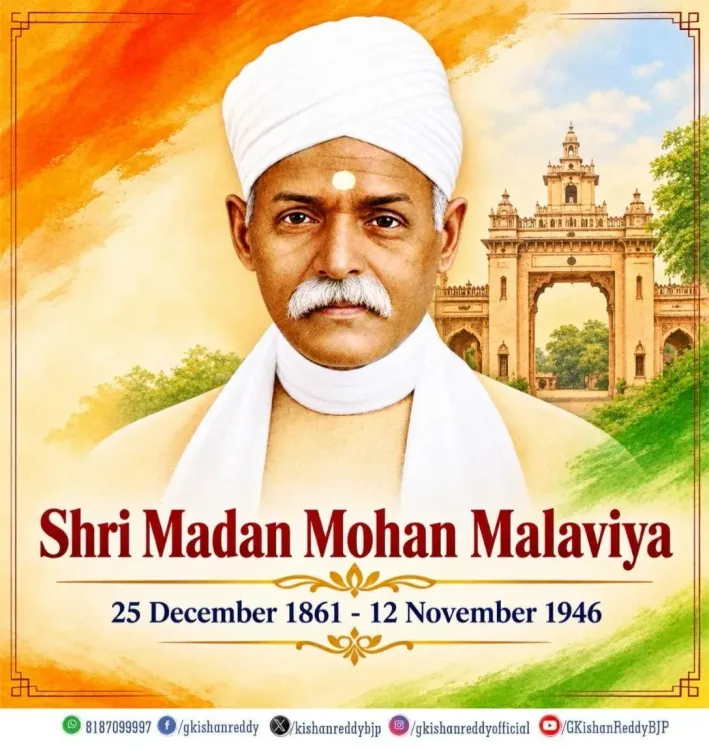
Synopsis
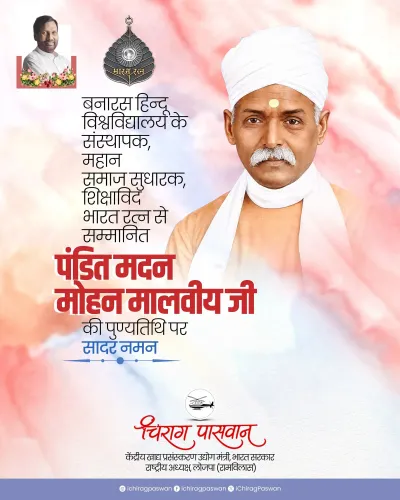
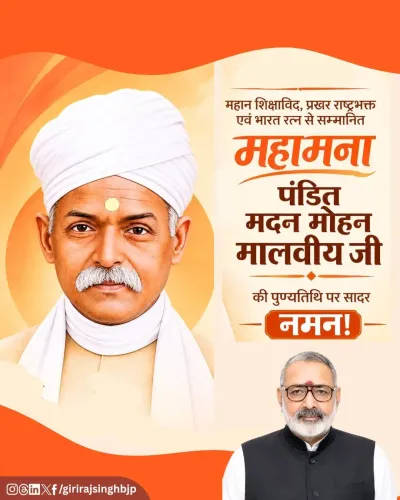
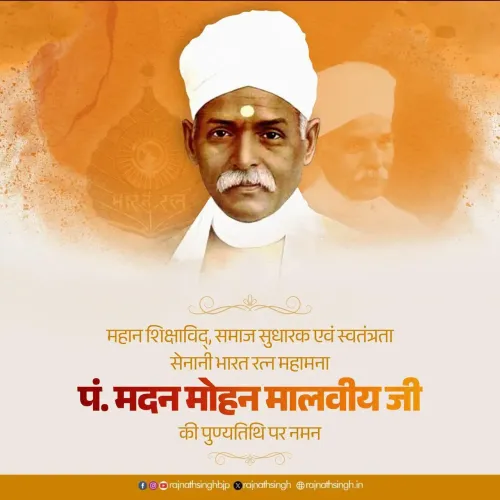
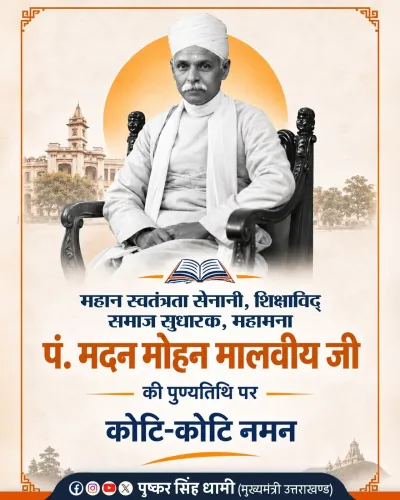
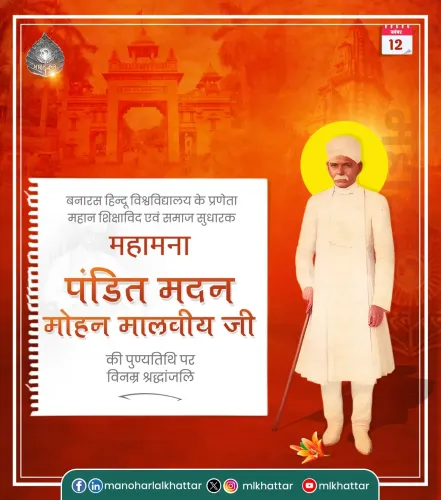
Union Minister G. Kishan Reddy paid homage to Bharat Ratna Pandit Madan Mohan Malaviya on his Punyatithi, remembering the freedom fighter who founded Banaras Hindu University in 1916 and championed education as a tool of national renewal.
Key Takeaways
Union Coal and Mines Minister G.
Kishan Reddy paid tribute to Pandit Madan Mohan Malaviya on his Punyatithi on November 12, 2026 .
Malaviya founded Banaras Hindu University (BHU) in 1916 in Varanasi , blending modern education with India's classical traditions.
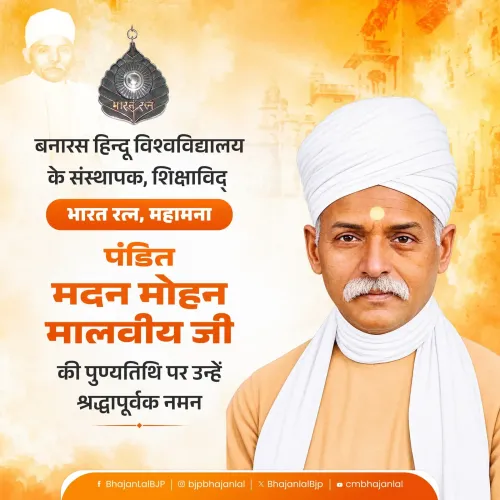
He was posthumously awarded the Bharat Ratna in 2015 , India's highest civilian honour.
Malaviya was a freedom fighter, educationist, and Congress leader who passed away in 1946 .
BHU today remains one of Asia's largest central universities, a living monument to Malaviya's educational philosophy.
On his Punyatithi, the memory of Bharat Ratna Pandit Madan Mohan Malaviya draws renewed reverence — a man who turned a vision into one of Asia's largest universities and proved that education could be an act of patriotism. Union Coal and Mines Minister G. Kishan Reddy offered his tributes on Thursday, November 12, 2026, honouring the statesman-educationist's enduring legacy.
The man who built a university to build a nation
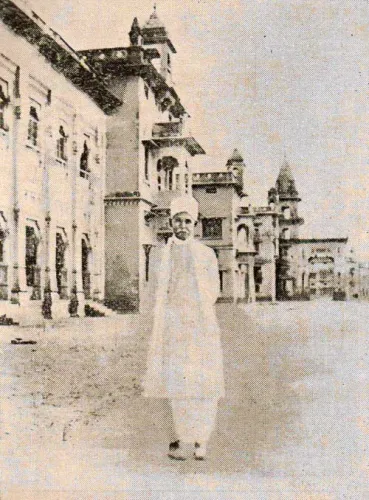
Malaviya was no ordinary reformer. A freedom fighter, a Congress stalwart, and a Sanskrit scholar, he believed that India's subjugation was as much an intellectual crisis as a political one. His answer was Banaras Hindu University (BHU), established in 1916 in Varanasi — a central university designed to marry the rigour of modern science and law with the depth of India's classical traditions. That founding instinct — that a civilisation must educate itself on its own terms — made BHU unlike any other institution of its era. Reddy's tribute captured precisely that duality, noting that Malaviya 'championed education as a powerful instrument of nation building, blending modern knowledge with India's rich cultural values.' The phrase is not rhetoric. It describes an architectural choice Malaviya made in 1916 and that still shapes BHU's curriculum more than a century later.Bharat Ratna — a posthumous recognition, long overdue
Malaviya passed away in 1946, just a year before the independence he had spent decades working toward. Decades later, in 2015, the Government of India awarded him the Bharat Ratna posthumously — the country's highest civilian honour — finally placing him alongside the statesmen and scientists the Republic most celebrates. For many in higher education circles, it was recognition that had waited too long. Today, BHU stands as the most visible monument to his philosophy: a sprawling central university in Varanasi that serves hundreds of thousands of students across faculties ranging from engineering and medicine to Sanskrit and fine arts. It is, in many ways, the longest-running argument that he won.Why annual tributes to Malaviya carry policy weight
Indian ministers regularly mark the death anniversaries of freedom fighters and educationists — it is part of the republic's civic calendar. But tributes to Malaviya carry a specific charge in the present moment. With debates ongoing around the character, autonomy, and cultural orientation of central universities, invoking Malaviya is never purely ceremonial. His model of education — rooted in Indian tradition but open to modern knowledge — remains a touchstone in those conversations, cited across the political spectrum. Reddy, as BJP's Telangana state president and a Union Cabinet minister, speaking on this Punyatithi, keeps that conversation alive. The ideals, as he noted, 'continue to inspire generations.'Point of View
Modern university sits at the centre of ongoing debates about the identity and direction of India's central universities. Reddy's invocation of 'blending modern knowledge with India's rich cultural values' echoes a phrase the current administration has used to frame higher education reform more broadly. That Malaviya received the Bharat Ratna only in 2015, under the present government, adds a layer of political ownership to these annual tributes. The gesture thus functions simultaneously as historical reverence and a quiet articulation of educational philosophy.
NationPress
12 Nov 2026
Frequently Asked Questions
Who was Pandit Madan Mohan Malaviya?
Pandit Madan Mohan Malaviya was an Indian freedom fighter, educationist, and leader who founded Banaras Hindu University (BHU) in 1916 . He was posthumously awarded the Bharat Ratna in 2015 and passed away in 1946 .
When did Madan Mohan Malaviya found BHU?
Madan Mohan Malaviya founded Banaras Hindu University in 1916 in Varanasi , with the aim of combining modern academic disciplines with India's classical cultural and spiritual traditions.
Why did G. Kishan Reddy post a tribute to Madan Mohan Malaviya?
Union Minister G. Kishan Reddy paid tribute on Malaviya's Punyatithi (death anniversary) on November 12, 2026 , honouring his contributions as a freedom fighter, educationist, and founder of BHU.
When was Madan Mohan Malaviya awarded the Bharat Ratna?
Madan Mohan Malaviya was posthumously awarded the Bharat Ratna in 2015 , recognising his lifelong contributions to Indian education and the freedom movement.
What is Banaras Hindu University known for?
Banaras Hindu University (BHU) , founded in 1916 , is one of Asia's largest central universities. It is known for integrating modern disciplines — engineering, medicine, law — with classical Indian studies and arts, reflecting Malaviya's founding vision.