Kishan Reddy lands in Sydney for IMARC 2026 mining talks
Synopsis
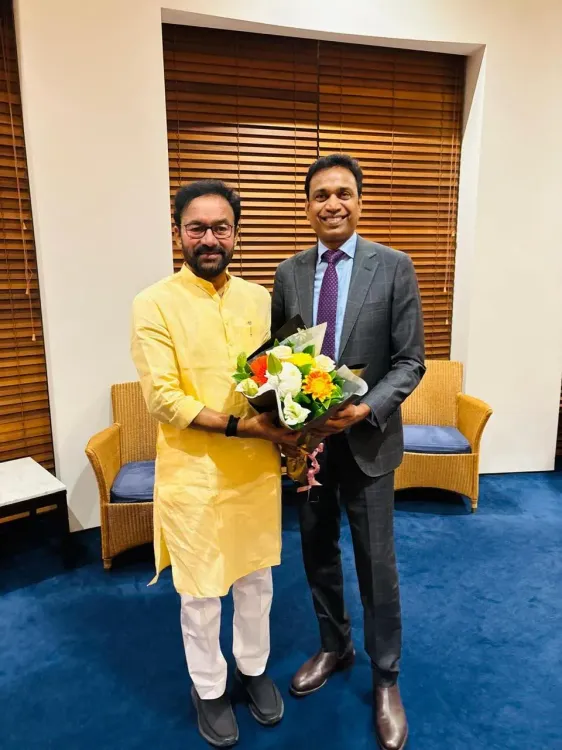
Union Coal and Mines Minister G. Kishan Reddy arrived in Sydney on 24 October 2026 and was received by Consul General Dr. S. Janakiraman. Over five days he will attend IMARC 2026, meet global mining leaders, and engage the Indian diaspora — advancing India's critical-minerals agenda with Australia.
Key Takeaways
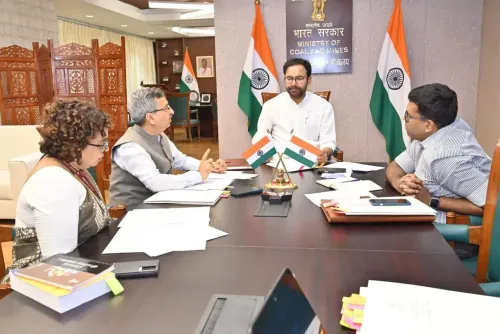
Kishan Reddy , Union Minister of Coal and Mines, arrived in Sydney, Australia on 24 October 2026 for a five-day visit .
He was received by Dr.
Janakiraman , Consul General of India in Sydney.
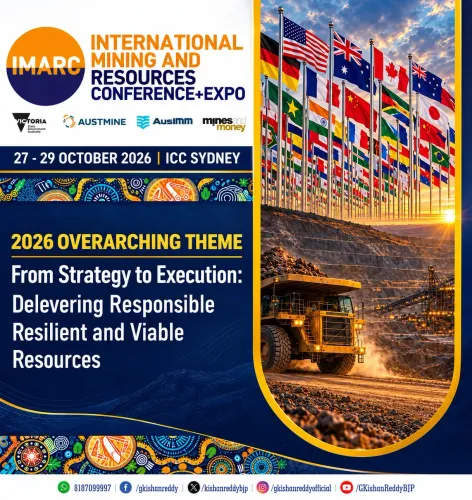
The centrepiece is the International Mining and Resources Conference (IMARC) 2026 , a leading global mining and resources event held in Australia.
The visit aims to advance cooperation in critical minerals — including lithium, cobalt, and rare earths — vital for India's EV and renewable-energy targets.
KABIL (Khanij Bidesh India Ltd), established in 2019 , has identified Australia as a priority destination for overseas mineral-asset acquisition.
India and Australia have held a Comprehensive Strategic Partnership since 2020 , with critical minerals as an explicit priority sector.
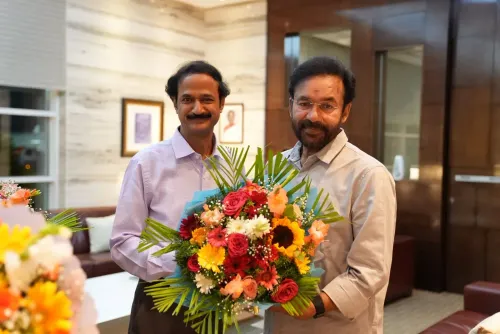
India's push to secure the critical minerals that will power its electric-vehicle revolution and renewable-energy grid has landed Union Coal and Mines Minister G. Kishan Reddy in Sydney, Australia, on Saturday, 24 October 2026 — where he was received on arrival by Dr. S. Janakiraman, India's Consul General in Sydney.
Reddy confirmed a packed five-day programme that centres on the International Mining and Resources Conference (IMARC) 2026, one of the world's premier gatherings of mining executives, investors, and policymakers. Beyond the conference floor, he will engage with global industry leaders on mining cooperation and critical minerals — and will also meet members of the Indian diaspora in Australia.
Why IMARC and why now
IMARC is not a networking junket — it is where deals get seeded and supply chains get rewired. For India, the timing is pointed: the country is racing to lock in long-term access to lithium, cobalt, and rare earths, the raw materials without which its EV and clean-energy ambitions cannot scale. Australia holds some of the world's largest deposits of precisely those minerals, and its stable regulatory environment makes it a preferred partner over more volatile sources.
The institutional groundwork is already in place. Khanij Bidesh India Ltd (KABIL), set up by the Government of India in 2019 specifically to acquire overseas mineral assets, has identified Australia as a priority destination. The two countries elevated their ties to a Comprehensive Strategic Partnership in 2020, with resources and critical minerals explicitly named as pillars of that deeper relationship.
Ministerial resource diplomacy as a pattern
Reddy's Sydney visit is not an isolated event — it is part of a deliberate, recurring pattern of high-level Indian resource diplomacy. Ministerial attendance at IMARC has become a signal in itself: it tells global mining capital that India is a serious buyer and a serious policy partner, not merely a spectator at the table.
The India-Australia alignment also sits within the broader Indo-Pacific strategic framework, including Quad cooperation, where supply-chain resilience for critical minerals has become a shared priority among like-minded democracies. Every bilateral conversation at an event like IMARC thus carries weight beyond the deal memo — it is also geometry.
Diaspora engagement alongside the resource agenda
Reddy's planned interaction with the Indian community in Australia adds a people-to-people dimension to what is otherwise a hard-nosed economic mission. Australia hosts one of the fastest-growing Indian diaspora communities in the world, and ministerial outreach during official visits has become standard practice for the current government.
Watch for any MoUs, joint statements, or project-level announcements that emerge from the IMARC meetings — those will be the real measure of whether five days in Sydney translate into minerals on Indian soil.
Point of View
Amplified by Quad-era strategic convergence. Ministerial-level attendance at commercial mining forums signals to global capital that India's resource diplomacy operates at the highest levels of government. Any MoUs or project commitments that emerge will feed directly into KABIL's mandate and could set the pace for India's domestic battery and EV manufacturing pipeline.
NationPress
24 Oct 2026
Frequently Asked Questions
Why is Kishan Reddy visiting Australia in October 2026?
He is attending the International Mining and Resources Conference (IMARC) 2026 in Sydney to engage with global mining leaders and advance India's cooperation with Australia on critical minerals such as lithium, cobalt, and rare earths.
What is KABIL and what is its role in Australia?
Khanij Bidesh India Ltd (KABIL) was set up by the Government of India in 2019 to acquire strategic mineral assets overseas. Australia is one of KABIL's priority destinations given its large deposits of critical minerals needed for India's EV and clean-energy ambitions.
What is the India-Australia Comprehensive Strategic Partnership?
India and Australia elevated their bilateral relationship to a Comprehensive Strategic Partnership in 2020, identifying resources and critical minerals as priority cooperation areas alongside defence, trade, and Indo-Pacific security.
What outcomes should we watch for from Kishan Reddy's Sydney visit?
Key things to watch include any MoUs, investment announcements, or joint statements on critical-minerals projects that emerge from the IMARC meetings and bilateral engagements during the five-day visit.