Kishan Reddy hails India–US Critical Minerals pact as supply chain milestone
Synopsis
Union Coal and Mines Minister G. Kishan Reddy on 26 May 2026 endorsed the India–US Critical Minerals partnership, saying it will accelerate investment, technology collaboration, and supply chain integration for EVs, semiconductors, clean energy, and advanced manufacturing, deepening the India–US strategic relationship.
Key Takeaways
Kishan Reddy , Union Coal and Mines Minister, endorsed the India–US Critical Minerals partnership on 26 May 2026 .
The agreement targets supply chain resilience for EVs, semiconductors, clean energy, and advanced manufacturing .
India joined the US-led Mineral Security Partnership , a 13-country grouping, in June 2023 .
The iCET framework launched in January 2023 laid the groundwork for critical minerals and technology cooperation.
India's 2023 Mines and Minerals Act amendment opened critical mineral blocks to private and foreign investment.
Key next steps include joint investment projects , processing facility development, and India's upcoming critical mineral block auctions .
Union Coal and Mines Minister G. Kishan Reddy on Tuesday, 26 May 2026 welcomed the India–US Critical Minerals partnership, calling it a major step towards building resilient and future-ready supply chains for sectors including electric vehicles, semiconductors, clean energy, and advanced manufacturing.
Context
Reddy stated that the agreement 'will accelerate investment, technology collaboration, mineral processing capabilities, and supply chain integration.' He framed the partnership as central to strengthening India's ambition of becoming a global manufacturing and energy transition hub while deepening the broader India–US strategic partnership.
The minister's remarks come as India and the United States have been systematically expanding cooperation across critical and emerging technologies, with minerals sitting at the core of both countries' industrial and clean-energy strategies.
Policy Backdrop
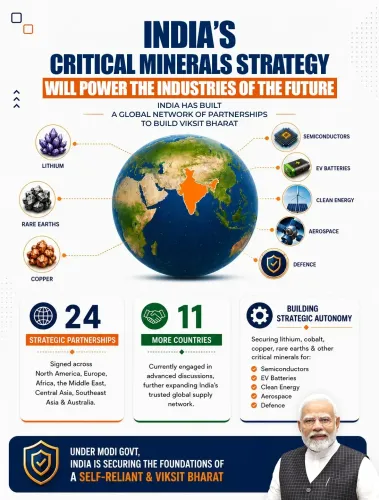
The partnership builds on a layered architecture of India–US cooperation. In January 2023, the two countries launched the India–US Initiative on Critical and Emerging Technology (iCET), which explicitly included cooperation on critical minerals processing and supply chain resilience. India formally joined the US-led Mineral Security Partnership (MSP) — a 13-country grouping focused on diversifying critical mineral supply chains — in June 2023.
Domestically, India amended its Mines and Minerals Act in 2023 to open critical mineral blocks for private-sector auctions and foreign investment, signalling intent to expand both exploration and processing capacity for materials such as lithium, cobalt, and rare earth elements.
The United States has pursued similar agreements with allies including Australia and Canada as part of a broader strategy to reduce dependence on China's near-monopoly on the processing and refining of critical minerals essential for next-generation technologies.
Stakeholders and Impact
The sectors most directly affected span EV manufacturers, semiconductor firms, and clean energy developers operating in or sourcing from India. Secured and diversified mineral supply chains are a prerequisite for scaling up domestic production of EV batteries, solar panels, and advanced electronics.
For India, the partnership offers a pathway to attract foreign investment and technology transfer into mineral processing — a segment where the country currently has limited capacity relative to its raw mineral potential. For the United States, India represents a large, strategically aligned partner capable of absorbing investment and providing an alternative node in global supply chains.
What's Next
Attention will now shift to the operationalisation of the agreement — specifically, progress on joint investment projects, technology-transfer arrangements, and processing facility development announced under the partnership. India's upcoming rounds of critical mineral block auctions will also serve as an early indicator of whether the bilateral framework translates into on-ground activity.
As India positions itself at the intersection of economic security and the global energy transition, the success of this partnership will be a key benchmark for the country's broader manufacturing and clean-energy ambitions through the rest of this decade.
Point of View
Multi-year policy arc in which New Delhi has used bilateral and plurilateral frameworks to reduce supply chain exposure to single-country dominance in strategic materials. The minister's framing — positioning India as a future 'global manufacturing and energy transition hub' — signals that the government views mineral security not merely as a defensive trade measure but as an offensive industrial strategy. The timing also reflects the broader India–US technology alignment that has accelerated since the iCET launch, suggesting minerals are now as central to the bilateral relationship as defence and digital cooperation. Whether the partnership delivers concrete processing capacity and investment flows, rather than remaining a statement of intent, will determine its long-term strategic significance.
NationPress
11 Oct 2026
Frequently Asked Questions
What is the India–US Critical Minerals partnership?
The India–US Critical Minerals partnership is a bilateral agreement aimed at building resilient supply chains for critical minerals used in EVs, semiconductors, clean energy, and advanced manufacturing, accelerating investment and technology collaboration between the two countries.
Why is India partnering with the US on critical minerals?
India is partnering with the US to diversify its critical mineral supply chains away from single-country dependence, attract foreign investment into domestic processing, and secure inputs needed for its EV, electronics, and renewable energy manufacturing targets.
What is the Mineral Security Partnership and is India a member?
The Mineral Security Partnership is a US-led grouping of 13 countries and the European Union focused on securing diversified, resilient critical mineral supply chains. India joined the MSP in June 2023 .
What is iCET and how does it relate to critical minerals?
iCET, the India–US Initiative on Critical and Emerging Technology, was launched in January 2023 and explicitly includes cooperation on critical minerals processing and supply chain resilience, forming a key policy foundation for the current partnership.
What did India change in its mining laws to attract investment in critical minerals?
India amended its Mines and Minerals Act in 2023 to open critical mineral blocks for private-sector auctions and foreign investment, enabling greater exploration and processing of materials such as lithium, cobalt, and rare earth elements.