Kishan Reddy: India Builds Critical Minerals Network Across 24 Nations
Synopsis
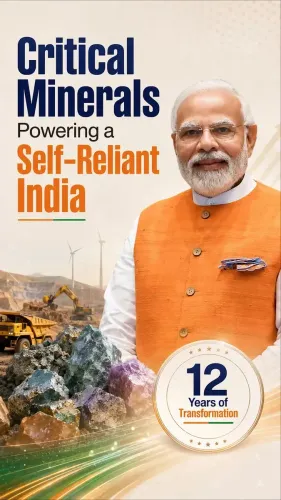
Union Coal and Mines Minister G. Kishan Reddy says India has built critical mineral partnerships with 24 countries and is in talks with 11 more, securing lithium, cobalt and rare earth supply chains vital to electric mobility, clean energy, semiconductors and defence under the Viksit Bharat vision.
Key Takeaways
Union Coal and Mines Minister G.
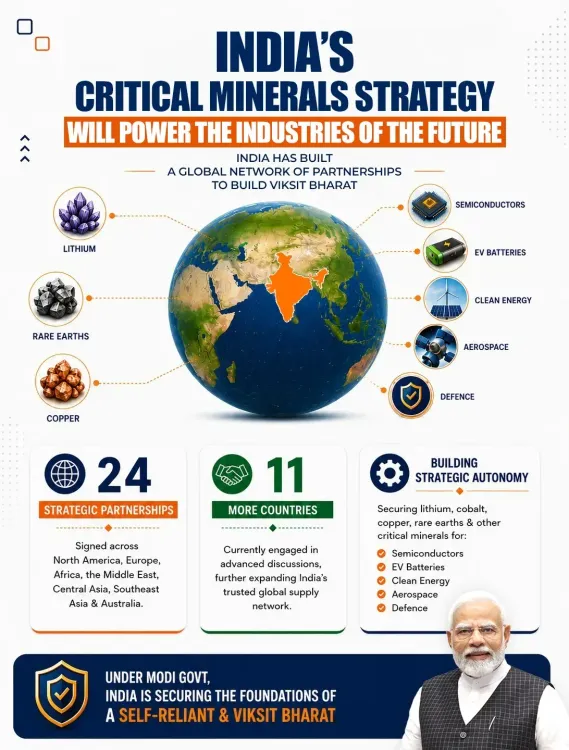
Kishan Reddy announced India has strategic critical mineral partnerships with 24 countries , with discussions underway with 11 more .
Key minerals targeted include lithium, cobalt, copper and rare earths, essential for EVs, clean energy, semiconductors, aerospace and defence.
Khanij Bidesh India Ltd (KABIL) , incorporated in 2019 , is the primary state vehicle for acquiring overseas mineral assets.
The Mines and Minerals Amendment Act, 2023 created a dedicated fast-track auction route for 30 critical minerals .
India's participation in the Mineral Security Partnership (MSP) reflects a strategic effort to reduce dependence on concentrated supply sources.
The initiative is framed as foundational to Atmanirbhar Bharat and the broader Viksit Bharat development goal.
Union Coal and Mines Minister G. Kishan Reddy on Friday, 10 July 2026, highlighted India's expanding global critical minerals strategy, stating that the country has forged strategic partnerships with 24 countries and is in active discussions with 11 more to secure supply chains for resources essential to its industrial and clean-energy future.
Context
In his post on X, the Minister described India as 'steadily strengthening its global critical minerals ecosystem' under the leadership of Prime Minister Narendra Modi. The minerals cited — lithium, cobalt, copper and rare earths — are the building blocks of electric vehicles, semiconductors, clean energy infrastructure, and aerospace and defence systems. Reddy framed the effort as central to achieving 'economic resilience, technological leadership and strategic autonomy.'
The push is explicitly linked to the government's Viksit Bharat vision, which targets a developed-nation status for India and leans on resource security as a prerequisite for advanced manufacturing.
Policy Backdrop
India's critical minerals diplomacy has been built on a sequence of domestic and international moves since 2019. The government revised the National Mineral Policy that year to open strategic mineral exploration to private and overseas players, and incorporated Khanij Bidesh India Ltd (KABIL) — a public-sector joint venture — to identify and acquire mineral assets abroad.
In 2023, Parliament passed the Mines and Minerals (Development and Regulation) Amendment Act, creating a dedicated category and an expedited auction route for 30 critical minerals, a list that formally includes lithium, cobalt, rare earths and copper. India also joined the Mineral Security Partnership (MSP), a US-led grouping of like-minded nations aimed at diversifying supply chains away from concentrated sources — a clear reference to China's dominant position in rare-earth processing.
The strategy sits within the broader Atmanirbhar Bharat framework, which ties resource security directly to India's ambitions in battery manufacturing, electronics and defence production.
Stakeholders and Impact
The sectors with the most direct stake in this policy are electric vehicle manufacturers, renewable energy firms and the defence industry, all of which depend on uninterrupted access to the minerals in question. A resilient, diversified supply chain reduces the risk of price shocks or geopolitical disruptions that have historically constrained India's manufacturing scale-up.
State-backed overseas acquisitions through KABIL, combined with new bilateral agreements, are designed to give Indian industry a degree of supply certainty that purely market-driven procurement cannot guarantee. The 35 countries cited by the Minister — 24 with active partnerships and 11 under discussion — represent a significant widening of India's mineral diplomacy footprint.
What's Next
Upcoming critical mineral block auctions by state governments will be an early test of whether domestic regulatory reforms translate into actionable exploration activity. On the international front, any new memoranda of understanding signed during bilateral state visits or multilateral energy forums will indicate the pace at which the 11 ongoing discussions convert into formal partnerships.
As India accelerates its clean-energy transition and defence indigenisation, the breadth and depth of these mineral partnerships will increasingly determine the country's capacity to meet its own industrial targets — making critical minerals a strategic variable as consequential as oil once was.
Point of View
With 24 active partnerships representing a tangible deliverable the government can point to. The framing around 'strategic autonomy' and 'self-reliance' is consistent with a broader BJP narrative that positions mineral security as an extension of national sovereignty, not merely an economic policy. The reference to 11 additional countries under discussion also serves a forward-looking purpose — sustaining political momentum around a policy whose results will take years to fully materialise. Critically, the convergence of domestic regulatory reform (the 2023 Amendment Act), state-backed overseas acquisition (KABIL) and multilateral alignment (MSP) suggests a more structured, multi-track approach than India has historically applied to strategic resource planning.
NationPress
9 Oct 2026
Frequently Asked Questions
What are critical minerals and why does India need them?
Critical minerals are raw materials — such as lithium, cobalt, copper and rare earths — that are essential for manufacturing electric vehicles, batteries, semiconductors, clean energy equipment and defence systems. India needs secure access to these minerals to meet its clean-energy targets and defence indigenisation goals, and to reduce vulnerability to supply disruptions.
How many countries has India signed critical mineral partnerships with?
According to Union Minister G. Kishan Reddy's statement on 10 July 2026 , India has active strategic partnerships with 24 countries and is in discussions with 11 more , though these specific figures have been stated by the government and are yet to be confirmed through publicly available treaty records.
What is KABIL and what is its role in India's critical minerals strategy?
Khanij Bidesh India Ltd (KABIL) is a public-sector joint venture incorporated in 2019 to identify and acquire overseas mineral assets — particularly lithium, cobalt and other critical minerals — on behalf of Indian industry. It is the primary government vehicle for securing foreign mineral supplies.
What did the Mines and Minerals Amendment Act 2023 change for critical minerals?
The Mines and Minerals (Development and Regulation) Amendment Act, 2023 introduced a separate legal category for 30 critical minerals and created a faster auction route for their exploration and extraction, aiming to accelerate domestic supply development alongside overseas acquisition efforts.
What is the Mineral Security Partnership and is India a member?
The Mineral Security Partnership (MSP) is a US-led grouping of like-minded countries formed to diversify global critical mineral supply chains away from concentrated sources. India is a member, reflecting its strategy of aligning with multilateral frameworks to reduce dependence on any single dominant supplier.