Kolkata's Netaji Subhas Dock raises 60-metre Tricolour for Har Ghar Tiranga

Synopsis
On the eve of Independence Day, Kolkata's historic port raised one of the city's tallest Tricolours — a 60-metre permanent flagmast at Netaji Subhas Dock, next to a clock tower older than the dock itself. For a port that has operated since 1870 and supplied the China-Burma-India theatre in World War II, the flag is less ceremony and more statement of continuity.
Key Takeaways
The Syama Prasad Mookerjee Port Authority (SMPA) hoisted a 30 ft × 20 ft Tricolour on a 60-metre flag post at Netaji Subhas Dock , Kolkata , on 14 August 2025 .
At nearly 197 feet , it is among the tallest national flag installations in the city.
The flag post is a permanent structure with a 25-year design life , built from hot-dip galvanised high-tensile steel on an RCC pile foundation.
The installation stands next to the port's 1899 clock tower , adjacent to Netaji Subhas Dock , which was commissioned in 1928 and renamed in 1973 .
Kolkata port , operational since 1870 , is India's oldest riverine major port and serves as a container hub for northern, northeastern India, Nepal , and Bhutan .
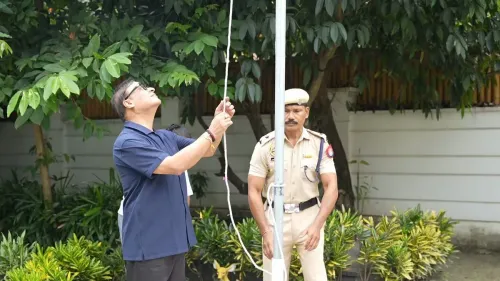
The Syama Prasad Mookerjee Port Authority (SMPA) hoisted the Indian Tricolour on a 60-metre-high (nearly 197 feet) flag post at Netaji Subhas Dock, Kolkata, on 14 August 2025, as part of the nationwide Har Ghar Tiranga initiative. The installation is among the tallest national flag displays in the city, placing the Tricolour prominently over India's oldest operational riverine major port.
The Flag Installation
The flag post carries a 30 ft × 20 ft National Flag, making it a new landmark on Kolkata's historic port skyline. It is a permanent installation with a design life of 25 years, constructed from a continuously tapered, hot-dip galvanised, 20-sided polygonal high-tensile steel shaft, supported on an RCC bored cast-in-situ pile foundation. The flag is operated through a motorised double-drum winch system.
A senior SMPA official said the towering flagmast makes the Tricolour 'a prominent new landmark on Kolkata's historic port landscape,' adding that the initiative 'reflects SMPA's commitment to the spirit of Har Ghar Tiranga and celebrates the values of national pride, unity and collective commitment towards a Viksit Bharat.'
A Historic Setting
The flag has been installed next to the port's historic clock tower, erected in 1899 to help arriving ships keep time — predating the dock itself. Netaji Subhas Dock was originally commissioned in 1928 as King George's Dock and was renamed in 1973. The Kolkata port formally began operations in 1870, making it the country's oldest operational riverine major port.
The dock carries significant wartime legacy: during World War II, it served as a critical landing point for men and equipment involved in the 'Over the Hump' operations across the China-Burma-India theatre.
Dock Operations and Strategic Role
Netaji Subhas Dock currently has 10 berths, comprising four dedicated container berths, a liquid cargo berth, and four multipurpose berths, along with two buoys and moorings. Its two dry docks are presently used by Garden Reach Shipbuilders and Engineers (GRSE) Ltd for vessel refit and repair.
The dock system connects to the River Hooghly through a 90-foot lock that regulates water flow into the berths. It functions as a major container hub, serving cargo needs of India's northern and northeastern hinterland, as well as the landlocked nations of Nepal and Bhutan.
Significance of the Initiative
The hoisting comes a day ahead of Independence Day, aligning with the Centre's Har Ghar Tiranga campaign, which encourages institutions and citizens to display the national flag. According to the official, the sight of the Tricolour flying over the historic docks 'symbolises the enduring contribution of the Kolkata port to India's maritime heritage and nation-building.' The flag post's permanence signals that the display is not a seasonal gesture but a lasting addition to the port's identity.
Point of View
But the more interesting detail is the permanence of the installation — a 25-year design life signals this is infrastructure, not decoration. Kolkata port's strategic relevance is often undersold in national discourse: it remains the primary gateway for Nepal and Bhutan, and its World War II role in the China-Burma-India theatre is largely forgotten. Anchoring the Tricolour to that history is a reminder that maritime heritage and national identity are not separate conversations. Whether the Har Ghar Tiranga campaign translates into sustained institutional investment in port infrastructure is the question that matters more than the flag's height.
NationPress
29 Sept 2026
Frequently Asked Questions
Where has the new Tricolour been hoisted in Kolkata?
The Tricolour has been hoisted at Netaji Subhas Dock, part of the Syama Prasad Mookerjee Port Authority (SMPA) complex in Kolkata. The 60-metre flag post stands next to the dock's historic 1899 clock tower.
How tall is the new flag post at Kolkata port?
The flag post stands 60 metres tall — nearly 197 feet — and carries a 30 ft × 20 ft National Flag. It is among the tallest national flag installations in Kolkata.
What is the Har Ghar Tiranga initiative?
Har Ghar Tiranga is a nationwide campaign by the Centre that encourages citizens and institutions to display the Indian national flag, particularly around Independence Day on 15 August. SMPA's flag hoisting at Netaji Subhas Dock is part of this initiative.
What is the historical significance of Netaji Subhas Dock?
Netaji Subhas Dock was originally commissioned in 1928 as King George's Dock and renamed in 1973. During World War II, it served as a key landing point for the 'Over the Hump' operations in the China-Burma-India theatre. It is part of the Kolkata port, which has been operational since 1870 — making it India's oldest riverine major port.
Is the new flag post a permanent structure?
Yes. The flag post is a permanent installation with a design life of 25 years. It is built from a hot-dip galvanised, 20-sided polygonal high-tensile steel shaft on an RCC bored cast-in-situ pile foundation, and is operated through a motorised double-drum winch system.