KTR warns EC is turning 'almost autocratic', calls for SC intervention
Synopsis
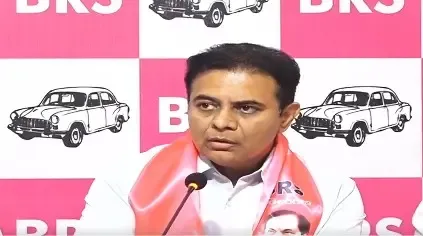
BRS working president K. T. Rama Rao accused the Election Commission of India of turning 'almost autocratic', citing two commissioners allegedly overruled on voter-roll decisions, and called on all parties and the Supreme Court to defend democratic institutions.
Key Takeaways
Rama Rao posted on 24 September 2026 warning the Election Commission of India is becoming 'almost autocratic'.
He alleged that two out of three Election Commissioners have been 'repeatedly raising objections' yet being overruled on voter registration, deletion and restoration decisions.
The criticism follows the Chief Election Commissioner and Other Election Commissioners (Appointment, Conditions of Service and Term of Office) Act, 2023 , which changed how commissioners are selected and drew legal challenges.
KTR called on all political parties, constitutional bodies, citizen forums, and the Supreme Court of India to act to protect democratic institutions.
The BRS is in national opposition and has consistently critiqued central institutional frameworks affecting electoral integrity.
Two out of three Election Commissioners raising objections — and still being outvoted. That is the alarm BRS working president K. T. Rama Rao sounded on Thursday, 24 September 2026, in a pointed broadside against the Election Commission of India, warning that the institution meant to protect democracy is itself becoming its greatest threat.
Posting on X, Rama Rao asked bluntly: 'Two out of three is a majority, or at least it used to be. Looks like the definition is changing now.' His charge — that decisions on voter registration, deletion and restoration are being 'pushed through questionably' even when two of the three commissioners are objecting — cuts to the heart of a growing institutional crisis that opposition parties have been flagging with rising urgency.
The 2023 law that changed who picks the commissioners
The flashpoint for much of this friction is the Chief Election Commissioner and Other Election Commissioners (Appointment, Conditions of Service and Term of Office) Act, 2023, which replaced the 1991 statute and rewrote the composition of the selection committee. Critics argued — and several petitions before the Supreme Court of India contended — that the new framework diluted the independence that had previously insulated commissioners from executive pressure.
The apex court has adjudicated multiple cases concerning the independence and appointment process of the Election Commission. Those proceedings gave the reform debate its legal scaffolding, even as Parliament pushed the new law through. KTR's post signals that, for the opposition at least, the legal challenge is far from settled.
Electoral rolls at the centre of the dispute
Beyond appointments, the immediate flashpoint is the handling of electoral rolls. Opposition parties have raised persistent objections over how voter names are added, deleted, and restored — processes that directly shape who gets to exercise the franchise. When such decisions are alleged to be 'pushed through questionably', the complaint is not merely procedural. It is an argument about whether outcomes are being pre-determined.
Rama Rao's post frames this in constitutional terms: 'If decisions on voter registration, deletion and restoration are pushed through questionably, are we even a democracy anymore?' The question is rhetorical in style but forensic in intent — pointing to a gap between India's self-image as the world's largest democracy and the mechanics of how that democracy is administered.
KTR's call: parties, constitutional bodies, and the Supreme Court
Unusually, the BRS leader's appeal is not directed solely at opposition parties. He explicitly calls on 'all political parties, constitutional bodies, citizen forums and, most importantly, the Supreme Court of India' to act. The invocation of the Supreme Court is deliberate — it is the one institution that retains both the authority and the perceived independence to compel structural reform of the Election Commission without requiring a parliamentary majority.
That framing matters. It positions the demand not as partisan point-scoring but as a constitutional SOS — a warning that 'the fate of this country cannot be decided by an institution whose foundations are eroding.' Whether that framing wins cross-party traction will be the real test of KTR's appeal.
If the Supreme Court agrees to hear — or expedite — a challenge to the 2023 Act or to specific electoral-roll decisions, the next few weeks could force a reckoning that Parliament, so far, has not been willing to stage.
Point of View
He acknowledges that the ruling coalition controls the legislative route but that the judiciary remains a viable pressure point. The charge of internal overruling within a three-member commission, if substantiated, would represent a structural breakdown unprecedented in the EC's post-independence history. The post's cross-party appeal is also a signal that BRS may be seeking to re-establish national relevance after its 2023 Telangana state defeat.
NationPress
24 Sept 2026
Frequently Asked Questions
What is KTR saying about the Election Commission of India?
BRS working president K. T. Rama Rao alleged on 24 September 2026 that the Election Commission is operating in an 'almost autocratic' manner, with two of its three commissioners being overruled on voter-roll decisions despite raising repeated objections.
What is the Election Commissioner appointment controversy in India?
The Chief Election Commissioner and Other Election Commissioners (Appointment, Conditions of Service and Term of Office) Act, 2023 changed the composition of the selection committee for commissioners. Critics and opposition parties argued the new law reduced the independence of the Election Commission and challenged it in the Supreme Court.
Why is KTR calling on the Supreme Court to intervene in the Election Commission?
KTR argues that parliamentary and executive channels have not addressed concerns about the EC's independence, so the Supreme Court — which has already adjudicated cases on the appointment process — is the most credible institution to compel reform.
What are the concerns about voter registration and deletion in India?
Opposition parties have raised objections about the manner in which voter names are added, deleted, and restored from electoral rolls, alleging that some decisions have been made without proper scrutiny or internal consensus within the Election Commission.
Who is K. T. Rama Rao and what party does he belong to?
K. T. Rama Rao, widely known as KTR, is the working president of the Bharat Rashtra Samithi (BRS), a Telangana-based regional party. He previously served as Minister for IT, Industries and Municipal Administration in the Telangana government.