KTR slams Telangana Congress for ditching Singareni coal
Synopsis
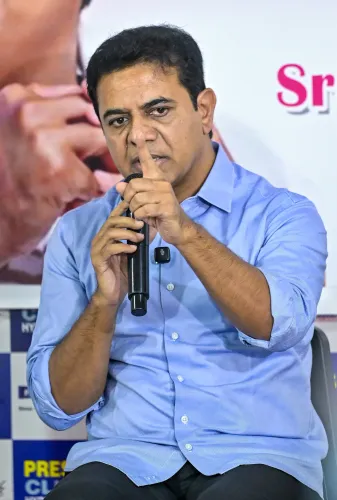
BRS working president K. T. Rama Rao has attacked the Telangana Congress government for allegedly favouring ₹9,000-per-tonne imported coal over domestically mined Singareni coal at ₹3,800 per tonne, calling it a 'Tughlaq decision' and demanding to know who benefits at the public's expense.
Key Takeaways
BRS working president K.
Rama Rao publicly challenged the Telangana Congress government on 29 September 2026 over coal procurement choices.
KTR claims Singareni coal costs ₹3,800 per tonne while the state is opting for imported coal at ₹9,000 per tonne — a gap of ₹5,200 per tonne .
Singareni Collieries is a state-centre joint venture and supplies coal to power plants in Andhra Pradesh, Tamil Nadu and Maharashtra as well as Telangana.
KTR credits the previous KCR-led BRS government (2014–2023) with delivering 24/7 power supply using Singareni coal through TS Genco .
The Congress government has not publicly stated its rationale for any shift toward imported coal; official TS Genco procurement details remain to be confirmed.
The controversy intensifies the ongoing political rivalry between BRS and Congress over Telangana's governance record since the 2023 election.
While Telangana sits atop the largest coal reserves in south India, BRS working president K. T. Rama Rao is asking a sharp question on Tuesday, 29 September 2026: why is the state's Congress government turning away domestic coal at ₹3,800 per tonne in favour of imports priced at ₹9,000 per tonne?
KTR posted the pointed challenge on X, calling the procurement move 'another Tughlaq decision of the Congress government' and demanding to know exactly who benefits from the roughly 2.4× price premium on overseas coal. The reference to the medieval Delhi sultan is a well-worn Opposition shorthand in Indian politics for a policy seen as perverse and self-defeating — and here it lands with deliberate force.
What makes Singareni so central to Telangana's power story
Singareni Collieries Company Limited (SCCL) is jointly owned by the Telangana government and the Government of India, making it one of the few large public-sector mining enterprises where a state holds a controlling stake. Its coal blocks underpin thermal generation not just for Telangana but also supply Andhra Pradesh, Tamil Nadu and Maharashtra — a supply footprint that gives the company outsized political and economic significance in the south.
KTR anchors his attack in the performance record of the previous BRS administration under former Chief Minister K. Chandrashekar Rao. During 9.5 years of the KCR government (2014–2023), he argues, TS Genco — the Telangana State Power Generation Corporation — ran its plants on Singareni coal and delivered 24/7 power supply across the state. Whether or not one accepts every element of that claim, the baseline is clear: domestic coal was the model, and it worked.
The ₹5,200 per tonne question
The arithmetic at the heart of KTR's post is brutal in its simplicity. A gap of ₹5,200 per tonne between local Singareni coal and imported coal, multiplied across the volumes a state utility consumes annually, runs into hundreds of crores — costs that eventually filter through to electricity bills paid by households, farmers and industry. That is the 'burden' KTR says the people of Telangana should not be made to bear.
The Congress government in Hyderabad has not, as of this writing, publicly detailed the rationale for any shift in procurement toward imports. Official TS Genco tender documents and state energy department statements in the coming weeks will be watched closely — both for the stated logic and for any revision to consumer tariffs that might follow.
BRS vs Congress: the post-2023 battle for the narrative
Since the Congress party swept the 2023 Telangana assembly elections, ending a decade of BRS rule, the two parties have locked into a steady pattern of charge and counter-charge on power, finance and industrial policy. KTR, functioning as the face of the Opposition, has repeatedly tried to draw a contrast between BRS-era self-reliance on local resources and what he portrays as Congress-era decisions that favour external vendors at the public's expense.
This post fits that template — but the specific price figures, if they hold up under scrutiny, give it concrete bite beyond ordinary political sparring. 'For whose benefit is this being done?' is not just rhetoric; it is an invitation for investigative scrutiny of procurement contracts.
Coal policy, electricity affordability and the future of Singareni workers are now squarely on Telangana's political agenda. The Congress government's next move on this file will be watched by consumers, coal workers and rival party alike.
Point of View
Not just a policy narrative. The 'for whose benefit' framing is also a deliberate corruption insinuation, raising the political temperature beyond routine criticism. If TS Genco tender documents eventually confirm the price gap KTR cites, it could become a durable liability for the ruling party heading into the next electoral cycle; if the government produces a credible operational justification — fuel quality, supply security, plant compatibility — the attack loses its edge. Either way, coal procurement has now entered Telangana's mainstream political discourse in a way that is hard to walk back.
NationPress
29 Sept 2026
Frequently Asked Questions
Why is KTR criticising Telangana government over coal imports?
KTR alleges the Congress-led Telangana government is choosing to import coal at ₹9,000 per tonne instead of using locally mined Singareni coal at ₹3,800 per tonne, a difference he says burdens Telangana's electricity consumers without justification.
What is Singareni Collieries and why does it matter for Telangana?
Singareni Collieries Company Limited is a coal-mining enterprise jointly owned by the Telangana state government and the Government of India. It operates the largest coal blocks in south India and has historically supplied fuel to TS Genco power plants as well as utilities in Andhra Pradesh, Tamil Nadu and Maharashtra.
Did Telangana have 24/7 power supply under the BRS government?
The BRS government under K. Chandrashekar Rao (2014–2023) repeatedly claimed to have achieved 24/7 power supply across Telangana using TS Genco plants fuelled by Singareni coal. KTR reiterates this claim in his post, though its full accuracy is a matter of ongoing political debate.
What is the price difference between Singareni coal and imported coal?
According to KTR's post, Singareni coal costs ₹3,800 per tonne while imported coal costs ₹9,000 per tonne — a gap of ₹5,200 per tonne. These specific figures have not been independently verified from official government data.
What does 'Tughlaq decision' mean in Indian politics?
Calling a policy a 'Tughlaq decision' is a common rhetorical device in Indian politics, comparing it to the historically controversial decisions of the medieval Delhi Sultan Muhammad bin Tughluq, widely seen as counterproductive and self-defeating. KTR uses it here to ridicule the alleged shift from cheaper domestic coal to costlier imports.