Drug Abuse Destroying Society: J&K L-G Sinha Launches 'Drug-Free J&K' Drive
Synopsis
J&K L-G Manoj Sinha launched the 'Drug-Free J&K' campaign in Reasi, warning that drug abuse is destroying society's foundations. In just 12 days, authorities seized drugs worth Rs 3 crore, cancelled 187 licences, and formed 1,947 women committees. He also flagged the alarming drug-terror nexus operating across the Union Territory.
Key Takeaways
J&K L-G Manoj Sinha launched the 'Drug-Free J&K (Nasha-Mukt J&K)' Campaign in Reasi on April 24, 2025 , calling drug abuse a crisis eroding society's foundations.
In 12 days (April 11–22) , authorities in Jammu division seized narcotics worth Rs 3 crore and attached properties worth Rs 1 crore .
187 driving licences and 15 drug-store licences were cancelled; financial investigations were initiated against 48 drug peddlers .
1,947 women committees have been formed across Jammu division districts to build community-level resistance against drug abuse.
L-G Sinha explicitly linked drug traffickers to terrorists , stating they operate hand in hand and must be treated as allies in crime.
Over two dozen drug traffickers have been identified and are being tracked, with thousands of peddlers under active surveillance across the Jammu division.
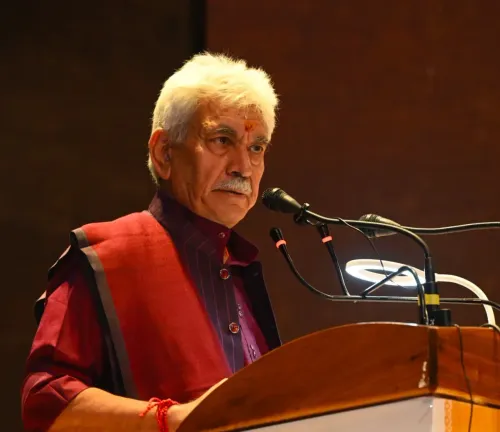
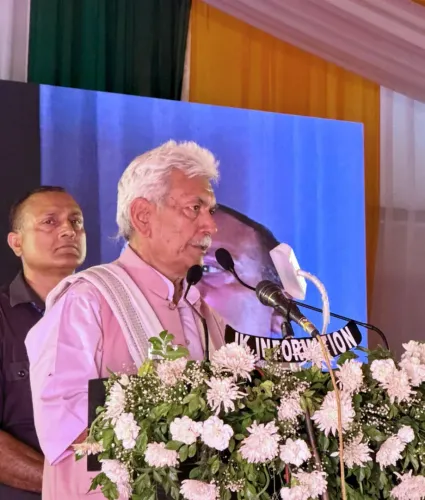
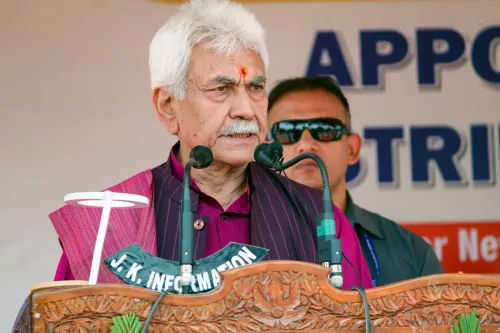
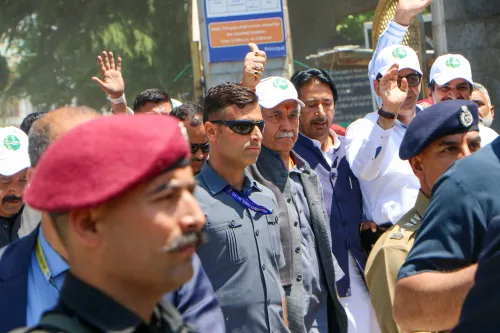
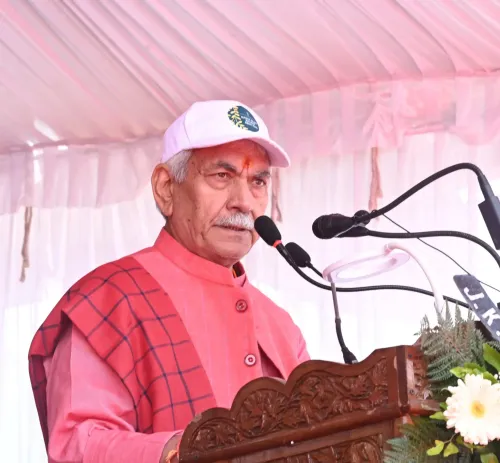
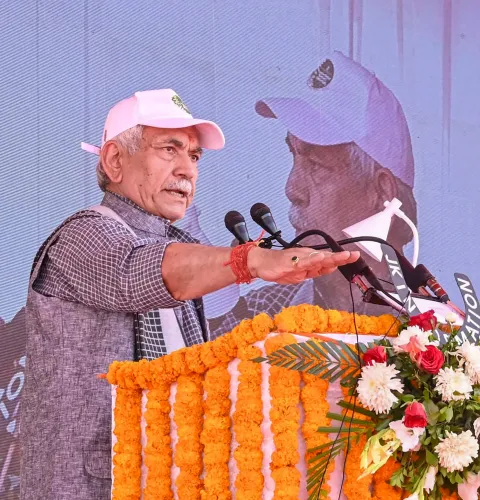
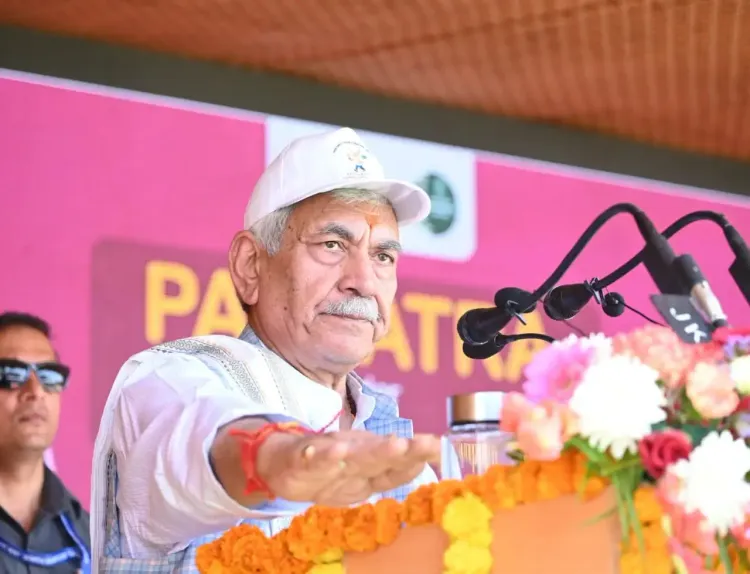
Jammu, April 24: Jammu and Kashmir Lieutenant Governor Manoj Sinha on Friday sounded the alarm over the drug menace, declaring that substance abuse is "eroding the very foundations of society from within" as he formally launched the 'Drug-Free J&K Campaign' in Reasi. The initiative, which has been active for 12 days since April 11, aims to mobilise communities, institutions, and individuals into a unified people's movement against narcotics across the Union Territory.
Campaign Achievements in 12 Days
In just under a fortnight, the anti-drug drive has already delivered measurable results across the Jammu division. Between April 11 and April 22, enforcement agencies registered a large number of cases, arrested several drug smugglers, and seized narcotics valued at nearly Rs 3 crore.
Additionally, movable and immovable properties worth approximately Rs 1 crore were attached from drug traffickers. Properties belonging to drug smugglers have also been demolished as part of zero-tolerance enforcement.
On the administrative front, authorities cancelled 187 driving licences and four vehicle registrations, initiated financial investigations against 48 drug peddlers, and revoked 15 drug-store licences following inspections of chemist shops. Drug users have been referred to de-addiction and rehabilitation centres, with counselling services extended to those affected.
Women at the Forefront of the Anti-Drug Movement
One of the most significant structural outcomes of the campaign has been the formation of 1,947 women committees across districts in the Jammu division since April 11. L-G Sinha underscored the central role of women in this battle, calling mothers and sisters "the moral bedrock of our society."
"We must build a historic movement, one that rises from homes, schools, mohallas, and communities — a movement that begins with open, honest dialogue in towns and villages. With their help, we can win this battle," the L-G stated.
The emphasis on women-led community vigilance reflects a broader strategy to make the campaign self-sustaining at the grassroots level, moving beyond purely law-enforcement approaches.
Drug Traffickers and Terror Nexus: L-G's Warning
L-G Sinha made a pointed observation that drew national security implications into the anti-drug narrative. He explicitly stated that drug traffickers and terrorists operate hand in hand and must be treated as "allies in crime" by police and enforcement agencies.
"Our response should be decisive, thorough, and unyielding. Every route drug smugglers exploit should be watched, every financial chain should be dismantled, and every asset stripped away until their networks are completely destroyed," he said.
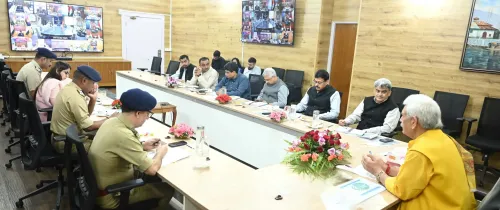
He further revealed that more than two dozen drug traffickers have already been identified and are being tracked. Thousands of drug peddlers across the Jammu division remain under active surveillance. Security checks have been intensified around schools, colleges, and other vulnerable areas to protect the youth.
Call for a Broader People's Movement — 'Nasha-Mukt J&K'
The L-G acknowledged that for more than a decade, Jammu and Kashmir endured a heavy silence around the drug menace, and this campaign was launched to shatter that silence. He invoked constitutional values, the rule of law, and the spirit of 'Jan Bhagidari' (public participation) as pillars of the 'Nasha-Mukt J&K' campaign.
"Drugs are a wound in the heart of our society. To heal this wound, we require a people's movement that mobilises the full strength of society to eradicate drugs at their roots," the L-G said.
He made a direct appeal to NGOs, social workers, spiritual leaders, and educators to join the campaign in cities and villages alike, calling them "frontline guardians of this mission."
Broader Context: Why This Campaign Matters Now
The launch of the Drug-Free J&K Campaign comes amid growing concern across India about the narcotics pipeline flowing through the India-Pakistan border, particularly through Punjab and Jammu & Kashmir. Intelligence reports have long flagged the use of drug money to fund cross-border terrorism, making the drug-terror nexus a dual national security and public health crisis.
Notably, J&K has witnessed a sharp rise in drug-related cases over the past several years, with the NDPS Act registrations increasing significantly post-2019 reorganisation of the UT. The current crackdown — combining financial investigations, property attachment, licence cancellations, and community mobilisation — signals a more holistic approach compared to earlier enforcement-only models.
Critics and policy analysts have long argued that sustainable anti-drug campaigns require equal investment in rehabilitation infrastructure, education, and economic alternatives for vulnerable youth — dimensions that the 'Nasha-Mukt J&K' initiative appears to be attempting to address through its community-committee model.
As the campaign moves beyond its initial 12-day phase, the administration is expected to expand the drive to the Kashmir division with similar intensity. The coming weeks will test whether the momentum can be sustained and whether the 1,947 women committees can evolve into permanent watchdog structures at the village level.
Point of View
A framing that justifies harsher crackdowns and greater central resources. However, the real test lies in sustainability: India's history is littered with high-profile anti-drug campaigns that faded after the initial media cycle. The formation of 1,947 women committees is a promising community-ownership model, but without parallel investment in rehabilitation infrastructure and economic opportunities for at-risk youth, enforcement alone risks becoming a revolving door. The campaign's success will ultimately be measured not in seizures, but in whether J&K's next generation grows up with fewer reasons to turn to drugs.
NationPress
24 Sept 2026
Frequently Asked Questions
What is the Drug-Free J&K Campaign launched by L-G Manoj Sinha?
The Drug-Free J&K Campaign, also called 'Nasha-Mukt J&K', is an anti-drug initiative launched by J&K Lieutenant Governor Manoj Sinha on April 11, 2025, aimed at eradicating drug abuse through community mobilisation, law enforcement, and rehabilitation. The campaign was formally expanded at a public event in Reasi on April 24, 2025.
What action has been taken in 12 days under the Drug-Free J&K Campaign?
Between April 11 and April 22, authorities in the Jammu division seized drugs worth nearly Rs 3 crore, attached properties worth Rs 1 crore, cancelled 187 driving licences and 15 drug-store licences, and initiated financial probes against 48 drug peddlers. Nearly 1,947 women committees were also formed across districts.
What is the drug-terror nexus mentioned by J&K L-G Sinha?
L-G Manoj Sinha stated that drug traffickers and terrorists in J&K operate hand in hand and should be treated as allies in crime by law enforcement. This refers to the well-documented use of drug money to fund cross-border terrorist activities, particularly through the India-Pakistan border.
Why is drug abuse a major problem in Jammu and Kashmir?
Jammu and Kashmir's proximity to the Afghanistan-Pakistan drug corridor has made it vulnerable to narcotics trafficking for decades. NDPS Act registrations in the UT have risen significantly in recent years, with drugs being used both as a social weapon targeting youth and as a funding source for terrorist networks.
What role are women playing in the Drug-Free J&K Campaign?
A total of 1,947 women committees have been established across Jammu division districts since April 11 to serve as grassroots watchdogs against drug abuse. L-G Sinha described mothers and sisters as the 'moral bedrock of society', positioning women-led community vigilance as central to the campaign's long-term success.