Lalan Singh greets 8 states on Foundation Day
Synopsis
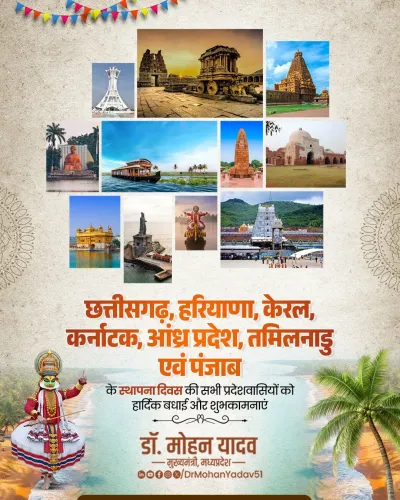
Union Minister Rajiv Ranjan Singh (Lalan Singh) marked 1 November 2026 by greeting residents of eight states — Andhra Pradesh, Chhattisgarh, Haryana, Karnataka, Kerala, Madhya Pradesh, Punjab and Tamil Nadu — on their State Foundation Days, honouring the 1956 and 1966 reorganisations and Chhattisgarh's 2000 formation.
Key Takeaways
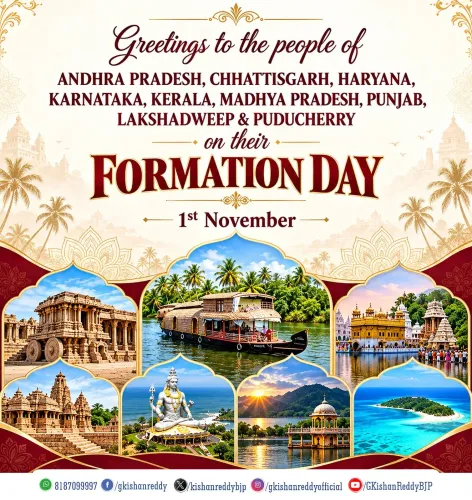
Eight states — Andhra Pradesh, Chhattisgarh, Haryana, Karnataka, Kerala, Madhya Pradesh, Punjab and Tamil Nadu — mark their Foundation Days on 1 November every year.
Union Minister Rajiv Ranjan Singh (Lalan Singh) extended greetings via X on 1 November 2026 , saying the nation is proud of the states' culture and hard work.
Five of the eight states — Andhra Pradesh, Karnataka, Kerala, Madhya Pradesh and Tamil Nadu — were formed under the States Reorganisation Act, 1956 .
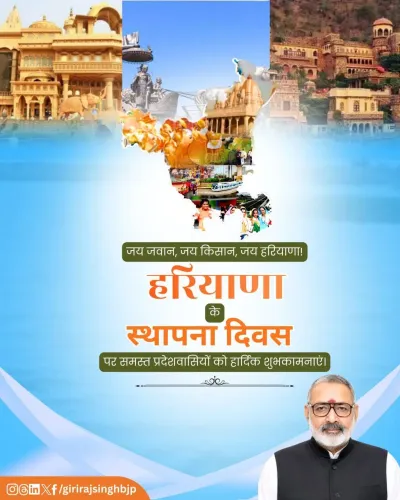
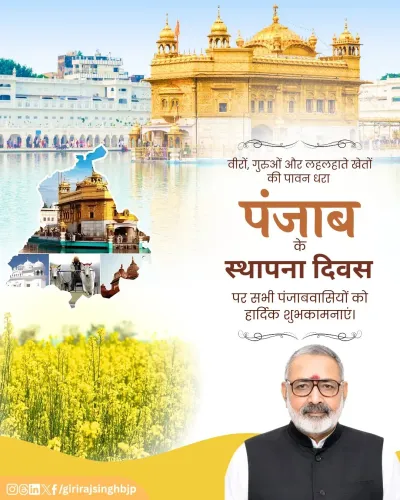
Haryana and Punjab were bifurcated on 1 November 1966 following the Punjabi Suba movement.
Chhattisgarh , the youngest of the eight, was carved from Madhya Pradesh on 1 November 2000 , completing 25 years in 2025.
Lalan Singh is a senior Janata Dal (United) leader and Union Minister holding the Panchayati Raj, Fisheries, Animal Husbandry and Dairying portfolios.
Eight states, one shared calendar date, and a Union Minister's message spanning the length and breadth of India. On Sunday, 1 November 2026, Union Minister for Panchayati Raj, Fisheries, Animal Husbandry and Dairying Rajiv Ranjan Singh — popularly known as Lalan Singh — extended greetings to the residents of Andhra Pradesh, Chhattisgarh, Haryana, Karnataka, Kerala, Madhya Pradesh, Punjab and Tamil Nadu on their respective State Foundation Days.
Posting in Hindi on X, Singh wrote: 'Aapki sanskriti aur parishram par desh ko garv hai' — 'The nation is proud of your culture and hard work.' The message, tagged #StateFoundationDay, is a familiar fixture of India's political calendar each November 1, when central leaders reach across regional lines to acknowledge the diversity that defines the federal republic.
Why eight states share a single birthday
November 1 is arguably the most crowded date on India's state-formation calendar. Andhra Pradesh, Karnataka, Kerala, Madhya Pradesh and Tamil Nadu all trace their modern boundaries to the States Reorganisation Act of 1956, which redrew the map largely along linguistic lines. Haryana and Punjab were carved from the old undivided Punjab on 1 November 1966, following the Punjabi Suba movement. The youngest of the eight, Chhattisgarh, was separated from Madhya Pradesh on 1 November 2000, making it a quarter-century old this year.
Ceremonial outreach and federal courtesies
Union ministers routinely issue such greetings on state foundation days — a practice that crosses party lines and underscores the Centre's acknowledgement of regional identities within India's constitutional framework. For Lalan Singh, a senior Janata Dal (United) leader and NDA coalition partner, the gesture also carries a quiet political dimension: JD(U)'s national footprint depends in part on building goodwill beyond its Bihar base.
Across the eight states, official programmes, cultural events and administrative announcements mark the day in state capitals — from Amaravati and Raipur to Chandigarh and Thiruvananthapuram. The celebrations range from gubernatorial addresses to folk performances, each state curating its own version of a shared federal milestone.
Eight different histories. One date. And a reminder that India's map is not just geography — it is language, labour, and pride stitched together by a reorganisation that reshaped a nation.
Point of View
Whose national ambitions extend beyond Bihar, such gestures help project a pan-India stature that pure electoral arithmetic cannot deliver alone. The convergence of eight state birthdays on a single date also quietly highlights the enduring legacy of the States Reorganisation Act as the scaffolding of modern Indian federalism. That scaffolding, 70 years on, still needs tending.
NationPress
1 Nov 2026
Frequently Asked Questions
Why do so many Indian states celebrate Foundation Day on November 1?
The States Reorganisation Act of 1956, which redrew India's internal boundaries largely on linguistic lines, came into effect on 1 November 1956, giving Andhra Pradesh, Karnataka, Kerala, Madhya Pradesh and Tamil Nadu that date as their Foundation Day. Haryana and Punjab were bifurcated on 1 November 1966, and Chhattisgarh was formed on 1 November 2000.
Which states celebrate Foundation Day on November 1, 2026?
Eight states mark Foundation Day on 1 November: Andhra Pradesh, Chhattisgarh, Haryana, Karnataka, Kerala, Madhya Pradesh, Punjab and Tamil Nadu.
When was Chhattisgarh formed and why?
Chhattisgarh was carved out of Madhya Pradesh on 1 November 2000 to create a separate state for the predominantly tribal and mineral-rich region, making it one of India's newest states.
What is the States Reorganisation Act of 1956?
The States Reorganisation Act of 1956 was a landmark law that restructured India's state boundaries primarily along linguistic lines, coming into effect on 1 November 1956 and creating the modern map of several major states.