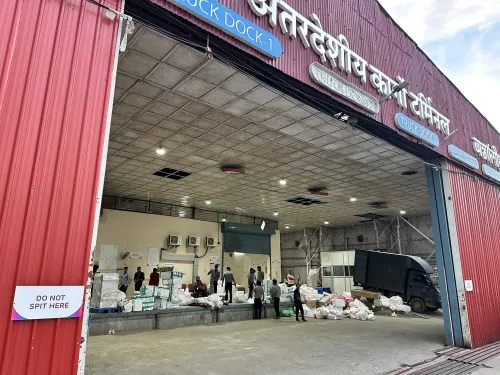
Guwahati's LGBI Airport rainwater harvesting covers 28% of Terminal 2 water use

Synopsis
Guwahati's LGBI Airport is turning monsoon rainfall into a measurable operational asset — harvested rainwater covered 28% of Terminal 2's water needs in July alone. With 1,000 kilolitres of storage, a full treatment plant, and Guwahati's 1,800–2,200 mm annual rainfall as a natural advantage, the airport is building a credible case for water positivity as it expands.
Key Takeaways
LGBI Airport in Guwahati reported that harvested rainwater met approximately 28 per cent of Terminal 2 's total water consumption in July 2025 .
The airport has two rainwater collection tanks with a combined capacity of 1,000 kilolitres .
Harvested water is treated at an on-site Water Treatment Plant and used for drinking, equipment cleaning, and cooling tower operations.
Guwahati receives 1,800–2,200 mm of annual rainfall; the airport had already recorded 1,320 mm by 9 August 2025 .
The initiative spans five internal teams and is part of the airport's goal to become water positive .
Lokapriya Gopinath Bordoloi International (LGBI) Airport in Guwahati has significantly upgraded its rainwater harvesting and utilisation system, with harvested rainwater accounting for approximately 28 per cent of total water consumed at its newly built Terminal 2 in July 2025, airport officials confirmed on Wednesday, 12 August. The development marks a concrete step in the airport's drive to become water positive.
How the System Works
The airport operates two large rainwater collection tanks with a combined storage capacity of 1,000 kilolitres. Harvested rainwater is channelled through the airport's Water Treatment Plant, where it undergoes multi-stage purification before being deployed across several operational uses — including drinking water fountains, equipment cleaning, and cooling tower make-up water. For potable applications, the water meets prescribed drinking water quality standards after full purification.
Why Guwahati Is Well-Suited for This
Guwahati receives between 1,800 mm and 2,200 mm of rainfall annually, giving the airport a substantial natural resource to work with. By 9 August 2025, the airport had already recorded approximately 1,320 mm of rainfall for the year — underlining the scale of harvestable water available even before the monsoon season concludes.
Operational and Environmental Impact
Officials noted that the initiative is designed to reduce dependence on external water sources at a time when passenger footfall is rising and infrastructure expansion is ongoing. The integrated water management system coordinates across Engineering and Maintenance, Environment, Social and Governance (ESG), Operations, and Projects teams. Airports require substantial water volumes for passenger facilities, maintenance, cooling systems, and daily operations — making greater self-sufficiency through harvested rainwater a meaningful efficiency gain.
Part of a Broader Sustainability Drive
LGBI Airport has been pursuing a range of sustainability measures focused on responsible resource management and environmental protection. The rainwater harvesting programme is positioned as a long-term infrastructure investment aligned with the airport's expansion trajectory. Officials said the integrated approach reflects a commitment to building a resilient airport ecosystem capable of meeting growing water demands without proportionally increasing pressure on conventional sources. As aviation infrastructure in Guwahati continues to scale, the airport's water management model could serve as a benchmark for other regional airports in high-rainfall zones.
Point of View
Not a press-release aspiration — and that distinction matters. Most Indian airport sustainability announcements stop at capacity numbers; LGBI is publishing utilisation data, which is a harder and more honest metric. The real question is whether this scales to Terminal 1 and the airport's broader operational footprint, and whether the model gets shared with other northeast Indian airports that sit in similarly high-rainfall corridors. Guwahati's rainfall advantage is not unique — Shillong, Agartala, and Imphal airports face the same hydrology. The bottleneck has always been infrastructure investment and inter-team coordination, both of which LGBI appears to have addressed here.
NationPress
27 Sept 2026
Frequently Asked Questions
What is the rainwater harvesting system at LGBI Airport, Guwahati?
LGBI Airport in Guwahati has installed two large rainwater collection tanks with a combined capacity of 1,000 kilolitres. Harvested rainwater is treated at an on-site Water Treatment Plant and reused for drinking water, equipment cleaning, and cooling tower operations at Terminal 2.
How much of Terminal 2's water needs does harvested rainwater cover?
Harvested rainwater met approximately 28 per cent of Terminal 2's total water consumption in July 2025, according to airport officials. This figure reflects actual utilisation, not just collection capacity.
Why is Guwahati a good location for airport rainwater harvesting?
Guwahati receives between 1,800 mm and 2,200 mm of rainfall annually, one of the higher figures among major Indian cities. By 9 August 2025, the airport had already recorded around 1,320 mm for the year, providing a substantial and reliable source for harvesting.
Is the harvested rainwater safe to drink?
Yes. For potable applications, harvested rainwater at LGBI Airport undergoes multi-stage treatment and purification to meet prescribed drinking water quality standards before being supplied to drinking water fountains.
What is LGBI Airport's broader sustainability goal?
The airport aims to become water positive by integrating rainwater collection, treatment, and reuse across all its operations. The programme is coordinated across Engineering and Maintenance, ESG, Operations, and Projects teams, and is expected to scale as passenger footfall and infrastructure expand.