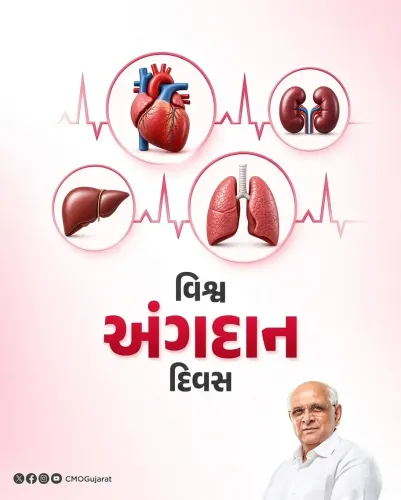
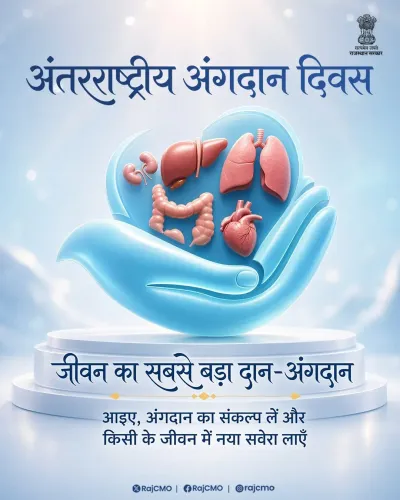
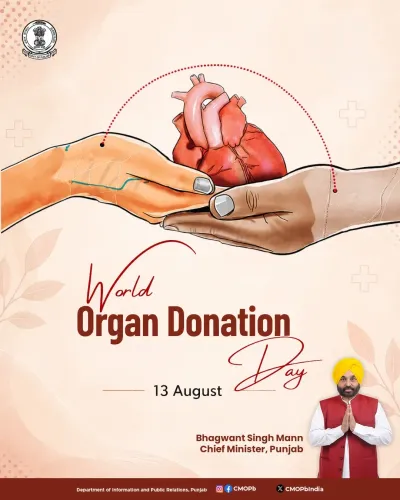
Maharashtra CMO marks 16th Indian Organ Donation Day

Synopsis
The Chief Minister's Office of Maharashtra marked the 16th Indian Organ Donation Day on 3 August 2026, reaffirming that organ donation gives life even after death and tagging PM Modi and CM Fadnavis in a state-backed awareness push.
Key Takeaways
The Chief Minister's Office of Maharashtra observed the 16th Indian Organ Donation Day on 3 August 2026 .
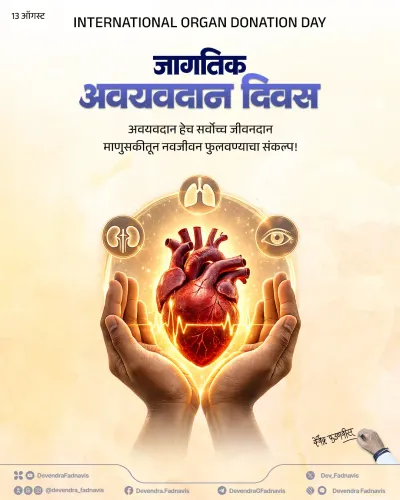
The post described organ donation as 'अवयवदान मृत्यूनंतरही जीवन देणारे महान दान' — 'the greatest gift that gives life even after death.' Prime Minister Narendra Modi and Chief Minister Devendra Fadnavis were tagged, signalling coordinated state-centre messaging.
NOTTO , established in 2014 , is India's national body for organ and tissue transplant coordination and awareness.
India's deceased donor rate remains critically low at roughly 0.8 per million population , far below global benchmarks.
Maharashtra has been among India's more active states in running transplant programmes, particularly through hospitals in Mumbai and Pune .
Every year, thousands of Indians wait in silence — for a kidney, a liver, a heart — while India's organ donation rate remains among the lowest in the world. On Monday, 3 August 2026, the Chief Minister's Office of Maharashtra joined the national observance of the 16th Indian Organ Donation Day, sharing a message that organ donation is 'the greatest gift that gives life even after death.'
The post, addressed to Prime Minister Narendra Modi and Chief Minister Devendra Fadnavis, carried the Marathi phrase 'अवयवदान मृत्यूनंतरही जीवन देणारे महान दान' — 'organ donation, the greatest gift that gives life even after death.' It was tagged under #HealthForAll and #Maharashtra, signalling the state government's alignment with the national campaign.
India's organ donation gap — and why this day matters
India's deceased donor rate hovers at roughly 0.8 per million population — a fraction of rates seen in Spain or the United States, where figures exceed 40 per million. The gap is not one of willingness alone; it is one of awareness, infrastructure, and family consent at the critical moment. That is precisely the problem this annual observance was designed to chip away at.
The National Organ and Tissue Transplant Organisation (NOTTO), established in 2014, coordinates retrieval and distribution of organs across the country. Indian Organ Donation Day, observed annually on 3 August, has grown into a platform for both central and state governments to push registration drives and shift public perception around brain-stem death donation.
Maharashtra's role in the national push
Maharashtra has historically been one of India's more active states on organ donation, with hospitals in Mumbai and Pune running established transplant programmes. The CMO's public acknowledgment — tagging both the Prime Minister and the Chief Minister — reflects a coordinated top-down signalling effort that state health machinery should treat this observance as a policy priority, not merely a calendar date.
The quiet consistency of this messaging, year after year, is itself the strategy: normalise the conversation until donation becomes a default consideration, not an exception.
One post, one day — but behind it, millions of patients still waiting for a second chance at life.
Point of View
Emotionally resonant, and politically anchored by tagging both the Prime Minister and the Chief Minister. It fits a broader pattern in which state governments use national health observances to signal alignment with central policy priorities without committing to specific targets. Maharashtra's consistent participation in organ donation messaging reflects the state's relatively advanced transplant infrastructure, but the real test remains whether such awareness days translate into measurable upticks in donor registrations or family consent rates — the two levers that actually move India's stubbornly low deceased-donor numbers.
NationPress
17 Sept 2026
Frequently Asked Questions
When is Indian Organ Donation Day observed?
Indian Organ Donation Day is observed annually on 3 August across India to promote voluntary organ and tissue donation awareness.
What did Maharashtra CMO post on Organ Donation Day 2026?
The Chief Minister's Office of Maharashtra posted a message on 3 August 2026 calling organ donation 'the greatest gift that gives life even after death,' tagging PM Narendra Modi and CM Devendra Fadnavis.
What is NOTTO and what does it do?
NOTTO — the National Organ and Tissue Transplant Organisation — was established in 2014 to coordinate the retrieval, distribution, and awareness of organs and tissues across India.
How does India's organ donation rate compare globally?
India's deceased donor rate is approximately 0.8 per million population , far below countries like Spain or the United States, where rates exceed 40 per million, making awareness campaigns especially critical.
How can someone register as an organ donor in India?
Indians can register as organ donors through the NOTTO portal or through state transplant coordination centres; family consent at the time of brain-stem death remains essential for donation to proceed.