CM Fadnavis Launches Chief Minister Fellowship 2026 for Maharashtra Youth
Synopsis
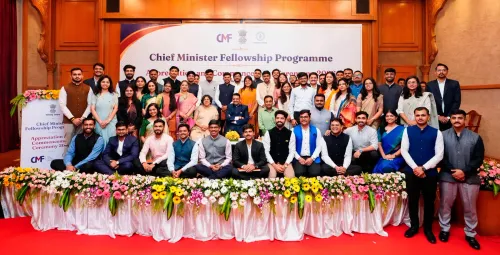
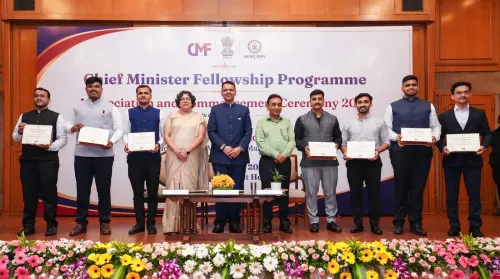
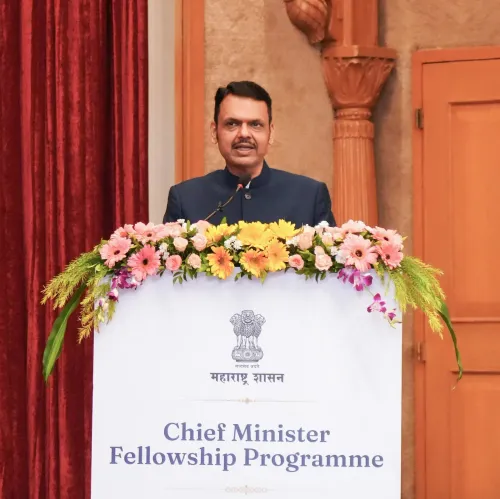
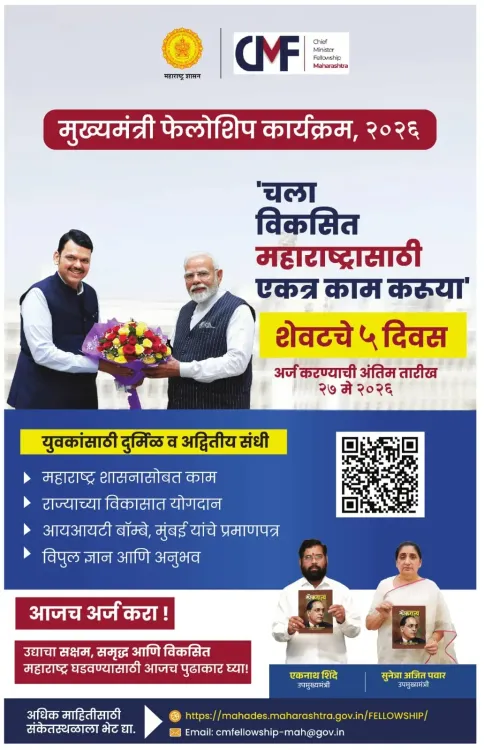
The Chief Minister's Office of Maharashtra has announced the Chief Minister Fellowship Programme 2026, calling on young professionals to work alongside the state government under the slogan 'Come, let us work together for a developed Maharashtra.' The initiative continues Maharashtra's long-standing effort to embed youth talent in governance and policy implementation.
Key Takeaways
The Chief Minister's Office of Maharashtra announced the Chief Minister Fellowship Programme 2026 on 23 May 2026 .
The programme's tagline is 'चला विकसित महाराष्ट्रासाठी एकत्र काम करूया!' — 'Come, let us work together for a developed Maharashtra!' Chief Minister Devendra Fadnavis was directly tagged in the announcement, signalling strong political ownership of the initiative.
The fellowship is designed to place young professionals inside government departments for short-term policy and implementation work.
Maharashtra has run similar youth-engagement programmes since Fadnavis 's first term ( 2014–2019 ), making this a continuation of an established policy tradition.
Detailed eligibility criteria, the application portal, and project themes are expected to be released in the coming weeks.
The Chief Minister's Office of Maharashtra on Saturday, 23 May 2026 announced the Chief Minister Fellowship Programme 2026, inviting young professionals to join hands with the state government under the rallying call 'चला विकसित महाराष्ट्रासाठी एकत्र काम करूया!' ('Come, let us work together for a developed Maharashtra!'). The post, addressed to Chief Minister Devendra Fadnavis, signals the formal launch of the 2026 cohort of the fellowship aimed at embedding youth talent within state administration.
Context
The Chief Minister's Office shared the announcement with the hashtags #CMFellowship2026 and #YouthEmpowerment, framing the programme as a collaborative effort between the government and young citizens to accelerate Maharashtra's development agenda. The tagline — 'Come, let us work together for a developed Maharashtra' — echoes the broader national vocabulary of 'Viksit Bharat' (Developed India), localising it at the state level under Fadnavis's administration.
The fellowship is a state-level initiative designed to place young professionals inside government departments for short-term policy and implementation work, giving them direct exposure to governance at the secretariat and district level.
Policy Backdrop
The Chief Minister Fellowship Programme is not new to Maharashtra. During Devendra Fadnavis's first term as Chief Minister between 2014 and 2019, the state ran multiple youth engagement and skill development initiatives that channelled graduates into public-sector projects. The 2026 edition continues that policy lineage, now under his returned tenure that began in late 2023.
Across India, state governments have increasingly used time-bound fellowship programmes to inject fresh talent into administration, mirroring central initiatives that place young professionals in district-level developmental roles. Maharashtra, as India's most industrialised state and home to Mumbai, has consistently positioned such programmes as a bridge between educated youth and the machinery of governance. The short-term contractual structure also aligns with fiscal caution on permanent government hiring.
Stakeholders and Impact
The primary beneficiaries of the Chief Minister Fellowship Programme 2026 are young professionals — recent graduates, postgraduates, and early-career individuals — who seek meaningful engagement with public policy outside of traditional civil-service routes. For the state administration, fellows have historically contributed to data collection, policy analysis, and on-ground implementation support at the department level.
Broader civil society and district administrations also stand to gain, as fellows are typically deployed on projects that address local governance gaps, from rural infrastructure tracking to urban service delivery. The programme thus creates a two-way pipeline: the state gets analytical capacity, and fellows gain credibility in the public-sector space.
What's Next
The formal announcement is expected to be followed by the release of detailed eligibility criteria, an application portal, and district-level project themes in the coming weeks. Prospective applicants and civil-society observers will watch closely for details on the selection process, duration of the fellowship, and the departments or districts where the 2026 cohort will be deployed.
With Chief Minister Fadnavis personally tagged in the announcement, the programme carries visible political ownership, suggesting it will be a flagship youth-engagement initiative for the current Maharashtra government heading into the next phase of its term.
Point of View
The government is consciously aligning state-level ambition with the national 'Viksit Bharat' narrative, a politically useful association for a BJP-led dispensation. Fellowship programmes of this kind carry low fiscal risk while generating visible goodwill among educated urban and semi-urban youth — a demographic that matters electorally. The real test, however, will be in the programme's implementation details: stipend competitiveness, geographic spread of deployments, and whether fellows are given substantive work or ceremonial roles.
NationPress
14 Sept 2026
Frequently Asked Questions
What is the Chief Minister Fellowship Programme 2026 in Maharashtra?
The Chief Minister Fellowship Programme 2026 is a Maharashtra state government initiative that places young professionals inside government departments for short-term policy and implementation work, announced by the Chief Minister's Office on 23 May 2026.
Who is eligible for the CM Fellowship 2026 Maharashtra?
Detailed eligibility criteria have not yet been released. The programme is broadly aimed at young professionals, and the application portal and specific requirements are expected to be announced in the coming weeks.
What is the last date to apply for CM Fellowship Maharashtra 2026?
The application deadline has not been announced yet. Prospective applicants should watch for official updates from the Chief Minister's Office of Maharashtra on the application portal and timeline.
What does the CM Fellowship Programme involve?
Fellows are typically placed in government departments at the secretariat or district level, contributing to policy analysis, data collection, and on-ground implementation support for a fixed short-term period.
Is the Maharashtra CM Fellowship a permanent government job?
No. The Chief Minister Fellowship Programme is a short-term contractual engagement, not a permanent government appointment. It is designed to give young professionals governance experience without creating permanent recruitment commitments.