Mahua Moitra flags conflict-of-interest in EC appointment case
Synopsis
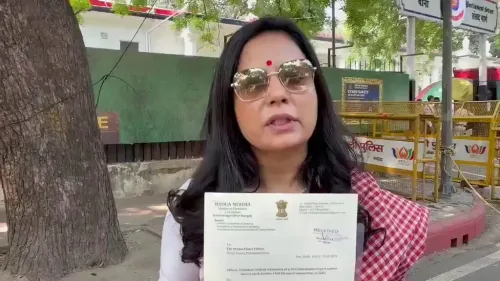
TMC MP Mahua Moitra has alleged a serious conflict of interest in the ongoing legal challenge to Election Commissioner Gyanesh Kumar's appointment, claiming a judge's son was serving as EC standing counsel while his father adjudicated the case — without disclosure to the bench or petitioners.
Key Takeaways
Gyanesh Kumar was appointed Election Commissioner of India on 15 March 2024 under the government-weighted selection panel created by the 2023 Act .
The son of a judge referred to as Justice Sharma was empanelled as EC standing counsel on 10 July 2024 , according to Moitra's post.
Gyanesh Kumar is named as Respondent 3 in the petition challenging his own appointment, making Justice Sharma's son's role a direct conflict-of-interest concern.
Co-bench judge Justice Datta allegedly had no knowledge of the familial connection, nor did the petitioner's lawyers.
The Election Commission Appointment Act, 2023 replaced a Supreme Court-directed panel that included the Chief Justice of India with an executive-dominated committee, drawing multiple legal challenges.
The alleged non-disclosure raises questions about recusal obligations and institutional transparency in constitutional litigation.
A sitting judge's son serving as legal counsel for the very constitutional body his father is adjudicating over — that is the explosive conflict TMC MP Mahua Moitra has placed squarely in the public domain on 27 September 2026, targeting the ongoing legal challenge to the appointment of Election Commissioner Gyanesh Kumar.
Moitra's post lays out a precise, date-stamped sequence: Gyanesh Kumar was appointed Election Commissioner on 15 March 2024. The son of a judge — identified only as Justice Sharma — was subsequently empanelled as standing counsel for the Election Commission of India (ECI) on 10 July 2024. The kicker: Gyanesh Kumar himself is named as Respondent 3 in the very petition challenging the legality of his appointment, meaning Justice Sharma was hearing a matter in which his own son's client was a named party.The EC appointment that landed in court
Gyanesh Kumar's appointment sits at the centre of a broader legal and political storm. Parliament's Election Commission (Appointment, Conditions of Service and Term of Office) Act, 2023 rewrote the selection process for Election Commissioners — replacing a Supreme Court-directed three-member panel comprising the Prime Minister, Leader of Opposition, and Chief Justice of India with a committee of the Prime Minister, a Union Cabinet Minister, and the Leader of Opposition. That committee, effectively government-weighted, cleared Gyanesh Kumar's appointment. Multiple petitions before the courts have challenged this process as undermining the ECI's independence. The Supreme Court's 2023 ruling in Anoop Baranwal v. Union of India had specifically mandated the CJI's inclusion to insulate the Commission from executive overreach — a safeguard the 2023 Act quietly dismantled.Justice Datta, Justice Sharma, and the empanelment no one disclosed
Moitra's post singles out a second judge — identified as Justice Datta — as a co-bench member who, she claims, had no knowledge that his fellow judge Justice Sharma's son was serving as ECI's standing counsel. Nor, she alleges, were the petitioner's lawyers aware of the connection. In judicial practice, a conflict of interest of this nature — a judge's immediate family member acting as counsel for a respondent in a case before that judge's bench — is precisely the kind of relationship that triggers disclosure obligations and, in serious cases, recusal. If the facts are as Moitra states, the non-disclosure raises questions not just about individual conduct but about institutional safeguards in high-stakes constitutional litigation.Why the ECI's legal shield matters here
The Election Commission engages standing counsel to defend its positions in court — these lawyers represent the institution consistently across multiple matters. When a judge's son holds that brief and the judge is simultaneously hearing a case in which the ECI (and its appointee) is a respondent, the line between institutional neutrality and personal entanglement blurs. The concern is not merely optics: courts are the last line of defence for election law challenges, and any perception of compromised adjudication weakens public trust in both the judiciary and the election body at once. For Moitra, a fierce critic of the government's handling of electoral institutions, the post is a calculated escalation — presenting a paper trail of dates and names that invites scrutiny from bar associations, court administrators, and civil society well beyond the Lok Sabha chamber.Point of View
If verified, touches two institutions simultaneously: it questions adjudicatory neutrality in the judiciary while reinforcing doubts about the independence of an Election Commission appointed through a process the Supreme Court had originally sought to insulate from executive dominance. It also lands at a sensitive moment — with general elections on the horizon, the ECI's perceived legitimacy is under heightened scrutiny from opposition parties who view the 2023 Act as structurally tilting the playing field. The burden now falls on the courts and bar bodies to clarify whether the empanelment was disclosed and whether the bench was properly constituted.
NationPress
27 Sept 2026
Frequently Asked Questions
Who is Gyanesh Kumar and why is his appointment controversial?
Gyanesh Kumar was appointed Election Commissioner of India on 15 March 2024 by a selection committee constituted under the Election Commission (Appointment, Conditions of Service and Term of Office) Act, 2023 , which critics argue gives the government disproportionate influence over the panel. His appointment has been challenged in court on grounds that the 2023 Act violates the spirit of the Supreme Court's 2023 Anoop Baranwal ruling.
What is the conflict of interest Mahua Moitra is alleging?
Moitra alleges that the son of Justice Sharma — a judge hearing the petition challenging Gyanesh Kumar's appointment — was serving as standing counsel for the Election Commission of India , one of the respondents in the same case. She claims neither co-bench judge Justice Datta nor the petitioner's lawyers were aware of this familial connection.
What is the Anoop Baranwal case and why does it matter here?
The Supreme Court's ruling in Anoop Baranwal v. Union of India (2023) directed that Election Commissioners be appointed by a three-member panel including the Chief Justice of India , to insulate the process from executive control. Parliament's subsequent 2023 Act replaced the CJI with a Union Cabinet Minister — the change that lies at the heart of the ongoing petitions.
What is a 'standing counsel' for the Election Commission?
A standing counsel is a lawyer formally empanelled to represent a government body — in this case the Election Commission of India — in court proceedings. The role involves regularly defending the ECI's positions across multiple cases, creating an ongoing professional relationship between the lawyer and the institution.
What happens if a judge's conflict of interest is not disclosed in a case?
In Indian judicial practice, judges are expected to disclose any personal or familial interest in matters before them — including a family member acting as counsel for a party — and to recuse themselves if a conflict exists. Failure to disclose can be grounds to challenge the validity of orders passed by that bench, though the outcome depends on the specific rules and facts of the case.