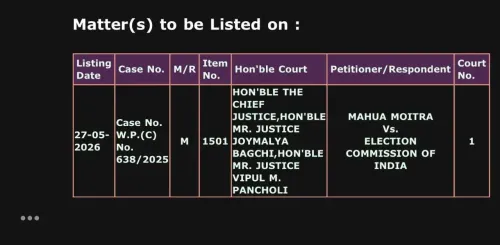
Mahua Moitra Urges CJI to Act on Judge's Son-ECI Lawyer Link
Synopsis
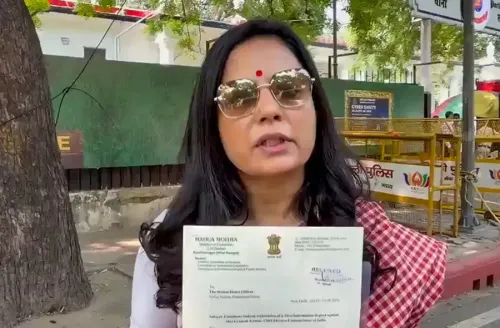
TMC MP Mahua Moitra has publicly urged the Chief Justice of India to take immediate remedial action after alleging that Justice SC Sharma adjudicated ECI-linked matters — including an out-of-turn hearing — while his son served as standing counsel for the Election Commission.
Key Takeaways
TMC MP Mahua Moitra publicly called on the Chief Justice of India to take immediate remedial action over a judicial propriety concern on 25 September 2026 .
She alleged that Justice SC Sharma's son is a standing counsel for the Election Commission of India , creating a direct conflict of interest.
Moitra alleged Justice Sharma heard at least two ECI-linked matters, one of them out of turn, while the familial professional tie existed.
India lacks a codified recusal statute; the standard flows from constitutional doctrine and Supreme Court precedent on familial professional interests.
The Election Commission is a constitutional body under Article 324 , making any conflict of interest in court proceedings involving it a matter of heightened public concern.
The allegation echoes broader recurring debates in India about judicial independence and institutional conflict-of-interest safeguards in election-related litigation.
A pointed conflict-of-interest allegation landed at the doorstep of India's Chief Justice on Friday, 25 September 2026, as TMC MP Mahua Moitra publicly demanded immediate remedial action over what she called a glaring propriety lapse: a sitting judge's son allegedly serving as standing counsel for the Election Commission of India while the father adjudicated ECI-linked matters — including, she alleged, an out-of-turn hearing.
The Allegation: A Son in Court, a Father on the Bench
Moitra's post names the judge as Justice SC Sharma, whose son she claims is a standing counsel for the Election Commission of India (ECI). The MP alleges that Justice Sharma heard two matters — one concerning an individual she refers to as 'Gyanesh Chor' and another involving his daughter — both of which intersected with the ECI's legal interests, with at least one heard out of sequence. The post links to a detailed legal-affairs report raising identical propriety questions about the arrangement.
The core concern is elementary but consequential: if a judge's immediate family member is professionally retained by a party that appears before that judge, recusal is the standard expected remedy under accepted judicial conduct norms. Moitra's demand — directed at the Chief Justice of India — is that the apex court's administrative head step in where the judge himself did not.
Why Recusal Norms Exist — and When They Bite
India's judiciary does not have a codified statute on recusal, but the principle flows from the doctrine of nemo judex in causa sua — no one should be a judge in their own cause. The Supreme Court has, in several rulings, extended this to situations where a judge's close relatives have financial or professional interests in a litigating party. A standing counsel arrangement — a retainer relationship with a constitutional body — would ordinarily sit well within that zone of caution.
The Election Commission is not a routine litigant. Under Article 324 of the Constitution, it is the sole authority for superintending elections to Parliament, state legislatures, and the offices of President and Vice President. Cases before it — and before courts involving it — carry outsized public importance. In 2023, the Supreme Court's landmark ruling in Anoop Baranwal v. Union of India directed that Election Commissioners be appointed by a committee that included the Chief Justice of India, precisely to insulate the body from executive capture. The irony of a fresh conflict-of-interest question surfacing around the ECI's own legal representation in court is not lost on observers.
Moitra's 'Godi Judiciary' Charge and the Political Framing
Moitra did not stop at procedural propriety. She drew a direct line from what she termed 'GodiMedia' — a pejorative for press perceived as pliant to the ruling establishment — to a 'Godi Judiciary', suggesting a pattern of institutional deference rather than independence. It is a sharp political frame, and one the opposition has deployed with increasing frequency, but the underlying procedural question — did a judge hear a matter in which his son had a professional stake? — stands independent of that framing and warrants a factual response from the court's administration.
Allegations of this nature are not unprecedented in Indian legal discourse. Questions about familial ties, recusal standards, and the independence of the judiciary in election-related matters have surfaced periodically, forming part of a longer-running debate on how robustly India's institutions insulate themselves from perceived conflicts.
What the CJI's Office Now Faces
A public call for the Chief Justice to act — made by a sitting Member of Parliament on a platform with national reach — creates its own administrative pressure. The CJI's office can respond administratively (by calling for a report, reassigning matters, or issuing internal guidance), judicially (if a formal petition is filed), or remain silent and absorb the political heat. Any of the three choices will be read as a signal about how seriously the court treats propriety complaints originating outside formal petition channels.
For now, the ball is squarely in the Chief Justice's court — and every day without a response is itself a statement.
Point of View
The failure of self-recusal would represent a textbook institutional blind spot of the kind that erodes public trust incrementally but cumulatively. The CJI's administrative response — or silence — will inevitably be read as a benchmark for how robustly the court polices its own conduct in election-adjacent matters. Moitra's 'Godi Judiciary' framing will amplify the political noise, but the procedural question underneath it is independent of the political messenger.
NationPress
25 Sept 2026
Frequently Asked Questions
What is Mahua Moitra's allegation against Justice SC Sharma?
Moitra alleges that Justice SC Sharma heard matters involving the Election Commission of India and related individuals while his son was serving as a standing counsel — a retainer lawyer — for the Election Commission, raising a direct conflict-of-interest concern under accepted judicial conduct norms.
What is a standing counsel and why does it matter here?
A standing counsel is a lawyer retained on a regular basis to represent a government body or institution in legal proceedings. If a judge's close family member holds such a position with a party that appears before that judge, judicial norms in India call for the judge to recuse from those matters.
Does India have a law requiring judges to recuse themselves?
India does not have a standalone codified recusal statute, but the principle derives from the constitutional doctrine that no one should judge their own cause. The Supreme Court has applied this standard to situations involving judges' relatives having professional or financial ties to litigating parties.
Why is the Election Commission's involvement significant in this case?
The Election Commission is a constitutional body under Article 324 with sole authority over parliamentary and state elections. Cases involving it carry significant public interest, and any perceived conflict of interest in judicial handling of ECI matters is considered especially serious given the body's role in democratic processes.
What action can the Chief Justice of India take on Mahua Moitra's request?
The CJI can act administratively by calling for an internal report and reassigning affected matters, or wait for a formal petition before acting judicially. A public call from a sitting MP also creates political pressure for a visible, timely response from the court's administration.