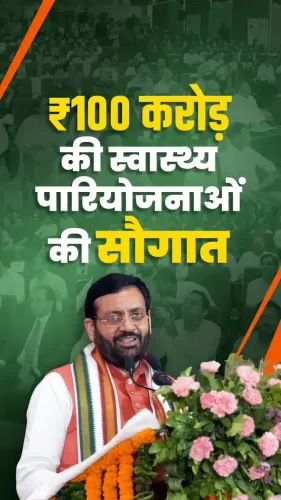
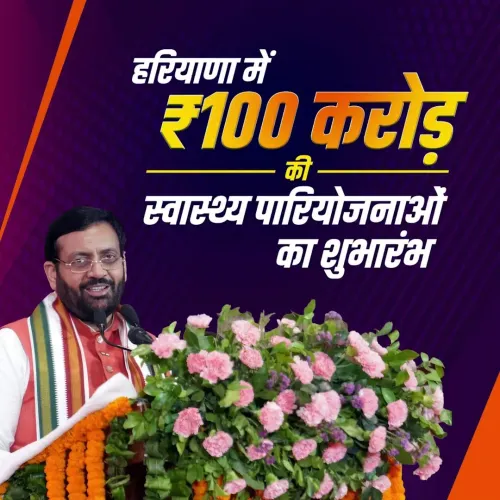
CM Nayab Saini pitches ₹10 meal scheme as dual win for nutrition and women's jobs
Synopsis
Haryana CM Nayab Singh Saini unveiled a dual-purpose welfare initiative offering nutritious meals at ₹10 and employment for women, framing it as one intervention delivering two transformative outcomes for low-income households across the state.
Key Takeaways
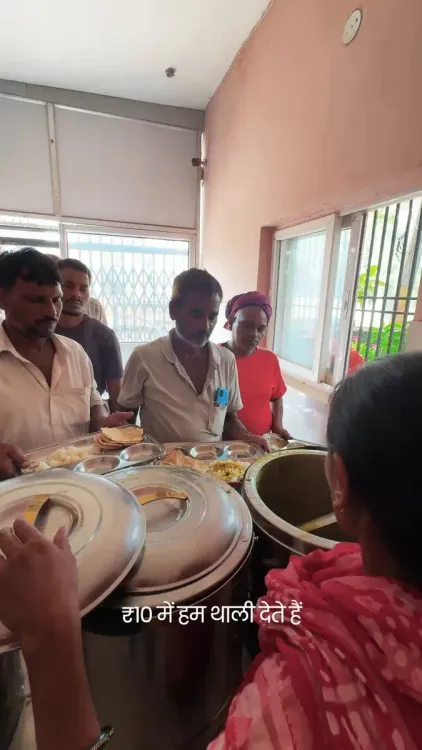
₹10 per meal : Haryana is rolling out a subsidised nutrition scheme priced at rupees ten, targeting low-income and daily-wage populations.
Women's employment is the second explicit goal, with the scheme designed to generate livelihoods alongside food access.
CM Nayab Singh Saini framed the initiative as 'one initiative, two strong changes' in a post on 25 September 2026 .
The model mirrors subsidised canteen programmes run by multiple Indian states since the 2010s, often powered by women's self-help groups.
Key details — scheme name, outlet locations, and number of women employed — are yet to be officially disclosed.
One initiative, two outcomes — and a price tag of just ₹10. Haryana Chief Minister Nayab Singh Saini on Friday, 25 September 2026 highlighted a subsidised meal programme that promises nutritious food at rupees ten while simultaneously creating employment opportunities for women, framing it as a compact welfare model with outsized social returns.
Posting on X, Saini described the initiative with the line 'एक पहल, दो मजबूत बदलाव' — 'one initiative, two strong changes' — pointing to affordable nutrition and a 'strong foundation of employment for women' as the twin pillars of the scheme.
₹10 and a full plate: the nutrition promise
Subsidised community meal schemes have proliferated across Indian states since the early 2010s, with governments from Tamil Nadu to Rajasthan and Odisha using low-cost canteens to address urban and semi-urban food insecurity. At ₹10 per meal, Haryana's model sits at the sharper end of that price spectrum, targeting daily-wage workers, migrant labourers, and low-income households who cannot afford restaurant or dhaba prices. The scheme fits into the broader national nutrition architecture anchored by POSHAN Abhiyaan and existing mid-day meal programmes.
Women at the centre of the delivery model
The second pillar — women's employment — is where this scheme carries structural weight. Across comparable state programmes, women's self-help groups (SHGs) have been the backbone of meal preparation and distribution, turning welfare delivery into a livelihood engine. By routing the scheme through women workers, the Haryana government would be adding an income-generation layer on top of the nutrition intervention — a design that development economists have consistently flagged as more cost-effective than single-purpose subsidies.
Haryana, under CM Saini who took office in March 2024 succeeding Manohar Lal Khattar, has increasingly leaned into welfare consolidation — packaging multiple social objectives into single programme announcements. The ₹10 meal scheme, as articulated in Friday's post, follows that template precisely.
What the announcement still leaves open
The post does not specify the scheme's official name, the number of outlets planned, or how many women are expected to gain employment under it. Those details — locations, scale, SHG partnerships, and rollout timeline — will determine whether the initiative reaches the density needed to make a measurable dent in both hunger and female unemployment across Haryana's districts. The numbers, when they arrive, will be the real test of the two-change promise.
A ten-rupee plate is an easy headline. Making it reach a million tables is the hard part.
Point of View
Two outcomes' framing is a deliberate political economy move — bundling a nutrition subsidy with a women's livelihood angle makes the scheme harder to dismiss as mere populism and broadens its appeal across voter blocs simultaneously. It reflects a pattern in BJP-governed states of packaging welfare delivery through self-help group networks, which deepens grassroots organisational reach while outsourcing implementation risk. The real question is scale: Haryana's electorate will judge this on how many outlets open and how many women actually draw a wage from it, not on the announcement alone. If executed with SHG depth, it could become a template; if it stays thin on the ground, it becomes another welfare headline without a welfare reality.
NationPress
25 Sept 2026
Frequently Asked Questions
What is Haryana's ₹10 meal scheme announced by CM Nayab Saini?
It is a subsidised community meal initiative announced by Haryana Chief Minister Nayab Singh Saini that provides nutritious food at just ₹10 per plate , while also aiming to create employment opportunities for women, likely through self-help group networks.
How does the Haryana ₹10 meal scheme help women?
The scheme is designed with a dual objective: delivering affordable nutrition to low-income households and generating employment for women, who are expected to be central to preparing and distributing the meals.
Which Indian states have run similar subsidised meal schemes?
Several states including Tamil Nadu, Rajasthan, and Odisha have operated low-cost community canteen programmes since the early 2010s. Haryana's scheme fits this broader national pattern of state-level nutrition interventions.
When did Nayab Singh Saini become Chief Minister of Haryana?
Nayab Singh Saini became Chief Minister of Haryana in March 2024 , succeeding Manohar Lal Khattar as the BJP's choice to lead the state government.
What is POSHAN Abhiyaan and how does this scheme relate to it?
POSHAN Abhiyaan is India's flagship national nutrition mission aimed at reducing malnutrition across age groups. Haryana's ₹10 meal scheme complements this central programme by addressing food access at the community level for working-age low-income populations.