Mahua Moitra: Govt Now Competing With Opposition Outside Parliament
Synopsis
TMC MP Mahua Moitra posted on 13 August 2026 that the government and treasury benches are now reduced to competing with the opposition outside Parliament, highlighting a structural shift in Indian political discourse away from the legislative chamber.
Key Takeaways
TMC MP Mahua Moitra posted on 13 August 2026 that the government is 'competing with opposition outside Parliament to play catch up.' The post implies a structural failure: a parliamentary majority that controls the House calendar is nonetheless losing the narrative battle beyond it.
Frequent adjournments and walkouts across multiple sessions since 2014 have progressively reduced actual legislative debate time.
Both treasury and opposition benches have historically used procedural disruptions, shifting political exchanges to press conferences and social media.
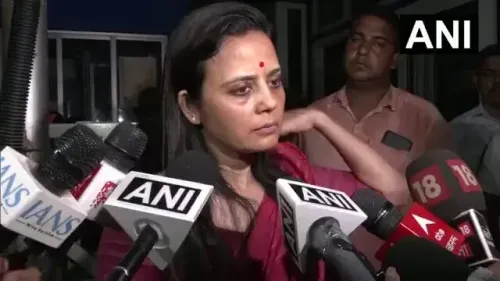
Moitra, Lok Sabha MP from Krishnanagar, West Bengal , is known for sharp parliamentary interventions and criticism of the central government.
The floor of Parliament is supposed to be where governments defend their record and oppositions hold them to account. But TMC MP Mahua Moitra is arguing that the arena has shifted — and that the shift itself is the story.
Posting on 13 August 2026, the Krishnanagar MP fired a pointed observation: 'Government and treasury benches reduced to competing with Opposition outside Parliament to play catch up!' The framing is deliberate — it is not just the opposition walking out, she is saying, but the government itself now chasing the news cycle beyond the chamber.
When the Chamber Empties, the Street Fills
The pattern Moitra is pointing to did not begin yesterday. Since at least 2014, successive Lok Sabha and Rajya Sabha sessions have been punctuated by adjournments, walkouts, and procedural standoffs — from both sides of the aisle. What follows, reliably, is a sprint to the press conference podium and the social media timeline. Ministers hold briefings. Opposition leaders hold counter-briefings. The cameras roll either way. The irony Moitra is underscoring is structural: when a government commands a parliamentary majority, it controls the legislative calendar, the committee agenda, and the speaking clock. If that majority is still scrambling to match the opposition's narrative outside the House, the post implies something has gone wrong inside it.A Longer Erosion of Legislative Debate Time
India's parliamentary record has documented a steady compression of actual debate time over decades. Disruptions — a tool used by opposition and treasury benches alike depending on political convenience — have eaten into the hours available for substantive questioning and response. The consequence is a displacement effect: arguments that should be tested on the floor, under the rules of the House, instead play out on platforms with no rules at all. Moitra, known for sharp parliamentary interventions, has consistently positioned herself as a defender of legislative rigour. Her post reads less as a partisan attack and more as a structural critique — the institution is losing ground to the spectacle around it.What the Next Session Will Reveal
The real test of whether this dynamic shifts lies in the next sitting: whether procedural disruptions ease, whether debate time is protected, and whether both government and opposition choose the chamber over the camera. Until then, the competition Moitra describes will keep running — just not on the floor where it belongs.Point of View
Political contests migrate to unregulated public platforms, weakening parliamentary accountability on all sides. The pointed irony — that a ruling majority is 'playing catch up' — signals that the opposition believes it is winning the extra-parliamentary argument, a perception that can itself shape the political climate ahead of the next session. This is less a partisan jab than a symptom of a broader erosion of legislative culture that reformers across party lines have flagged for years. The question it raises is whether either side has the incentive to restore the chamber's primacy when the street is working just as well.
NationPress
13 Aug 2026
Frequently Asked Questions
What did Mahua Moitra say about Parliament on 13 August 2026?
Mahua Moitra posted on X that the government and treasury benches are 'reduced to competing with Opposition outside Parliament to play catch up,' arguing that political debate has shifted away from the legislative chamber.
Why is the government competing with opposition outside Parliament?
Frequent adjournments, walkouts, and procedural disruptions across sessions have compressed actual debate time, pushing both sides to press conferences and social media to make their arguments.
Who is Mahua Moitra?
Mahua Moitra is a Trinamool Congress (TMC) MP representing the Krishnanagar constituency in West Bengal, known for assertive parliamentary speeches and frequent criticism of the central government.
Has Parliament seen fewer debates in recent years?
Yes, documented patterns since 2014 show that disruptions from both treasury and opposition benches have steadily reduced substantive debate time in Lok Sabha and Rajya Sabha sessions.
What does it mean when politics moves outside Parliament?
When political exchanges happen primarily through press conferences and social media rather than on the floor of the House, accountability mechanisms weaken — questions go unanswered under formal rules and scrutiny becomes harder to enforce.