What Insights Did Malayalam Writer K.P. Ramanunni Share at the Delhi Book Fair?
Click to start listening
Synopsis
At the New Delhi World Book Fair 2026, acclaimed Malayalam writer K.P. Ramanunni shared his literary experiences and insights, captivating an audience eager to explore India's rich intellectual traditions. His story, 'MTP', sheds light on the emotional complexities surrounding medical termination of pregnancy, while a panel discussion further delved into the depth of India's cultural heritage.
Key Takeaways
- K.P. Ramanunni shared valuable insights from his literary journey.
- The story 'MTP' highlights complex human emotions surrounding medical termination of pregnancy.
- Discussions on India's intellectual traditions were enriching and well-received.
- Engagements like this promote cultural awareness and dialogue.
- Literary events foster connections among writers, readers, and educators.
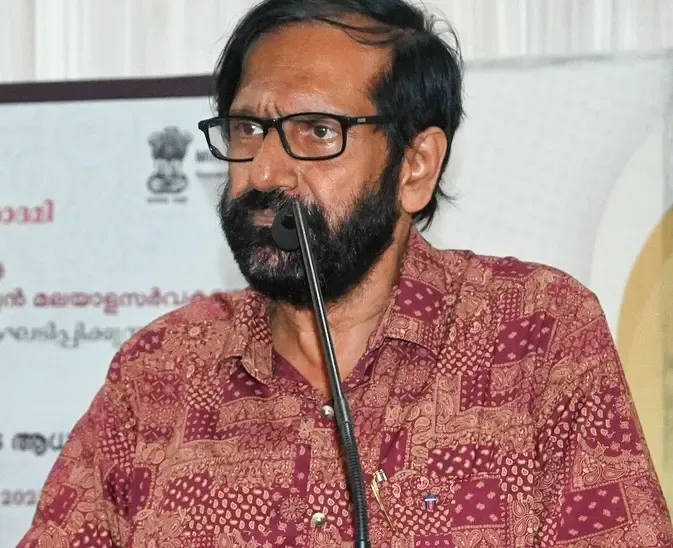
New Delhi, Jan 16 (NationPress) The Sahitya Akademi extended an invitation to distinguished Malayalam author K.P. Ramanunni at the New Delhi World Book Fair 2026, where a face-to-face program and a panel discussion focusing on India's intellectual heritage were conducted, as per an official announcement on Friday.
Ramanunni, a recipient of the Sahitya Akademi Award, engaged with the audience by sharing reflections from his literary career and insights on Thursday, as reported by the Ministry of Culture.
The writer, hailing from Kozhikode in Kerala, presented excerpts from his Malayalam short story 'MTP', which refers to the medical term for termination of pregnancy. This story was translated into English by Abu Bakar Kaba, according to the statement.
Structured as a play and segmented into seven parts, the narrative delves into the profound human drama involved in the medical termination of pregnancy, drawing from the author's personal life experiences.
In reflecting on his literary path, Ramanunni recounted his teenage years, during which he found himself immersed in both spiritual and communist literature, leading to an internal conflict that resulted in psychiatric consultation.
Although the treatment was unsuccessful, the experience motivated him to seek solace through writing, he noted.
The face-to-face event at the Fair was succeeded by a panel discussion on India’s intellectual traditions, featuring panellists Rawail Singh, Harekrishna Satapathy, and Basavaraj Kalgudi.
Rawail Singh traced the intellectual lineage of Punjab, from the ancient center of learning at Takshashila to the influences of Nath Yogis, Sufism, and Sikhism.
Harekrishna Satapathy assessed the contrasts between ancient and modern educational frameworks, referencing Brahma, Vishnu, and Mahesh as the Aadigurus and reciting a shloka from the Vedas.
Basavaraj Kalgudi presented on peripheral knowledge systems, categorizing them into oral and written traditions, while emphasizing the importance of tribal and agrarian wisdom traditions of ancient India.
Both events received positive feedback from the audience, consisting of students, educators, writers, and literature enthusiasts, fostering meaningful interactions and discussions.
Sandeep Kaur, Assistant Editor, delivered a vote of thanks on behalf of the Sahitya Akademi, the statement concluded.
Point of View
The engagement of K.P. Ramanunni at the New Delhi World Book Fair highlights the significance of promoting literary voices and understanding the depth of India's intellectual traditions. It is essential to encourage discussions that foster cultural dialogue and awareness among diverse audiences.
NationPress
16/01/2026
Frequently Asked Questions
What is the New Delhi World Book Fair?
The New Delhi World Book Fair is a significant annual event that celebrates literature and promotes reading culture, featuring authors, publishers, and literary discussions.
Who is K.P. Ramanunni?
K.P. Ramanunni is a prominent Malayalam writer known for his literary contributions, including his acclaimed works that explore human experiences.
What is the theme of Ramanunni's story 'MTP'?
The story 'MTP' examines the emotional turmoil surrounding medical termination of pregnancy, drawing from the author's personal experiences.
Who were the panellists in the discussion on India's intellectual traditions?
The discussion featured Rawail Singh, Harekrishna Satapathy, and Basavaraj Kalgudi, who shared insights on various aspects of India's cultural heritage.
What role does the Sahitya Akademi play in promoting literature?
The Sahitya Akademi is a national academy that promotes Indian literature, supports authors, and organizes literary events to enhance cultural dialogue.