Has Mamata Banerjee’s Balancing Act Between Muslim Welfare and Hindu Outreach Come Too Late?
Click to start listening
Synopsis
Explore the intricate political strategies of West Bengal Chief Minister Mamata Banerjee as she navigates between Muslim welfare initiatives and Hindu outreach. With upcoming elections, her recent shift towards temple construction raises questions about her timing and intentions. Will this balancing act resonate with both communities?
Key Takeaways
- Mamata Banerjee has shifted focus towards temple construction.
- Her initiatives aim to balance between Muslim welfare and Hindu outreach.
- Criticism from the BJP highlights the challenges of minority appeasement.
- Upcoming elections influence the timing of her strategies.
- The risk of alienating both communities is a significant concern.
New Delhi, Dec 30 (NationPress) The political approach of Mamata Banerjee, the Chief Minister of West Bengal, has often faced criticism for allegedly favoring minority appeasement through welfare initiatives, perceived to benefit Muslims disproportionately. However, her recent pivot towards temple construction indicates a shift in strategy.
During a visit to the state on Tuesday, Home Minister Amit Shah acknowledged her efforts but remarked, "it might be too late" in light of the impending Assembly elections.
The ruling Trinamool Congress has been under fire, particularly from the principal opposition party, the Bharatiya Janata Party (BJP), for introducing programs claimed to cater to Muslim voters, who constitute over 30% of Bengal's electorate. Conversely, Banerjee has significantly increased funding for Durga Puja committees and initiated major temple projects, such as the Rs 250-crore Jagannath Mandir in Digha, which has attracted over one crore visitors within just eight months of its inauguration. This year, she raised the government grant for each of the 40,000 Durga Puja committees from Rs 85,000 to Rs 1.10 lakh and removed taxes and service charges for Puja organizers.
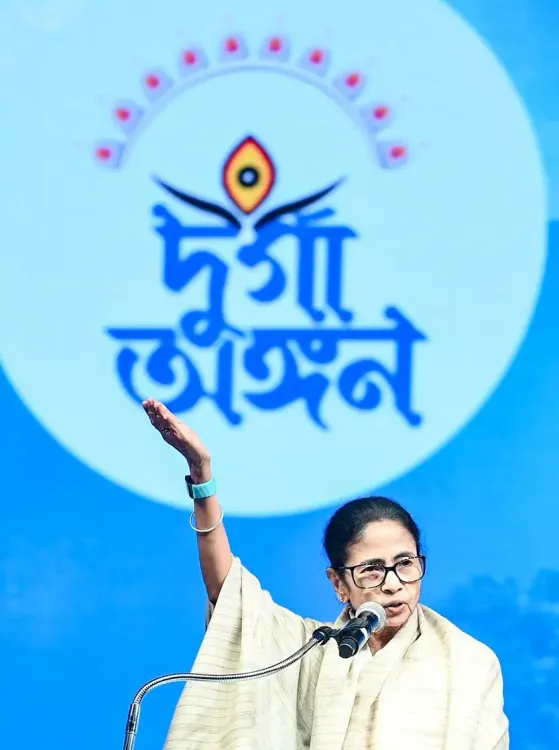
On Monday, she inaugurated the foundation for a Rs 262-crore Durga Angan in Kolkata, celebrating UNESCO's recognition of Durga Puja as a cultural heritage. This complex will encompass 17 acres with temples, museums, and cultural zones.
Earlier, she had also announced the construction of a large Mahakaal temple in Siliguri, with a trust set to be established for its development. She mentioned that land for the temple has already been earmarked, which is interpreted as a political maneuver in north Bengal, where her party has struggled in elections.
This surge in temple construction ahead of state elections, following previous minority-focused schemes, is perceived by some as a dual strategy aimed at consolidating minority votes while countering the BJP's Hindutva agenda.
Additionally, the Gangasagar Bridge Project, while infrastructural, carries strong religious significance, connecting pilgrims to a sacred site. However, at the Durga Angan foundation event, she asserted her identity as a "true secularist" and dismissed allegations of appeasement politics. Throughout her tenure, her administration has expanded financial aid for minority students, including both pre-matric and post-matric scholarships.
This year, the Sramasree scheme provided Rs 5,000 monthly allowances for a year to migrant workers, many of whom are Bengali Muslims returning from BJP-ruled states. Even certain initiatives branded as inclusive have been accused of being foregrounded in Muslim-majority regions.
Moreover, Banerjee has frequently participated in Eid prayers and events within the Muslim community, bolstering her image as a supporter of minority rights. Yet, she also takes part in Durga Puja celebrations and has been observing Kali Puja at her residence for decades.
Despite her efforts, the BJP continues to label her governance as having turned Bengal into a "haven for infiltrators," and claims she runs a "toll syndicate" through welfare initiatives, a sentiment echoed by the Home Minister on Tuesday. Nevertheless, Banerjee remains steadfast, periodically clarifying her stance, seemingly trying to counter the BJP's Hindutva narrative by adopting Hindu symbols while preserving her secular reputation.
A recent initiative by a former Trinamool MLA to construct a replica of the Babri Masjid in Murshidabad has caused her concern, as minority votes seem to rally behind Humayun Kabir, the builder of the replica. Consequently, her balancing act risks alienating both communities—Muslims may feel overlooked, while Hindus might view her outreach as insincere.
Point of View
It's crucial to maintain a balanced perspective on Mamata Banerjee's evolving political strategies. Her efforts to engage both Muslim and Hindu communities reflect the intricate dynamics of West Bengal politics. While initiatives may appear as dual approaches to consolidate votes, they also highlight the challenges faced by leaders in a diverse electorate. Understanding these complexities is key to grasping the state's future political landscape.
NationPress
09/01/2026
Frequently Asked Questions
What are the recent political strategies of Mamata Banerjee?
Mamata Banerjee has shifted towards building temples while maintaining her welfare schemes for minorities, aiming to balance outreach to both Muslim and Hindu communities.
How has the BJP responded to Mamata Banerjee's initiatives?
The BJP has criticized Banerjee for her perceived bias towards Muslim welfare, labeling her policies as appeasement tactics.
What are the implications of Banerjee's temple projects?
Her temple projects are seen as an attempt to counter the BJP's Hindutva narrative and consolidate Hindu votes ahead of the elections.
Why is the timing of her initiatives questioned?
With elections approaching, the timing of her shift towards temple construction is viewed as politically motivated, raising doubts about her sincerity.
What challenges does Banerjee face in maintaining her support base?
Banerjee risks alienating both Muslim and Hindu communities, as her balancing act may be perceived as insincere by either side.