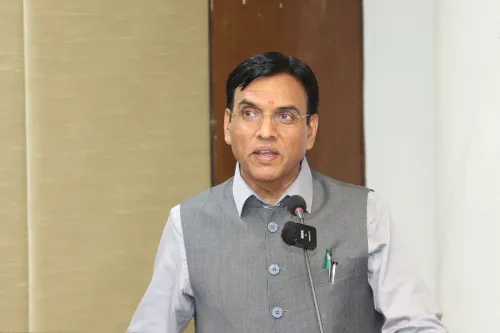
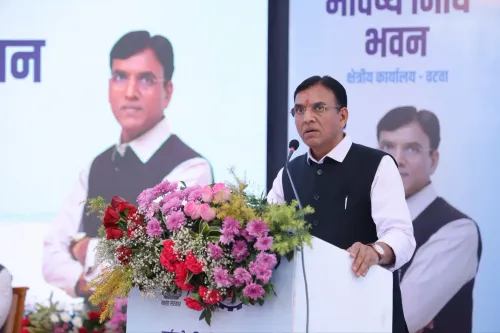
Mandaviya Marks EPFO's 74th Foundation Day
Synopsis
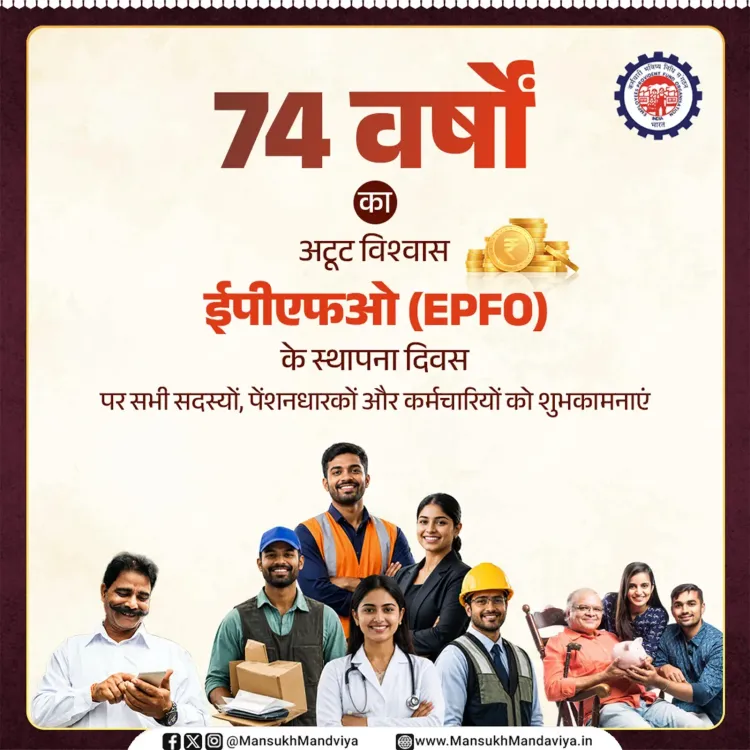
On 1 November 2026, Union Labour Minister Mansukh Mandaviya marked EPFO's 74th Foundation Day with a Hindi couplet honouring the body's mission to protect every formal-sector worker — 74 years after it was founded on the same date in 1952.
Key Takeaways
EPFO turned 74 on 1 November 2026 , marking the anniversary of its establishment on 1 November 1952 .
Union Labour and Sports Minister Mansukh Mandaviya extended greetings via X, posting a Hindi verse on labour and worker protection.
EPFO was created under the Employees' Provident Funds Act to provide provident fund, pension and insurance cover to formal-sector workers.
The organisation is a statutory body under the Ministry of Labour and Employment and is among the world's largest social-security administrators by membership.
Successive governments have expanded EPFO's reach through digital services and inclusion of new industry sectors.
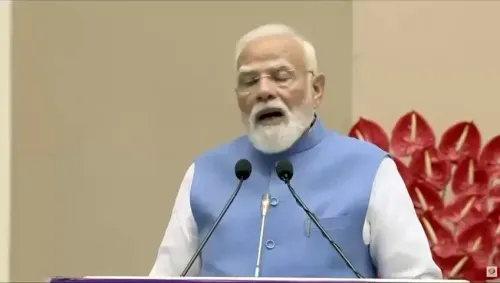
Seventy-four years after it was born to shield India's industrial workers from life's hardest blows, the Employees' Provident Fund Organisation received a warm salute from the minister who oversees it. On Sunday, 1 November 2026, Union Labour and Sports Minister Mansukh Mandaviya took to X to mark EPFO's 74th Foundation Day with a verse that doubled as a mission statement.
Posting in Hindi, Mandaviya offered a couplet: 'Shram se hi rashtra ka gaurav, shram se hi desh mahaan, har kamgaar ki suraksha hai, EPFO ki pehchaan' — translated: 'Labour alone brings the nation its pride, labour alone makes the country great; protecting every worker is the very identity of EPFO.' The minister followed it with warm wishes on the milestone, tagging the occasion #EPFOat74.Born on 1 November 1952: the organisation behind the safety net
EPFO was established on 1 November 1952 under the Employees' Provident Funds Act, created specifically to provide social security to workers in India's rapidly industrialising formal sector. Its three-pronged mandate — provident fund savings, pension, and insurance — remains intact seven decades later, covering tens of millions of salaried employees across the country.
As a statutory body under the Ministry of Labour and Employment, EPFO sits at the intersection of economic policy and everyday welfare. Every rupee it administers represents a worker's deferred security — a cushion against retirement, disability, or sudden death.
Seven decades of expanding the safety net
Over successive governments, EPFO's mandate has grown steadily: new industrial sectors have been brought under its umbrella, digital services have replaced paper-heavy processes, and outreach to previously uncovered workers has deepened. The organisation today stands as one of the world's largest social-security administrators by membership, a scale that mirrors India's own transformation from a primarily agrarian economy into a manufacturing and services powerhouse.
For Mandaviya — whose dual portfolio of Labour and Sports places him at the centre of both worker welfare and national pride — the anniversary carries institutional weight. His verse was not merely ceremonial; it framed EPFO's core purpose in the language of national dignity, linking the sweat of every factory floor and office cubicle to the country's larger story.
Seventy-four years on, the organisation's founding promise — that no formal-sector worker should face old age or adversity without a safety net — is still the yardstick by which it will be judged. The challenge ahead is bringing that promise closer to the millions who still work outside its reach.
Point of View
Framed as a verse rather than a policy statement, reflects a deliberate communication strategy by the BJP-led government: anchoring technical welfare infrastructure in the emotionally resonant language of national pride and 'shram' (labour). It signals that EPFO is being positioned not merely as a compliance body but as a symbol of the state's social contract with the organised workforce. With EPFO's coverage expansion and digital overhaul ongoing, the 74th anniversary provides a political moment to reinforce the government's worker-welfare narrative ahead of any fresh reform announcements. The couplet format also makes the message broadly shareable, suggesting grassroots outreach intent beyond a routine institutional greeting.
NationPress
1 Nov 2026
Frequently Asked Questions
When was EPFO founded?
EPFO was founded on 1 November 1952 under the Employees' Provident Funds Act to provide social security to formal-sector industrial workers in India.
What does EPFO do for workers?
EPFO manages three social-security schemes for formal-sector employees: a provident fund for retirement savings, a pension scheme, and a deposit-linked insurance scheme that provides cover in the event of a member's death.
Who oversees EPFO in the Indian government?
EPFO functions as a statutory body under the Ministry of Labour and Employment , which is currently headed by Union Minister Mansukh Mandaviya .
What did Mansukh Mandaviya say on EPFO's 74th Foundation Day?
Mandaviya posted a Hindi couplet on X on 1 November 2026 stating that labour is the source of national pride and that protecting every worker is EPFO's identity, and extended greetings on the 74th anniversary.
How has EPFO changed over 74 years?
Over seven decades, EPFO has expanded its membership base to cover new industrial sectors, launched digital services to simplify claim processes, and grown into one of the world's largest social-security administrators by membership.