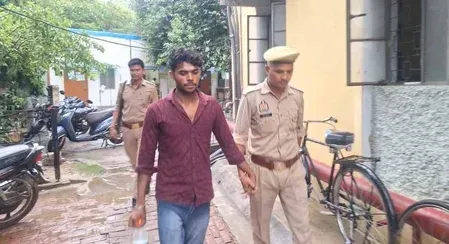
Mathura POCSO court awards life term to man for assaulting minor, fined ₹1.43 lakh

Synopsis
A Mathura POCSO court sentenced Shyam Bihari to life imprisonment for rape, aggravated penetrative sexual assault, and storing child sexual abuse material — with the CBI completing investigation, chargesheet, and trial in under 17 months. The case is notable for its swift timeline and the dual prosecution of physical abuse and digital CSAM under three separate laws.
Key Takeaways
Shyam Bihari was sentenced to life imprisonment by the Special POCSO Court, Mathura on 30 October 2026 .
He was also fined ₹1.43 lakh for offences under the POCSO Act, 2012 , the IPC , and the IT Act, 2000 .
Charges included rape, aggravated penetrative sexual assault, using a child for pornographic purposes, and storing CSAM .
The CBI registered the case on 17 June 2025 and filed a chargesheet on 14 August 2025 — within two months.
Trial charges were framed on 16 October 2025 ; the full trial was completed in under three months.
A special court under the Protection of Children from Sexual Offences (POCSO) Act in Mathura, Uttar Pradesh, has sentenced accused Shyam Bihari to life imprisonment for sexually assaulting a minor girl, additionally imposing a fine of ₹1.43 lakh, the Central Bureau of Investigation (CBI) confirmed on 31 October 2026. The verdict, delivered on 30 October, marks the culmination of an investigation that spanned barely over a year and involved digital evidence, forensic experts, and coordinated child-protection support.
Offences and Conviction
The Special Judge, POCSO Act, Mathura, convicted Shyam Bihari on multiple counts under the POCSO Act, 2012, the Indian Penal Code (IPC), and the Information Technology (IT) Act, 2000. The offences included rape, aggravated penetrative sexual assault, using a child for pornographic purposes, and the storage of Child Sexual Abuse Material (CSAM). The court found him guilty on all charges before awarding the maximum sentence.
How the Case Unfolded
The CBI registered the case on 17 June 2025, following allegations that Shyam Bihari had collected, transmitted, and published Child Sexual Abuse and Exploitative Material (CSAEM) in electronic form. During the investigation, it emerged that the accused had also committed aggravated penetrative sexual assault against a minor. The agency located the victim and, according to officials, conducted the probe with close attention to her safety, dignity, and emotional well-being. Appropriate counselling support was provided, and close coordination was maintained with forensic experts, medical professionals specialising in child sexual abuse cases, and child-protection authorities.
Evidence Handling and Chargesheet
Investigators took particular care in the collection, handling, and preservation of digital evidence to ensure all material was properly secured and admissible. A chargesheet was filed on 14 August 2025, within two months of registration — an unusually swift turnaround. The trial court framed charges on 16 October 2025, and the full trial was completed in under three months, reflecting the priority accorded to POCSO cases under judicial guidelines.
Sentence and CBI's Stance
Following the verdict, the court awarded Shyam Bihari life imprisonment and imposed a fine of ₹1.43 lakh for the cumulative offences under the POCSO Act, IPC, and IT Act. The CBI reiterated its commitment to investigating and prosecuting cases involving child sexual abuse and exploitation, stating that such offences are accorded the highest investigative priority, with due regard to the safety, rights, and dignity of children. This case underscores a broader push by central agencies to treat the digital distribution of CSAM as seriously as physical abuse — a standard that courts have increasingly upheld in recent POCSO judgments.
Point of View
A pace that remains rare in India's overburdened POCSO dockets. Equally notable is the three-law prosecution: layering POCSO, IPC, and IT Act charges signals a deliberate judicial strategy to close the loophole where offenders have historically escaped heavier punishment by being charged under only one statute. The handling of digital evidence with forensic rigour also sets a procedural benchmark, as CSAM cases are frequently derailed by chain-of-custody failures. Whether this swift conviction pattern can be replicated at scale — particularly in state-level POCSO courts without CBI involvement — remains the critical unanswered question.
NationPress
31 Oct 2026
Frequently Asked Questions
What sentence did the Mathura POCSO court give Shyam Bihari?
The Special POCSO Court in Mathura sentenced Shyam Bihari to life imprisonment on 30 October 2026, along with a fine of ₹1.43 lakh. He was convicted of multiple offences including rape, aggravated penetrative sexual assault, using a child for pornographic purposes, and storing child sexual abuse material.
Why did the CBI investigate this case?
The CBI registered the case on 17 June 2025 following allegations that the accused had collected, transmitted, and published Child Sexual Abuse and Exploitative Material (CSAEM) in electronic form. During the investigation, physical assault against a minor was also uncovered, making it a central agency matter given the digital cross-jurisdictional nature of the offences.
How quickly was the case resolved?
The case moved exceptionally fast: the CBI registered it in June 2025, filed a chargesheet in August 2025, and the trial court framed charges in October 2025. The verdict was delivered in October 2026 — roughly 17 months from registration to sentencing.
Under which laws was Shyam Bihari convicted?
He was convicted under three separate laws: the POCSO Act, 2012 (aggravated penetrative sexual assault, using a child for pornographic purposes, possessing CSAM), the Indian Penal Code (rape), and the Information Technology Act, 2000 (transmitting and storing CSAEM in electronic form).
What support was given to the victim during the investigation?
According to the CBI, the victim was provided appropriate counselling support throughout the investigation. The agency also coordinated with forensic experts, medical professionals specialising in child sexual abuse, and child-protection authorities, and took special care in handling digital evidence to protect her dignity and emotional well-being.