Has the Minimum Temperature Improved? Kashmiris Hope for Abundant Snowfall
Click to start listening
Synopsis
Srinagar reports a slight rise in minimum temperatures, yet remains below freezing. Locals pray for snowfall as the crucial 'Chillai Kalan' period approaches its end. The MeT Department forecasts mixed weather ahead, raising concerns about water resources in the region.
Key Takeaways
- Minimum temperatures have improved slightly but remain below freezing in Kashmir.
- The region is experiencing a crucial dry spell concerning water resources.
- The 'Chillai Kalan' period is nearing its end, with locals hoping for significant snowfall.
Srinagar, Jan 12 (NationPress) The minimum temperature across Kashmir showed improvement on Monday, although it remained below freezing levels. In Srinagar, the minimum temperature was recorded at -2.4 degrees Celsius, while both Gulmarg and Pahalgam logged -3.4 degrees.
In Jammu, temperatures were slightly warmer with readings of 3.4 degrees Celsius in Jammu city, 5 in Katra, 4.3 in Batote, 5.1 in Banihal, and -1.2 degrees in Bhaderwah.
The Meteorological (MeT) Department has predicted that the weather will be partly cloudy from January 11 to January 15.
“Cloudy weather with light rain or snow is expected in isolated to scattered higher elevations of the Kashmir division between January 16 and 17. From January 18 to 19, we anticipate partly to generally cloudy conditions. On January 20, there will be generally cloudy weather with light rain or snow in isolated areas. Between January 21 and 23, we expect partly to generally cloudy weather with light rain or snow in scattered locations. Finally, from January 24 to January 25, partly cloudy conditions are anticipated in J&K,” the MeT Department stated.
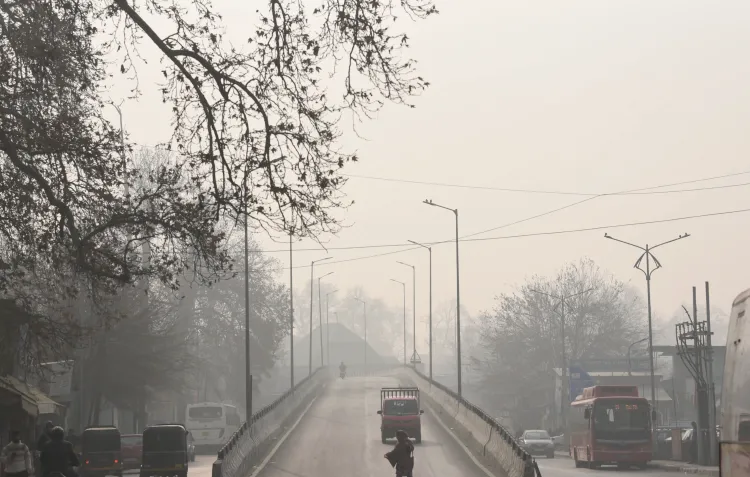
The department also issued an advisory indicating a gradual increase in minimum temperatures across many regions starting from Monday. “Moderate fog is likely over the plains of Jammu division, with dense fog at isolated spots continuing over the next five days,” the MeT advisory noted.
A concerning situation looms over Jammu and Kashmir, particularly in the Valley, as the MeT Department has issued warnings of predominantly cold, dry weather up until January 25.
This persistent dry spell has triggered alarm throughout the union territory, as all water bodies essential for agriculture, horticulture, and drinking water rely heavily on substantial snowfall during the ongoing 40-day period of harsh winter, locally known as ‘Chillai Kalan’.
As this crucial 40-day period is now more than halfway through, the plains of the Valley have yet to experience the first snowfall of the season. Chillai Kalan concludes on January 30, and snowfall in February and March is typically minimal, melting quickly and failing to replenish the perennial water reservoirs in the mountains.
Point of View
We view the current weather situation in Jammu and Kashmir critically. The region's dependence on winter snowfall for water resources is alarming, especially with the ongoing dry spell during the vital 'Chillai Kalan.' Our commitment remains to inform the public accurately through this challenging period.
NationPress
13/01/2026
Frequently Asked Questions
What is the current minimum temperature in Kashmir?
As of January 12, the minimum temperature in Srinagar is recorded at -2.4 degrees Celsius, with Gulmarg and Pahalgam at -3.4 degrees.
What does 'Chillai Kalan' signify?
'Chillai Kalan' is a critical 40-day period in winter, crucial for snowfall in the Kashmir region, essential for replenishing water resources.
What weather conditions are expected in the coming days?
The MeT Department predicts partly cloudy weather with light rain or snow expected between January 16 and January 25.