TMC MP Mahua Moitra warns IPS officer over voter papers
Synopsis
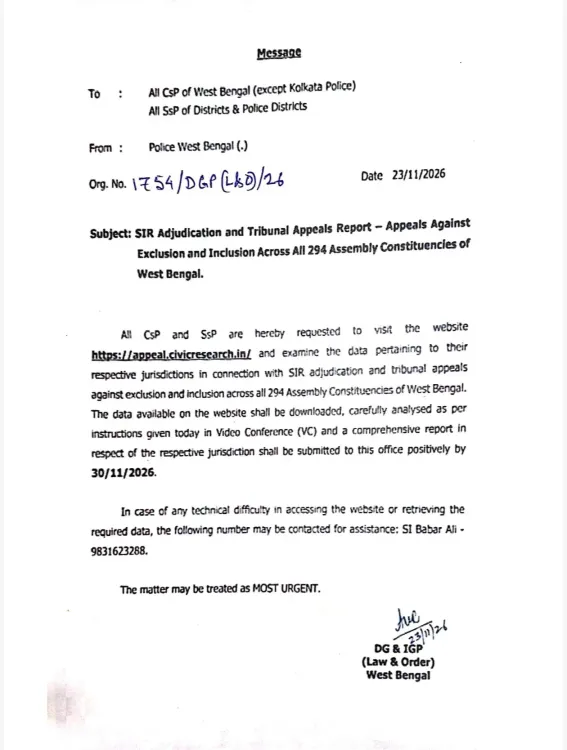
TMC MP Mahua Moitra on 27 November 2026 warned IPS officer Ajay Ranade to stop issuing illegal orders, saying West Bengal Police cannot seek documents from voters awaiting appeal. She said such cases lie solely with the Election Commission, invoked Nuremberg, and told the officer he would pay.
Key Takeaways
TMC MP Mahua Moitra on 27 November 2026 warned Ajay Ranade , an IPS 1995 officer, to stop issuing what she called illegal orders.
She said West Bengal Police has no authority to ask documents from voters awaiting appeal.
Moitra argued such appeals fall under the sole jurisdiction of the Election Commission of India and said the Commission had no idea about the police action.
She invoked Nuremberg and told the officer, 'You will pay.' The Representation of the People Act, 1950 vests exclusive control of electoral rolls with the Election Commission, not state police.
TMC MP Mahua Moitra has put a serving IPS officer on notice over the voter list. On 27 November 2026, the Krishnanagar parliamentarian named Ajay Ranade, an IPS 1995 officer, and told West Bengal Police to stop demanding documents from voters whose appeals are still pending. She said the force has no such power. The Election Commission, she added, had no idea this was even happening.
Her post was blunt. 'Dear Ajay Ranade IPS 1995. Remember Nuremberg. Stop issuing illegal orders,' she wrote, tagging the state police and the Commission's voter-education handle. West Bengal Police, she said, 'has no authority to ask documents from voters awaiting appeal which is sole sole jurisdiction' of the Election Commission of India. She closed with a warning: 'You will pay.'
Moitra names Ajay Ranade of the 1995 IPS batch
The charge is personal and operational. Moitra addressed Ranade by name and batch, not a faceless department. She framed any document hunt aimed at voters still in the appeal queue as an illegal order, and she told the officer to stop issuing them.
She published no copy of an order in the post. What she did publish was a jurisdictional claim: police cannot sit in the Commission's chair while a voter waits for an appeal to be heard.
Why the Representation of the People Act matters here
The law is not vague. The Representation of the People Act, 1950, and later amendments, give the Election Commission of India exclusive control over preparing and revising electoral rolls. Eligibility, claims, objections and appeals run through the Commission and its designated officers.
State police can be, and often are, deployed to keep order at polling stations and during revisions. That is a law-and-order job. It is not a licence to collect papers from citizens whose cases the Commission already has on file. That gap is what Moitra put on the public record.
West Bengal's long police-roll friction
Arguments over who may touch the voter list are not new in West Bengal. State agencies and the Commission have repeatedly collided during roll revisions, with opposition parties frequently alleging overreach. This warning is different in one respect: it comes from a TMC Lok Sabha MP, aimed at the state police of a TMC-governed state.
Voters stuck in appeal are the ones who feel the knock on the door. A Commission directive on the limits of police power, or a state-government clarification, would turn a social-media rebuke into a formal boundary. Until then, Moitra has drawn that boundary herself and attached a Nuremberg warning to it.
When a ruling-party MP tells a state IPS officer to remember Nuremberg over a voter's papers, the fight is no longer only about one order. It is about who owns the roll.
Point of View
Not only in court. The Representation of the People Act leaves little room for a state force to process voter appeals. How the Commission and the state government answer will signal whether roll revision stays a constitutional process or becomes another law-and-order theatre.
NationPress
27 Nov 2026
Frequently Asked Questions
What did Mahua Moitra say about West Bengal Police and voters?
TMC MP Mahua Moitra said West Bengal Police has no authority to ask documents from voters awaiting appeal. She argued those appeals sit solely with the Election Commission of India and warned IPS officer Ajay Ranade to stop issuing what she called illegal orders.
Who is Ajay Ranade IPS?
Ajay Ranade is an IPS officer of the 1995 batch, named by Mahua Moitra in connection with West Bengal Police. The post does not spell out his current posting beyond that police linkage.
Can state police demand papers from voters whose ECI appeals are pending?
Under the Representation of the People Act, 1950, preparation and revision of electoral rolls, including claims and appeals, rest with the Election Commission of India. State police handle law and order and do not hold statutory power over voter-list appeals.
What did Mahua Moitra mean by Remember Nuremberg?
She wrote 'Remember Nuremberg' while telling an IPS officer to stop issuing illegal orders. The Nuremberg trials established that carrying out unlawful orders is not a legal defence.
What could happen next after Mahua Moitra's warning?
Watch for any Election Commission clarification on police powers during pending voter appeals and any West Bengal government response. The post itself does not confirm the text of any specific police order.