CM Office Hails Monyul FC as Arunachal Women's League 2026 Champions
Synopsis
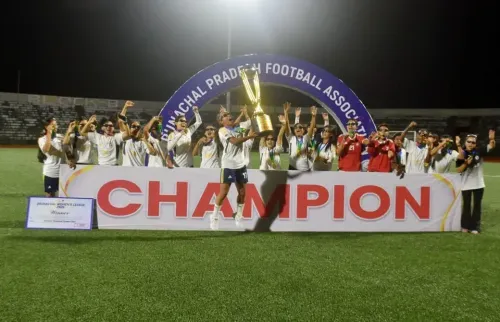
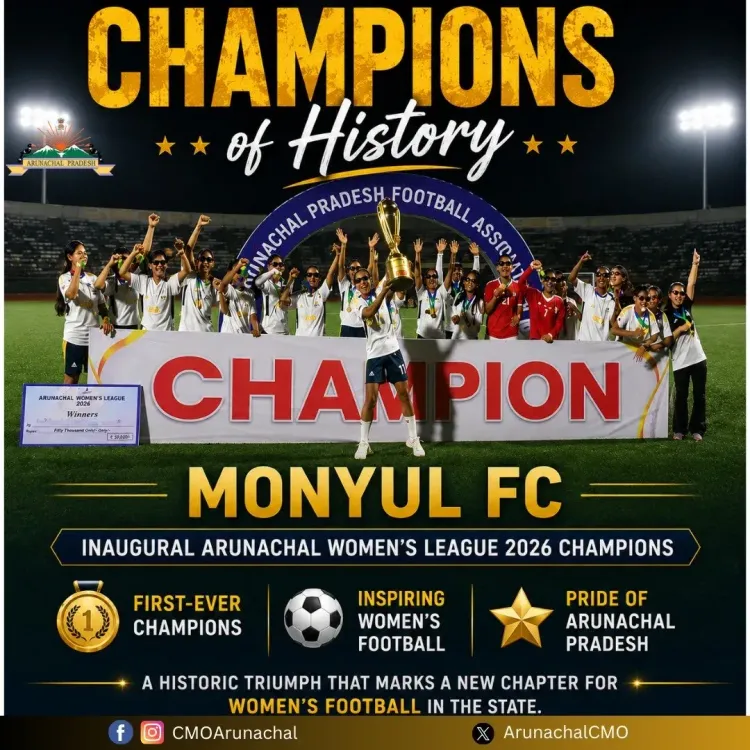
Monyul FC has been crowned the inaugural champions of the Arunachal Women's League 2026, with the Chief Minister's Office calling it a historic milestone for women's football in the northeastern state. The league marks Arunachal Pradesh's entry into structured women's club football, aligning with national efforts to expand the sport beyond traditional northeastern strongholds.
Key Takeaways
Monyul FC won the Arunachal Women's League 2026 , becoming the inaugural champions of the state's first women's football league.
The Chief Minister's Office of Arunachal Pradesh officially congratulated the club on 24 July 2026 , calling the win a 'historic triumph.' The league represents Arunachal Pradesh's first structured women's club football competition, a significant first for the state.
The initiative aligns with the national Khelo India scheme and the AIFF Indian Women's League framework aimed at expanding women's football across India.
The development could open player pathways from Arunachal Pradesh into national-level competitions and training programmes.
The Chief Minister's Office of Arunachal Pradesh on Friday, 24 July 2026, congratulated Monyul FC on winning the Arunachal Women's League 2026, describing the club as the inaugural champions of the state's first-ever women's football league. The official post called the victory a 'historic triumph' and a 'proud milestone for women's football in Arunachal Pradesh.'
Context
The Arunachal Women's League 2026 is the first structured women's club football competition to be held in the state, making Monyul FC's title the first of its kind in Arunachal Pradesh's sporting history. The Chief Minister's Office's public acknowledgement signals official recognition of the league as a significant step forward for women's sport in the state. Such recognition from the highest executive office in the state lends institutional weight to what is otherwise a grassroots sporting achievement.
Policy Backdrop
The emergence of a state-level women's football league in Arunachal Pradesh fits within a national pattern set in motion when the All India Football Federation (AIFF) launched the Indian Women's League in 2016-17 to build a club ecosystem for female players across the country. The Khelo India scheme, introduced in 2017 by the Ministry of Youth Affairs and Sports, has since channelled funds toward grassroots football and women's participation in states that historically lacked the infrastructure to sustain competitive leagues. Arunachal Pradesh, a northeastern state bordering China and Bhutan, has seen increasing state investment in youth and women's sports as part of this broader national push.
Stakeholders and Impact
The primary beneficiaries of the Arunachal Women's League are the state's women footballers, who now have a formal competitive structure within their home state rather than having to seek opportunities exclusively in traditional football strongholds such as Manipur and Mizoram. For Monyul FC, the championship title carries historic significance as the club's name will permanently be associated with the league's first edition. Youth players and sports clubs across Arunachal Pradesh stand to benefit if the league creates a visible talent pipeline that attracts further state support and private sponsorship.
What's Next
Attention will now turn to whether Arunachal Pradesh sustains the league across subsequent seasons and whether top performers from the inaugural edition earn pathways into the AIFF Indian Women's League or national training camps. State budget allocations for women's sports infrastructure in the next fiscal year will be a key indicator of the government's long-term commitment to the competition. A consistent league structure, if maintained, could position Arunachal Pradesh as a meaningful contributor to India's national women's football talent pool in the years ahead.
Point of View
Reducing the dependency on Manipur and Mizoram as the sole nurseries of northeastern women's football. If the state follows through with sustained funding and league continuity, this moment could mark the beginning of a genuine talent pipeline rather than a one-off ceremonial gesture. The real test will be whether the league returns for a second season with expanded participation and visible state budget support.
NationPress
22 Oct 2026
Frequently Asked Questions
Who won the Arunachal Women's League 2026?
Monyul FC won the Arunachal Women's League 2026 , becoming the inaugural champions of the competition, as confirmed by the Chief Minister's Office of Arunachal Pradesh on 24 July 2026.
What is the Arunachal Women's League?
The Arunachal Women's League is the first structured women's club football league held in Arunachal Pradesh , marking the state's entry into organised women's football competition.
Is the Arunachal Women's League connected to the AIFF?
The league aligns with the All India Football Federation's broader push to expand women's club football across Indian states, though the specific administrative relationship between the state league and the AIFF has not been detailed in official communications.
What is the Khelo India scheme and how does it relate to women's football?
The Khelo India scheme, launched in 2017 by the Ministry of Youth Affairs and Sports , funds grassroots sports including women's football across Indian states, and has been a key enabler of expanding women's competitions in northeastern states like Arunachal Pradesh .
What does this mean for women's football in northeast India?
The launch of the Arunachal Women's League broadens the competitive landscape for women's football in northeast India beyond traditional strongholds like Manipur and Mizoram , potentially creating new pathways for players from Arunachal Pradesh into national competitions.