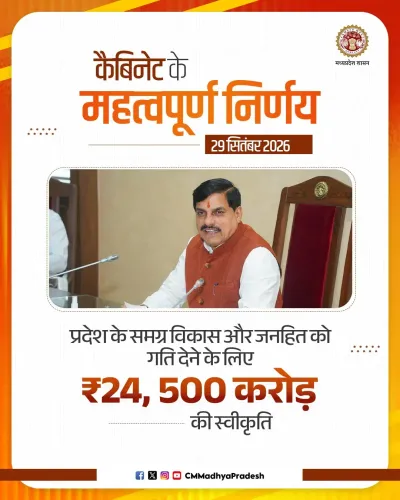
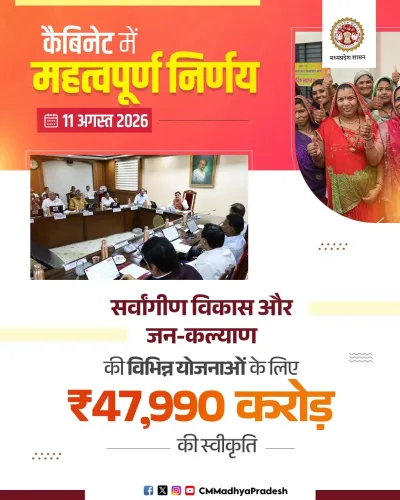
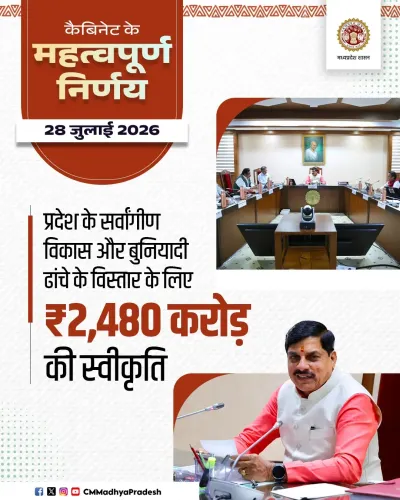
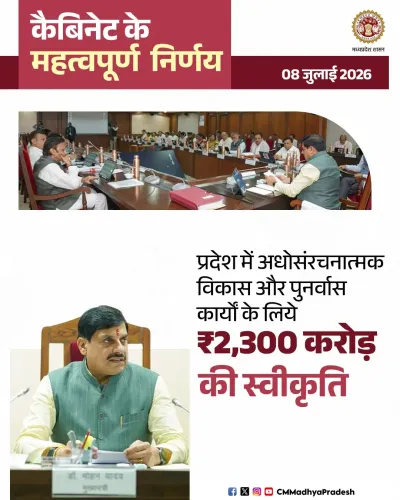
MP Cabinet clears ₹10,800 cr development proposals under CM Mohan Yadav
Synopsis
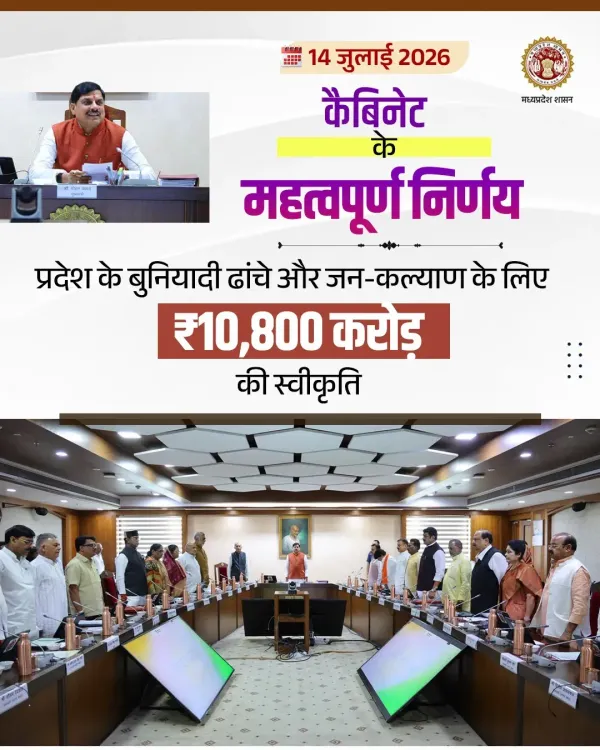
The Madhya Pradesh cabinet, chaired by Chief Minister Dr. Mohan Yadav, approved development proposals worth ₹10,800 crore on 14 July 2026 to strengthen the state's infrastructure and public welfare under the 'Viksit Madhya Pradesh' vision.
Key Takeaways
The Madhya Pradesh cabinet approved development proposals totalling ₹10,800 crore in a single meeting on 14 July 2026 .
Mohan Yadav chaired the cabinet meeting where the proposals were cleared.
The approvals target both physical infrastructure and public welfare under the 'Viksit Madhya Pradesh' vision.
The outlay aligns with national frameworks such as PM Gati Shakti , which promotes integrated infrastructure planning.
Key stakeholders include Madhya Pradesh residents and infrastructure contractors across the state.
Rollout timelines, tendering processes, and on-ground progress will determine the real-world impact of the approvals.
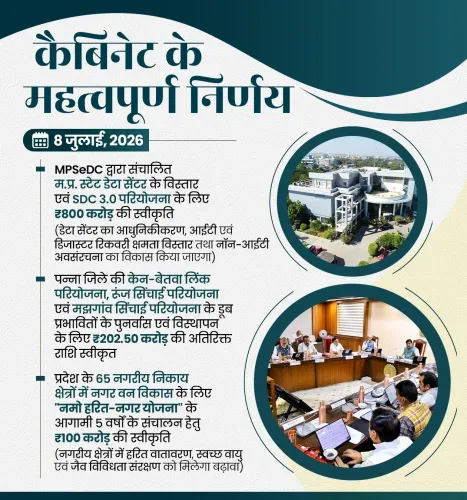
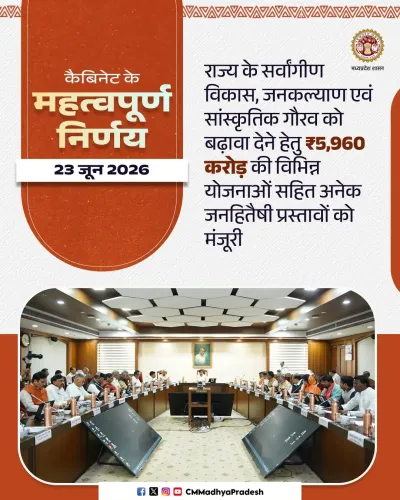
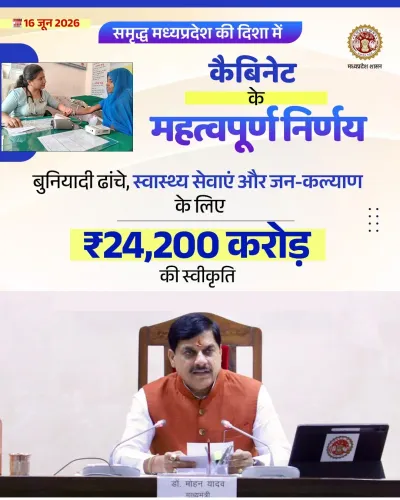
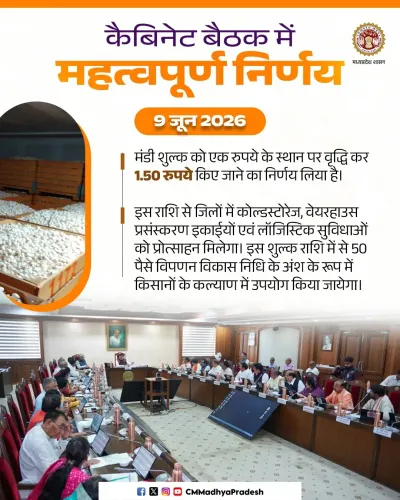
The Chief Minister's Office of Madhya Pradesh announced on Tuesday, 14 July 2026 that the state cabinet, chaired by Chief Minister Dr. Mohan Yadav, approved development proposals worth ₹10,800 crore aimed at strengthening the state's infrastructure and public welfare.
Context
The cabinet meeting, held under Dr. Mohan Yadav's chairmanship, cleared multiple development proposals in a single sitting. The official post described the approvals as giving 'new momentum to the resolve of a developed Madhya Pradesh' — Viksit Madhya Pradesh ke sankalp ko nayi gati — signalling the government's intent to accelerate its development agenda. The combined outlay of ₹10,800 crore spans both physical infrastructure and public welfare schemes.
Policy Backdrop
Madhya Pradesh has consistently pursued large capital outlays across successive administrations through the 2020s, covering roads, irrigation networks, and urban facilities. The current dispensation, led by Dr. Mohan Yadav since December 2023, has framed its development strategy around the 'Viksit Madhya Pradesh' vision — mirroring the national 'Viksit Bharat' goal of a developed India by 2047. State cabinets across India routinely use such consolidated approvals to push capital expenditure in alignment with frameworks such as PM Gati Shakti, which promotes integrated infrastructure planning.
The dual focus on buniyadi dhanche (basic infrastructure) and jan-kalyan (public welfare) reflects a standard twin-track approach that several state governments have adopted to demonstrate both physical development and social delivery within a single policy cycle.
Stakeholders and Impact
The primary beneficiaries of these approvals are the residents of Madhya Pradesh, who stand to gain from improved connectivity, utilities, and welfare services once the sanctioned projects are executed. Infrastructure contractors and allied industries are also among the direct stakeholders, as large state-level capital approvals typically generate procurement and employment activity across districts.
For the Madhya Pradesh government, the announcement reinforces its public commitment to development spending at scale. A cabinet-level clearance of ₹10,800 crore in a single meeting is a significant signal of fiscal intent, though the actual impact will depend on the pace of tendering, contracting, and on-ground execution in the months ahead.
What's Next
Observers and stakeholders will watch for the rollout of individual project tenders, departmental allocations, and physical progress reports in forthcoming state budget reviews. The speed at which these approvals translate into ground-level activity — construction, procurement, and service delivery — will determine whether the ₹10,800 crore commitment delivers measurable outcomes before the next electoral cycle. Progress updates are expected to feature prominently in the state government's public communications in the coming months.
Point of View
800 crore cabinet clearance is a deliberate show of fiscal muscle by the Mohan Yadav government, coming roughly two and a half years into its tenure — a period when state administrations typically seek to demonstrate delivery ahead of electoral scrutiny. The framing around 'Viksit Madhya Pradesh' consciously mirrors the national 'Viksit Bharat' narrative, tying state ambition to the ruling party's broader ideological brand. Bundling infrastructure and welfare in a single announcement is a well-worn political communication strategy that allows governments to appeal simultaneously to growth-oriented and social-equity audiences. The real test, as with most large cabinet approvals in Indian states, will be the gap between sanction and execution.
NationPress
13 Oct 2026
Frequently Asked Questions
What did the Madhya Pradesh cabinet approve on 14 July 2026?
The Madhya Pradesh cabinet approved various development proposals worth ₹10,800 crore aimed at strengthening the state's infrastructure and public welfare.
Who chaired the Madhya Pradesh cabinet meeting?
Chief Minister Dr. Mohan Yadav chaired the cabinet meeting in which the ₹10,800 crore development proposals were approved.
What is 'Viksit Madhya Pradesh'?
'Viksit Madhya Pradesh' is the Madhya Pradesh government's development vision, framed around building a developed state in alignment with the national 'Viksit Bharat' goal of a developed India by 2047.
Which sectors will benefit from the ₹10,800 crore MP cabinet approval?
The approvals cover both physical infrastructure — such as roads, irrigation, and urban facilities — and public welfare schemes, though specific project breakdowns have not yet been officially detailed.
When did Dr. Mohan Yadav become Chief Minister of Madhya Pradesh?
Dr. Mohan Yadav became Chief Minister of Madhya Pradesh in December 2023.