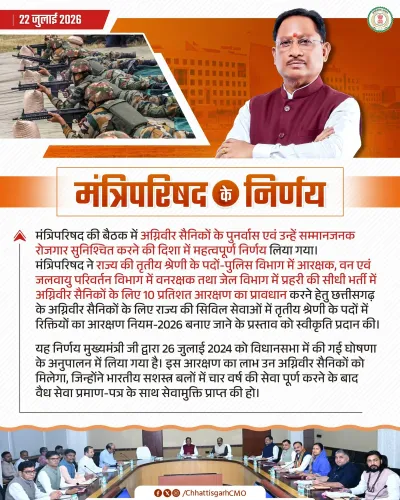
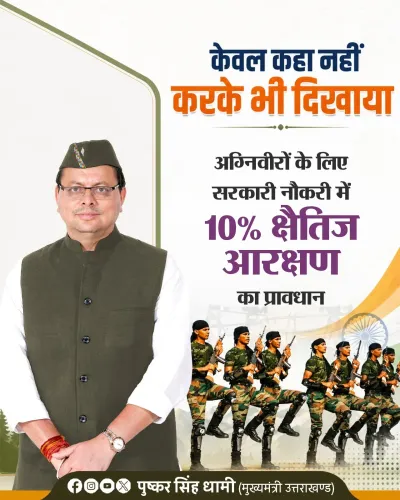
MP Cabinet clears 20% Agniveer reservation in uniformed services
Synopsis
Madhya Pradesh has formalised one of the broadest Agniveer rehabilitation packages in the country — a 20 per cent horizontal reservation spanning police, special armed force, jail, forest, and excise cadres. The Cabinet meeting also cleared a ₹358.22 crore Ujjain river-diversion project tied to the 2028 Simhastha Mahaparv, making it a session with far-reaching implications for both ex-military youth and religious infrastructure.
Key Takeaways
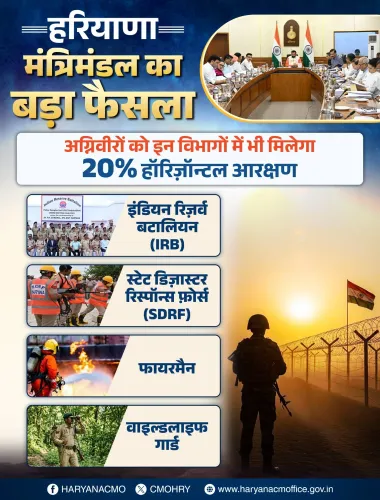
The MP Cabinet on 29 September 2026 approved 20% horizontal reservation for Agniveers across five uniformed cadres.
Departments covered: Home (Constable GD & Special Armed Force), Jail, Forest , and Commercial Tax (Excise Constable) . ₹358.22 crore cleared for the Kanh Diversion Closed Duct Project in Ujjain (2026–27 to 2030–31), ahead of Simhastha Mahaparv 2028 .
Re 1/kg food grain extended to hostels and ashrams of Denotified, Nomadic and Semi-Nomadic Tribe welfare centres. ₹2.41 crore approved for Directorate of Handlooms , creating 12 new posts in Mauganj, Chhindwara, Maihar, and Tikamgarh.
Mineral transport fees fixed at ₹81/tonne (first-category) and ₹52/tonne (second-category).
The Madhya Pradesh Council of Ministers on 29 September 2026 approved a 20 per cent horizontal reservation for Agniveers across the state's uniformed services, marking one of the most comprehensive post-Agnipath rehabilitation measures adopted by any state government. Chief Minister Mohan Yadav framed the decision as central to his administration's youth empowerment agenda.
Reservation breakdown across departments
The policy introduces a structured horizontal reservation across five recruitment categories. For Constable (General Duty) posts under the Home Department, the breakdown is 10 per cent for Home Guards, 5 per cent for veterans, and 20 per cent for Agniveers.
The Special Armed Force (Home Department) follows an identical split — 10 per cent Home Guards, 5 per cent ex-servicemen, and 20 per cent Agniveers. For Jail Guard posts under the Jail Department and Forest Guard posts under the Forest Department, Home Guards receive 15 per cent, ex-servicemen 5 per cent, and Agniveers 20 per cent. Excise Constable posts under the Commercial Tax Department carry the same 10–5–20 split as Home Department constables.
Why this matters for Agniveers
The Agnipath scheme, launched by the Centre in 2022, allows short-service military recruitment for four years, after which only a fraction of personnel are retained. The bulk — known as Agniveers — re-enter civilian life, prompting concerns about post-service employment security. Several states have since announced preferential hiring, but Madhya Pradesh's Cabinet-level approval across five distinct uniformed cadres signals a more systematic approach. Notably, this is the first time the state has formalised Agniveer quotas in the Forest and Jail departments alongside the more commonly targeted police cadre.
Other key Cabinet decisions
The Cabinet approved the distribution of food grains at Re 1 per kilogram to residents of hostels, ashrams, and community welfare centres run by the Department for the Welfare of Denotified, Nomadic and Semi-Nomadic Tribes — mirroring an existing arrangement for Scheduled Caste and Scheduled Tribe institutions.
An allocation of ₹2.41 crore was cleared for the Directorate of Handlooms, including 12 new posts for district handloom offices in Mauganj, Chhindwara, Maihar, and Tikamgarh.
A major outlay of ₹358.22 crore was approved for the continuation of the Kanh Diversion Closed Duct Project in Ujjain from 2026–27 to 2030–31. The project diverts polluted water from the Kanh River through a 30.15-kilometre underground tunnel and covered canal to the Gambhir River, preventing contamination of the holy Shipra River. The work is being fast-tracked ahead of the Simhastha Mahaparv scheduled in Ujjain in 2028.
The Council also fixed mineral transport fees at ₹81 per tonne for first-category minerals — including limestone, dolomite, manganese ore, and iron ore — and ₹52 per tonne for second-category minerals such as flagstone, granite, marble, and soil or stone.
Finally, the Cabinet approved a payment of ₹691.01 crore — exceeding the Government of India's maximum expenditure limit — towards outstanding liabilities for court building construction under a Centrally sponsored scheme, drawing on available state plan funds.
What comes next
Implementation timelines for the Agniveer reservation and departmental recruitment notifications are awaited. Welfare advocates have welcomed the food-grain extension to denotified and nomadic tribe hostels as a long-overdue parity measure, while the Kanh diversion clearance is expected to accelerate civil works in Ujjain ahead of the 2028 religious congregation.
Point of View
Whereas Bhopal has extended the quota into jails, forests, and excise, signalling a deliberate effort to absorb ex-short-service personnel across the security apparatus. That said, horizontal reservation in practice often runs into seniority and roster disputes; without clear recruitment rules and a litigation-proof implementation framework, the announcement could stall in court. The Cabinet session also reveals a government balancing immediate optics — youth empowerment, welfare parity — with longer-horizon infrastructure imperatives like Simhastha 2028, which carries enormous political and religious capital for the ruling dispensation.
NationPress
29 Sept 2026
Frequently Asked Questions
What is the Agniveer reservation approved by the MP Cabinet?
The Madhya Pradesh Cabinet has approved a 20 per cent horizontal reservation for Agniveers in uniformed service recruitment across five categories — Constable (GD) and Special Armed Force under the Home Department, Jail Guards, Forest Guards, and Excise Constables. The decision is intended to provide post-service employment pathways for personnel discharged under the central Agnipath scheme.
Which departments are covered under MP's Agniveer reservation policy?
Five cadres are covered: Home Department (Constable GD and Special Armed Force), Jail Department (Jail Guard), Forest Department (Forest Guard), and Commercial Tax Department (Excise Constable). In each case, Agniveers receive a 20 per cent horizontal reservation, with separate quotas for Home Guards and ex-servicemen.
What is the Kanh Diversion Closed Duct Project approved by the Cabinet?
It is a water infrastructure project in Ujjain designed to prevent polluted water from the Kanh River from entering the sacred Shipra River. The Cabinet cleared ₹358.22 crore for its operation from 2026–27 to 2030–31; the project routes wastewater through a 30.15-kilometre underground tunnel to the Gambhir River and is being prioritised ahead of the Simhastha Mahaparv in 2028.
Who benefits from the Re 1 per kilogram food grain scheme extended by the MP Cabinet?
Residents of hostels, ashrams, and community welfare centres run by the Department for the Welfare of Denotified, Nomadic and Semi-Nomadic Tribes will now receive food grains at Re 1 per kilogram. This brings them on par with Scheduled Caste and Scheduled Tribe hostels and ashrams, which already had access to the same subsidised rate.
Why does the Agnipath scheme raise post-service employment concerns?
The Agnipath scheme recruits personnel for a fixed four-year term, after which only about 25 per cent are retained in the armed forces. The remaining Agniveers re-enter the civilian job market at a relatively young age. Several states have since announced preferential hiring to address this gap; Madhya Pradesh's Cabinet approval formalises one of the broader such packages seen at the state level.