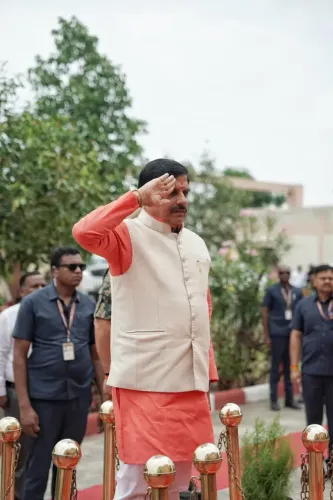
MP CM Mohan Yadav Champions Dense Plantation Drive

Synopsis
Madhya Pradesh Chief Minister Dr. Mohan Yadav has backed intensive tree plantation as a key conservation strategy, saying new techniques can build dense forests on less land in less time — aligning the state with India's 33 percent green-cover goal.
Key Takeaways
Mohan Yadav , Chief Minister of Madhya Pradesh , publicly backed dense afforestation as an effective environmental conservation tool on 1 August 2026 .
He stated that new plantation methods allow more saplings to be grown on less land, accelerating the development of dense forests.
India's national target is to bring 33 percent of its geographical area under forest and tree cover.
The National Mission for a Green India , launched around 2011 , provides the central policy framework for state-level afforestation drives.
State forest departments and local communities are the primary implementing stakeholders for such programmes.
Integration with CAMPA funds could be a key next step for Madhya Pradesh to scale its plantation ambitions.
Dense forests grown on less land, in less time — Madhya Pradesh Chief Minister Dr. Mohan Yadav has put intensive afforestation at the centre of the state's environmental agenda, calling it an effective initiative for conservation.
Posting on Saturday, 1 August 2026, the Chief Minister wrote: 'पर्यावरण संरक्षण के लिए सघन वृक्षारोपण एक प्रभावी पहल है।' ('Dense tree plantation is an effective initiative for environmental protection.') He added that using new methods, more saplings can be planted in less land, enabling the development of dense forests in a shorter span of time.
The Push for More Green in Less Space
The idea is straightforward but significant: traditional plantation drives spread saplings thin across large tracts of land, often with patchy survival rates. The approach Dr. Yadav is advocating — maximising plant density per unit of area — draws on techniques that have been tested across several Indian states to raise green cover faster and more reliably. Madhya Pradesh, a state with a substantial existing forest base, has run periodic afforestation programmes aligned with national targets. India's broader goal of bringing 33 percent of its geographical area under forest and tree cover remains a work in progress. The National Mission for a Green India, launched under the National Action Plan on Climate Change around 2011, set the policy foundation for exactly these kinds of state-level drives. State forest departments and local communities remain the two pillars that make or break such programmes on the ground.Where Madhya Pradesh Fits the National Picture
For a landlocked central Indian state, forest cover is not just an ecological asset — it is a water security buffer, a livelihood base for tribal communities, and a climate resilience tool. Dense plantation techniques, when properly executed, can compress what traditionally takes decades into a fraction of that time, delivering canopy cover that supports biodiversity and checks soil erosion. The post arrives as state governments increasingly look to integrate plantation targets with central funding mechanisms such as CAMPA (Compensatory Afforestation Fund Management and Planning Authority). Whether Madhya Pradesh backs this public push with specific budget allocations or measurable hectare targets in its next assembly session will determine how much weight this initiative carries beyond the statement itself. Words are a start. The saplings still need to go in the ground.Point of View
Particularly as states face growing pressure to meet forest-cover targets. The framing around 'new methods' — even if unspecified — is a deliberate pitch for a technocratic, efficiency-first approach to conservation, a register that resonates with BJP's governance-as-delivery narrative. The real test will be whether this translates into measurable targets and budget lines, or remains an aspirational statement. Linking state drives to CAMPA funds and national climate missions would give the initiative institutional weight beyond a social media post.
NationPress
16 Sept 2026
Frequently Asked Questions
What is dense tree plantation and why is MP CM Mohan Yadav promoting it?
Dense tree plantation involves planting a higher number of saplings per unit of land using optimised spacing and methods, enabling faster canopy formation. CM Dr. Mohan Yadav promoted it as an effective conservation strategy that can build forests in less time on less land.
What is India's forest cover target?
India aims to bring 33 percent of its total geographical area under forest and tree cover, a goal embedded in national climate and environment policy.
What is the National Mission for a Green India?
It is one of eight missions under India's National Action Plan on Climate Change, launched around 2011 , aimed at expanding and improving the quality of forest and tree cover across the country.
What is CAMPA and how does it relate to state afforestation?
CAMPA — the Compensatory Afforestation Fund Management and Planning Authority — manages funds collected from industries that divert forest land for non-forest use. States can draw on these funds to finance plantation and forest restoration programmes.
What is Madhya Pradesh's role in India's forest conservation efforts?
Madhya Pradesh is one of India's most forested states and has run periodic plantation drives aligned with national targets. Its forest cover serves as a critical ecological, water, and livelihood resource for the region.