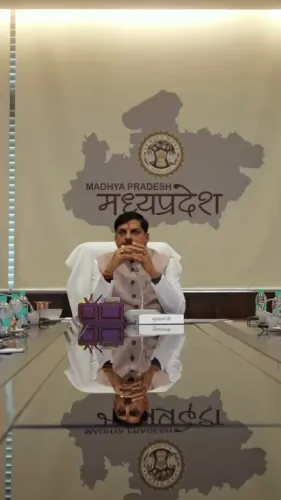
MP CM Mohan Yadav launches Sandipani Vidyalayas, pledges ₹25,000 cr

Synopsis
On Guru Purnima, MP Chief Minister Dr. Mohan Yadav inaugurated Sandipani Vidyalayas across Madhya Pradesh, invoking the legacy of Vedic sage Maharshi Sandipani and announcing approximately ₹25,000 crore for the school network's development — one of the state's most ambitious education infrastructure commitments.
Key Takeaways
Mohan Yadav inaugurated Sandipani Vidyalayas across Madhya Pradesh on Guru Purnima, 29 July 2026 .
Approximately ₹25,000 crore is being spent on the development and strengthening of these schools.
The schools are named after Maharshi Sandipani , the ancient Vedic sage and guru of Lord Krishna, whose ashram is linked to Ujjain, MP .
The initiative aligns with the goals of the National Education Policy 2020 on quality school infrastructure and holistic learning.
Key outcomes to watch include teacher recruitment, school-wise rollout timelines, and measurable learning improvements.
On the auspicious occasion of Guru Purnima, Madhya Pradesh made a statement about where it wants its schools to stand. The Chief Minister's Office of Madhya Pradesh announced on Wednesday, 29 July 2026 that Chief Minister Dr. Mohan Yadav has inaugurated Sandipani Vidyalayas across the state — a network of government schools named after the ancient Vedic sage Maharshi Sandipani — and committed approximately ₹25,000 crore toward their development and strengthening.
Posting on Guru Purnima, CM Yadav framed the launch in the language of civilisational continuity: 'Maharshi Sandipani ki prerna ko sakar karte hue' — 'realising the inspiration of Maharshi Sandipani' — the Sandipani Vidyalayas are being positioned as the state's answer to the enduring ideal of the guru-shishya tradition, grounded now in modern infrastructure and public spending.
Who was Maharshi Sandipani — and why does the name matter?
Maharshi Sandipani is the ancient Vedic sage revered in Hindu tradition as the guru of Lord Krishna, whose ashram is believed to have stood in present-day Ujjain, Madhya Pradesh. Naming a school network after him is a deliberate cultural signal: that quality public education in the state draws its legitimacy not just from policy documents but from a deep civilisational lineage. It is the kind of branding that resonates strongly in a state with a large rural and semi-urban student population.₹25,000 crore and the scale of ambition
The headline figure is striking. ₹25,000 crore earmarked for the development and strengthening of the Sandipani Vidyalaya network signals that this is not a token scheme. Madhya Pradesh has a long track record of successive school modernisation waves — residential schools, model schools, excellence schools — stretching back to the mid-2010s. Each iteration has attempted to raise learning standards in a state where government school enrolment remains high and the gap between urban and rural educational outcomes is pronounced. The current push also aligns with the framework of the National Education Policy 2020, which calls for holistic development, quality infrastructure, and outcome-based learning at the school level. State-level model school expansions are, in that sense, the implementation layer where national policy meets the classroom.What the inauguration means for students and teachers
The direct beneficiaries are government school students and teachers across Madhya Pradesh — a constituency that rarely commands prime-time attention. A statewide lokarpan (public dedication) of schools on Guru Purnima is both symbolically loaded and practically significant: it puts a political timestamp on a delivery promise. The question that will define the scheme's legacy is not the inauguration but what follows — teacher recruitment, learning outcome metrics, and whether the infrastructure investment translates into measurable gains in the classroom. Guru Purnima gave CM Yadav the perfect stage. Whether the Sandipani Vidyalayas deliver on that stage is the story that will be written in the years ahead.Point of View
CM Yadav frames a public expenditure programme as a civilisational act — a move that speaks directly to the BJP's core electoral vocabulary in Madhya Pradesh. The ₹25,000 crore figure, if substantiated through budget allocations, would represent a significant commitment in a state where government school outcomes have historically lagged urban benchmarks. The real test for this administration will come not on inauguration day but when annual education reports begin tracking whether the infrastructure investment has moved the needle on learning outcomes — the metric that NEP 2020 ultimately demands.
NationPress
29 Jul 2026
Frequently Asked Questions
What are Sandipani Vidyalayas in Madhya Pradesh?
Sandipani Vidyalayas are a network of government-run schools in Madhya Pradesh named after the ancient Vedic sage Maharshi Sandipani, positioned by the state government as vehicles for quality public education blending cultural heritage with modern infrastructure.
How much money is Madhya Pradesh spending on Sandipani Vidyalayas?
Chief Minister Dr. Mohan Yadav announced that approximately ₹25,000 crore is being spent on the development and strengthening of Sandipani Vidyalayas across the state.
Why were Sandipani Vidyalayas inaugurated on Guru Purnima?
Guru Purnima is a festival dedicated to honouring teachers and the guru-shishya tradition in Indian culture. The state government chose the occasion to symbolically connect the school launch to the legacy of Maharshi Sandipani, the guru of Lord Krishna.
Who is Maharshi Sandipani and what is his connection to Madhya Pradesh?
Maharshi Sandipani is an ancient Vedic sage revered as the guru of Lord Krishna. His ashram is traditionally believed to have been located in Ujjain, Madhya Pradesh, making him a culturally significant figure for the state.
How does the Sandipani Vidyalaya scheme relate to NEP 2020?
The scheme aligns with the National Education Policy 2020's goals of improving quality school infrastructure, holistic student development, and raising learning standards — objectives that state-level model school networks are designed to implement on the ground.