MP CM Office: 99% Application Resolution Marks Governance Milestone
Synopsis
The Chief Minister's Office of Madhya Pradesh declared on 26 July 2026 that 99 per cent of public applications have been resolved, framing the milestone as the fulfilment of the state's good-governance pledge and building on the Lok Seva Guarantee Adhiniyam enacted in 2010.
Key Takeaways
The Chief Minister's Office of Madhya Pradesh announced on 26 July 2026 that 99 per cent of public applications have been successfully resolved.
The claim is framed as the realisation of the state's sushasan ka sankalp — resolve for good governance.
Madhya Pradesh enacted the Lok Seva Guarantee Adhiniyam in 2010 , mandating time-bound public service delivery — one of India's earliest such laws.
The announcement aligns with the national Digital India programme's push for technology-enabled, transparent state administration.
Independent verification through a detailed grievance report or central audit has not yet been confirmed.
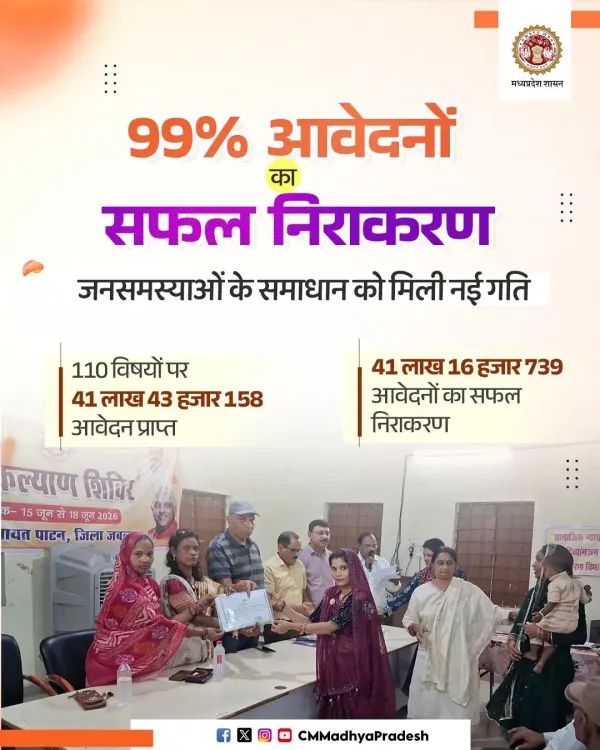
The Chief Minister's Office of Madhya Pradesh announced on Sunday, 26 July 2026 that 99 per cent of public applications have been successfully resolved, describing the achievement as the realisation of the state's commitment to good governance — or sushasan ka sankalp (the resolve for good governance).
Context
The post, shared from the official @CMMadhyaPradesh account, declared: '99% aavedonon ke safal niraakaran se saakaar hua sushasan ka sankalp' — meaning '99% successful resolution of applications has realised the resolve for good governance.' The announcement positions the figure as a concrete benchmark of administrative efficiency in Madhya Pradesh.
The state has long framed public service delivery as a governance priority. The current claim builds on that narrative by attaching a near-complete resolution rate to the broader idea of accountable administration.
Policy Backdrop
Madhya Pradesh enacted the Lok Seva Guarantee Adhiniyam in 2010, one of India's earliest state-level laws mandating time-bound delivery of public services. The legislation set enforceable deadlines for departments to process citizen applications and introduced accountability mechanisms for delays.
This legislative foundation was later reinforced by the national Digital India programme, launched in 2015, which encouraged states to migrate grievance and application systems to digital platforms. Madhya Pradesh has progressively expanded its online portals for service delivery, aligning with the broader national push for technology-enabled governance.
Across Indian states, publishing resolution percentages has become a standard method for governments to demonstrate progress on efficiency metrics and signal administrative responsiveness to citizens.
Stakeholders and Impact
The primary beneficiaries of a high application-resolution rate are ordinary citizens — residents who submit requests for government services, certificates, welfare entitlements, or grievance redressal through state portals. A 99 per cent resolution figure, if sustained, would represent a significant reduction in pending cases that historically burdened state departments.
For public applicants, faster resolution translates into quicker access to documents such as income certificates, caste certificates, land records, and social welfare benefits. Delays in these processes have historically had disproportionate impact on rural and lower-income populations who depend on government services for livelihood support.
What's Next
Attention will now turn to whether Madhya Pradesh publishes a detailed grievance report substantiating the 99 per cent figure — including data on the volume of applications processed, departmental breakdowns, and average resolution times. Central audits of state e-governance performance could also provide independent verification.
The state's ability to maintain this resolution rate as application volumes grow — driven by expanding digital access and rising citizen awareness — will be the real test of whether the governance infrastructure can sustain the benchmark it has now publicly set.
Point of View
Hard to independently verify without granular data on application volumes and departmental performance. Madhya Pradesh's invocation of sushasan (good governance) is a deliberate framing that connects routine administrative metrics to a broader electoral and ideological narrative the ruling dispensation has cultivated over years. The Lok Seva Guarantee Adhiniyam gives the state genuine institutional credibility on this issue, but the real test will be whether a detailed public report follows the announcement. In the current landscape where Indian states compete on governance optics, publishing the underlying data would distinguish a substantive milestone from a headline figure.
NationPress
26 Jul 2026
Frequently Asked Questions
What did the Madhya Pradesh CM Office announce on 26 July 2026?
The Chief Minister's Office of Madhya Pradesh announced that 99 per cent of public applications submitted to the state government have been successfully resolved, describing it as the realisation of its good-governance commitment.
What is the Lok Seva Guarantee Adhiniyam in Madhya Pradesh?
The Lok Seva Guarantee Adhiniyam is a Madhya Pradesh law enacted in 2010 that mandates time-bound delivery of public services, setting enforceable deadlines for government departments to process citizen applications.
What does '99% application resolution' mean for citizens in MP?
It means that out of all applications submitted for government services — such as certificates, land records, or welfare benefits — 99 per cent have reportedly been processed and closed, reducing the backlog of pending cases.
How does Digital India relate to Madhya Pradesh's governance push?
The national Digital India programme, launched in 2015, encouraged states including Madhya Pradesh to digitise grievance and service-delivery systems, enabling faster processing and transparent tracking of citizen applications.
Will there be an independent audit of Madhya Pradesh's 99% resolution claim?
No independent audit has been confirmed yet. Observers expect the state to release a detailed grievance report with departmental data, and central e-governance audits could provide external verification in due course.