Mahua Moitra Hails GenZ, Declares Godi Media Irrelevant
Synopsis
TMC MP Mahua Moitra on 26 July 2026 posted on X citing two 'fallouts': the growing irrelevance of 'Godi media' and BJP's IT cell failing to counter GenZ's organic digital activity. The post reflects a broader opposition argument about shifting media power in Indian politics.
Key Takeaways
Mahua Moitra posted on X on 26 July 2026 citing two political 'fallouts' she described as 'delightful.' She declared 'Godi media' — a term for outlets critics allege are pro-establishment — as 'never so irrelevant and so disliked.' She claimed BJP 's IT cell and 'troll army' have been unable to counter GenZ 's organic social media activity.
The term 'Godi media' has been in opposition vocabulary since approximately 2014–2019 ; BJP's IT cell operations date to the 2014 general election campaign.
The specific triggering events behind Moitra's claims have not been independently verified.
Upcoming IT rules debates and state assembly campaigns will test these competing digital-media narratives.
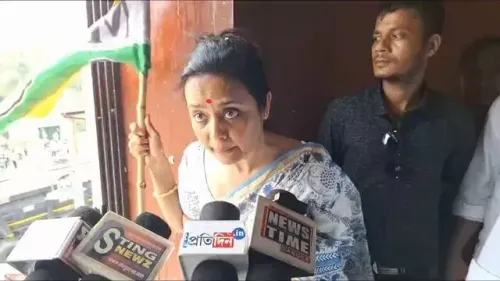
TMC MP Mahua Moitra took to X on Sunday, 26 July 2026, to claim two significant political 'fallouts' — the declining relevance of what she called 'Godi media' and the failure of the BJP's organised digital machinery to counter organic youth-led social media activity.
Context
In her post, Moitra listed what she described as 'delightful fallouts': first, the 'interment of Godi media,' asserting that pro-establishment mainstream outlets have 'never been so irrelevant and so disliked.' Second, she pointed to the 'inability of BJP's IT cell and troll army to take on GenZ's organic social media.' The post offers no reference to a specific triggering event, but is framed as a broader observation about the current media and digital landscape.
Policy Backdrop
The term 'Godi media' (roughly, 'lapdog media') entered opposition political vocabulary between 2014 and 2019 to describe television and print outlets critics alleged were editorially aligned with the central government. BJP's centralised IT cell and coordinated social media operations were themselves first widely noted during the 2014 general election campaign, and have since become a standard feature of the party's communications strategy. Opposition parties, including Trinamool Congress, have consistently alleged that mainstream coverage systematically favours the ruling establishment while independent digital content challenges that dominance.
Indian political communication has shifted substantially onto digital platforms over the past decade, with both ruling and opposition formations investing heavily in online narratives. Youth-generated content — particularly on short-form video and microblogging platforms — has increasingly been cited by analysts as a counterweight to organised political messaging.
Stakeholders and Impact
The observation directly implicates two sets of actors: legacy media organisations perceived as government-friendly, and the BJP's digital outreach infrastructure. On the other side, it elevates GenZ — Indians broadly born after 1996 — as an emergent force in shaping political narratives outside institutional media structures. Opposition MPs and civil society voices who have long argued that mainstream coverage is skewed are likely to amplify Moitra's framing.
For the BJP, the characterisation of its IT cell as ineffective against organic youth content represents a pointed challenge to a communications apparatus the party has invested in significantly since 2014. The claim, however, remains the MP's political assessment and has not been independently verified.
What's Next
Parliamentary discussions on IT rules and media regulation in forthcoming sessions will provide a formal arena where these competing narratives around digital governance and press independence are likely to resurface. Upcoming state assembly campaigns will also serve as real-world tests of whether GenZ-driven organic content continues to outpace coordinated political digital strategies — a question that both major formations will be watching closely.
Point of View
Uncontrollable counter-force is politically significant — it positions the opposition as aligned with youth energy rather than institutional structures. This fits a broader arc in which non-BJP parties have increasingly sought to contest the information battlefield on platforms rather than in television studios. Whether the claim reflects a genuine structural shift or is aspirational opposition messaging will only become clear in the next major electoral cycle.
NationPress
26 Jul 2026
Frequently Asked Questions
What did Mahua Moitra say about Godi media on 26 July 2026?
Mahua Moitra posted on X that 'Godi media' has never been 'so irrelevant and so disliked,' describing its decline as one of two 'delightful fallouts' in the current political moment.
What is 'Godi media' in Indian politics?
'Godi media' is a term — meaning roughly 'lapdog media' — used by opposition politicians and critics since around 2014–2019 to describe television and print outlets they allege are editorially aligned with the central government.
What did Moitra say about BJP's IT cell?
Moitra claimed that BJP's IT cell and what she called its 'troll army' have been unable to counter GenZ's organic social media activity, framing this as a significant political development.
Who is Mahua Moitra?
Mahua Moitra is a Trinamool Congress Lok Sabha MP from Krishnanagar, West Bengal, known for her vocal criticism of central government policies and the media ecosystem from the opposition benches.
When did BJP start its IT cell operations?
BJP's centralised IT cell and coordinated social media operations were first widely noted during the 2014 general election campaign and have since expanded into a major part of the party's communications strategy.