Rajnath Singh at Kargil Vijay Diwas: Pakistan military and militants now indistinguishable
Synopsis
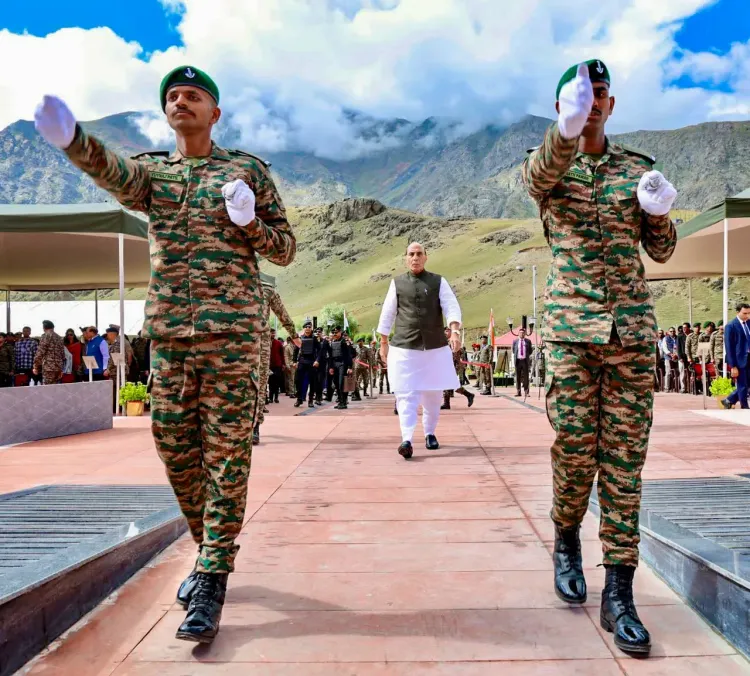
At the 27th Kargil Vijay Diwas in Drass, Rajnath Singh did not just commemorate — he indicted. Declaring Pakistan's military and militants indistinguishable, invoking Operation Sindoor as a precedent, and limiting any future talks to PoK alone, Singh's address signals that India's Pakistan policy has moved from strategic ambiguity to explicit deterrence.
Key Takeaways
Defence Minister Rajnath Singh said the line between Pakistan's military and militant groups has 'vanished', calling terrorism a Pakistani state policy, at Kargil Vijay Diwas commemorations in Drass on 26 July .
Singh said India will no longer distinguish between terrorists and their state sponsors, and future talks with Pakistan can only be on Pakistan-occupied Kashmir (PoK) .
He marked the first anniversary of Operation Sindoor , warning that any Pakistani misadventure would receive a 'befitting response'.
546 soldiers were martyred in the 1999 Kargil War ; Singh paid tribute to Captain Vikram Batra and Captain Manoj Pandey .
India's domestic defence manufacturing has risen from 30-35% to 65% of requirements since the Modi government took office, Singh said.
The government aims for full defence self-reliance by 2040 , covering strategic, economic, and cultural dimensions.
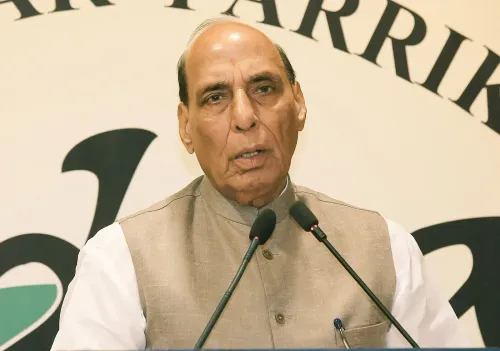
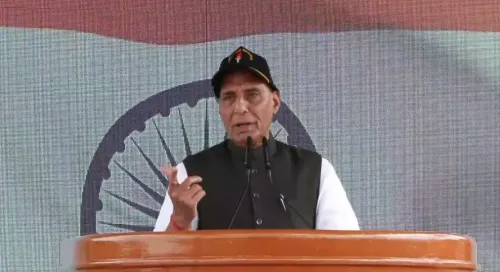
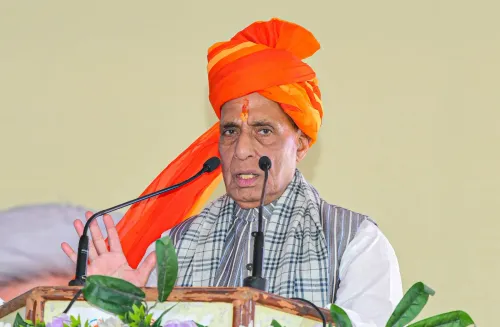
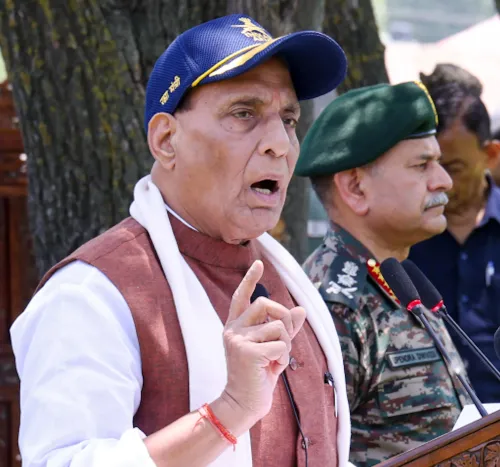
Defence Minister Rajnath Singh on Sunday, 26 July declared that terrorism has become an instrument of state policy in Pakistan, asserting that the line between the Pakistani military and militant groups has ceased to exist. Speaking at the 27th Kargil Vijay Diwas commemorations in Drass, Singh issued one of the sharpest official rebukes of Islamabad in recent memory, linking the indictment directly to Operation Sindoor and India's evolving security doctrine.
Singh's Core Charge Against Pakistan
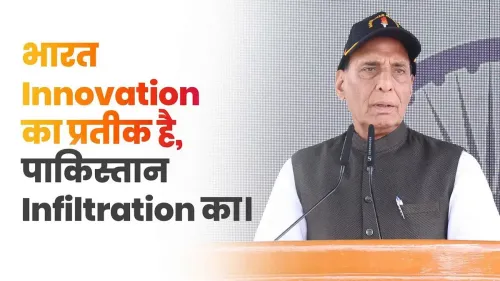
The defence minister drew a pointed contrast between the two neighbours. 'While India looks for innovation, Pakistan is looking for infiltration; while India designs chips, Pakistan designs terrorism; while we make startups for ecosystem, Pakistan looks for terror ecosystem. Our ways are now separate,' Singh said. He made clear that India no longer distinguishes between terrorists and their state sponsors — a formulation that signals a doctrinal shift in how New Delhi frames cross-border militancy.
Singh added that the only dialogue India is willing to hold with Pakistan concerns Pakistan-occupied Kashmir (PoK), which he described as an integral part of India. The statement effectively rules out broader bilateral engagement until Islamabad changes course.
Operation Sindoor and the Warning to Pakistan
Marking what he described as the first anniversary of Operation Sindoor, Singh said the operation had 'shattered the sponsors of terrorism in Pakistan.' He issued a direct warning: 'If they try any misadventure, our soldiers will respond befittingly. Any evil step towards our border will be stopped and destroyed.' The reference to Operation Sindoor underscores the government's intent to frame the operation as a decisive precedent rather than a one-off response.
Honouring the Kargil Martyrs
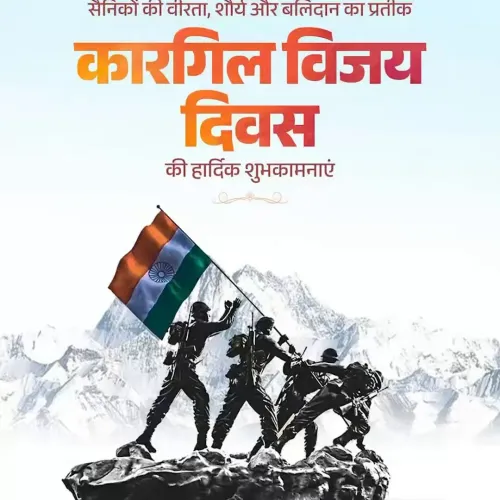
Singh opened his address by saluting the soldiers who gave their lives in the 1999 Kargil War, noting that 546 soldiers were martyred in the conflict. He recalled the near-impossible conditions under which Indian troops fought — at altitudes of 15,000 feet, with temperatures plunging to minus 40 degrees — and said that every book on military science had deemed the objective unachievable. 'Our soldiers created a new chapter in military science with their bravery, sacrifice and victory,' he said.
He paid specific tribute to Captain Manoj Pandey and Captain Vikram Batra, recounting Batra's famous words: 'I will either come back holding the Tricolour in my hand or come back wrapped in the Tricolour, but I will come back.' He also cited the account of former ambassador Naresh Chandra, who recalled a US Army general saying that even the US Marines might not have matched what Indian soldiers achieved on those peaks.
Defence Self-Reliance and the Road to 2040
Singh used the occasion to highlight India's defence indigenisation drive, noting that when the Narendra Modi government came to power, India imported 65 to 70 per cent of its defence requirements. Today, he said, the country manufactures 65 per cent of that equipment domestically. He cited indigenous air-to-air defence systems, drones, counter-drones, air-to-air missiles, and the commissioning of INS Vikrant as milestones, invoking Captain Batra's phrase: 'Yeh Dil Mange More.'
The government's stated goal of making India fully self-reliant by 2040, Singh said, encompasses not just economic prosperity but also strategic superiority and cultural cohesion. With tensions along the Line of Control remaining elevated, the Kargil Vijay Diwas address this year carried weight well beyond commemoration.
Point of View
As Operation Sindoor demonstrated. Restricting future dialogue exclusively to PoK effectively closes the door on any near-term bilateral reset, a position that hardens just as global pressure for India-Pakistan de-escalation mounts. The defence indigenisation numbers are real progress, but the leap from 65% domestic manufacturing to full self-reliance by 2040 will test supply chains, R&D pipelines, and private-sector capacity in ways the government has not yet publicly detailed. Kargil Vijay Diwas is increasingly serving a dual purpose: solemn remembrance and strategic signalling — and this year, the signalling was unmistakable.
NationPress
25 Oct 2026
Frequently Asked Questions
What did Rajnath Singh say about Pakistan at Kargil Vijay Diwas 2025?
Rajnath Singh declared that terrorism has become a part of Pakistani state policy and that the distinction between Pakistan's military and militant groups has effectively vanished. He said India will not differentiate between terrorists and their state sponsors, and that any future talks with Pakistan can only concern Pakistan-occupied Kashmir.
What is Operation Sindoor and why did Rajnath Singh mention it?
Operation Sindoor is a military operation in which India targeted sponsors of terrorism in Pakistan. Singh referenced its first anniversary at Drass to underline that India has already acted on its doctrine of holding state sponsors accountable, and warned that any future Pakistani misadventure would be met with a befitting response.
How many soldiers were martyred in the Kargil War?
According to Rajnath Singh's address, 546 Indian soldiers were martyred during the 1999 Kargil War . Singh paid special tribute to Captain Vikram Batra and Captain Manoj Pandey , whose acts of bravery have become symbols of the conflict.
What did Rajnath Singh say about India's defence manufacturing?
Singh said that when the Modi government assumed office, India imported 65 to 70 per cent of its defence requirements. Today, he said, India manufactures 65 per cent of that equipment domestically, citing INS Vikrant, indigenous drones, counter-drones, and air-to-air missiles as examples.
What is India's defence self-reliance target by 2040?
Rajnath Singh stated that the government's goal of making India completely self-reliant by 2040 goes beyond economic prosperity to encompass strategic superiority and cultural and social harmony. No specific budgetary outlay for the 2040 target was mentioned in the address.