Rajnath Singh warns Pakistan: Next terror strike will draw bigger retaliation
Synopsis
Rajnath Singh's warning on 15 October wasn't diplomatic boilerplate — it was a calibrated escalation signal. By explicitly stating that the next retaliatory strike will be bigger than Operation Sindoor, and backing it with hard numbers on indigenisation and exports, India's Defence Minister is drawing a public deterrence ladder against Pakistan that New Delhi rarely articulates this directly.
Key Takeaways
Rajnath Singh warned on 15 October 2026 that any future Pakistani-linked terror act will draw an Indian military response bigger than previous operations.
He cited Operation Sindoor as a model of 'technology-driven warfare,' highlighting the Akash Teer , Akash missile , and BrahMos missile systems.
India has achieved over 90 per cent self-reliance in ammunition, with 159 of 175 types now indigenously produced.
Defence exports have grown from ₹686 crore in 2013-14 to over ₹38,000 crore , reaching nearly 200 countries .
The Ministry of Defence has approved over ₹2,400 crore in procurement from MSMEs and start-ups, with 75% of the modernisation budget reserved for Indian industry.
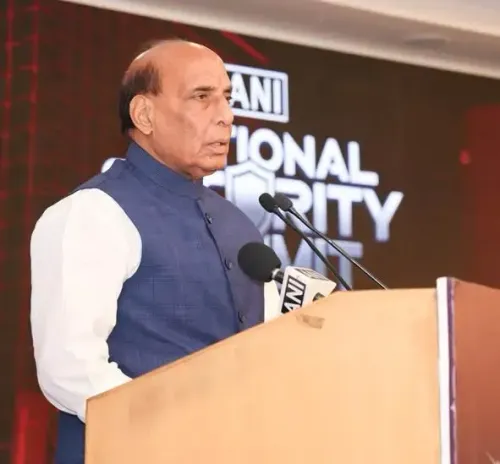
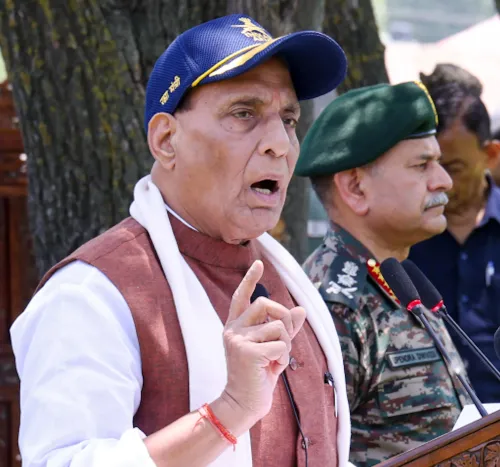
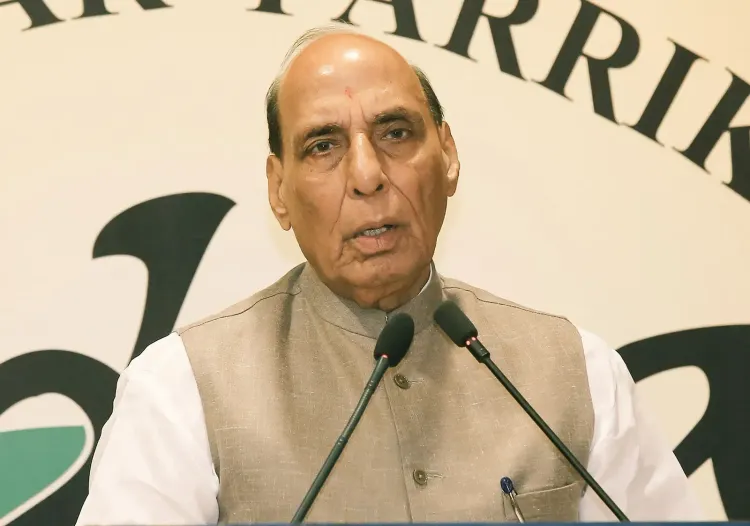
Defence Minister Rajnath Singh on Thursday, 15 October 2026, issued a pointed warning to Pakistan, declaring that any future act of terrorism originating from its territory would draw a military response even more powerful than India's previous operations. Addressing an event in New Delhi, Singh invoked Operation Sindoor and the 2016 Uri surgical strikes as evidence that India's deterrence posture has evolved — and will continue to escalate.
The Warning to Pakistan
Speaking at the event, Rajnath Singh stated that whenever terrorists have attempted to 'stain Indian soil with blood, India has delivered a fitting response — an echo of which likely still resonates with the masters of these terrorists.' He drew a clear line: India's preference for peace must not be mistaken for passivity. 'If further terrorist activity originates from its territory, India could launch a strike bigger than its previous operations,' he said, in remarks widely interpreted as a direct address to Islamabad.
Singh recalled the 2016 Uri attack, noting that Indian forces had 'carried out surgical strikes, completely destroying terrorist hideouts' in its aftermath. The invocation of both Uri and Operation Sindoor signals a deliberate escalation ladder — a message that each Pakistani-linked terror incident risks a disproportionately larger Indian response.
Operation Sindoor and the Technology Argument
Citing Operation Sindoor as a showcase of India's military modernisation, Singh described it as 'an excellent example of technology-driven warfare.' He highlighted the deployment of the Akash Teer air defence command and control system, the Akash missile system, and the BrahMos missile as evidence that Indian armed forces are 'leveraging advanced systems with great confidence.' This comes amid broader efforts to position India's military doctrine as precision-oriented and technologically self-reliant, rather than dependent on legacy imports.
Defence Self-Reliance: The Numbers
Singh underscored the scale of India's indigenisation drive, noting that 159 out of 175 types of ammunition in the armed forces' arsenal are now domestically produced — representing over 90 per cent self-reliance in that category. He further highlighted that India's defence exports, which stood at just ₹686 crore in 2013-14, have surged to over ₹38,000 crore, with defence products now being exported to nearly 200 countries. 'It is not just our defence exports that have increased; I believe this has bolstered India's reputation, enhanced its credibility, and strengthened global trust in Indian technology,' he said.
DRDO, Start-Ups and MSMEs in the Defence Ecosystem
The Defence Minister described the Defence Research and Development Organisation (DRDO) as having evolved beyond a research body into a 'national innovation platform' connecting industries, universities, start-ups, and scientists. He noted that the Ministry of Defence has approved procurement worth over ₹2,400 crore from micro, small, and medium enterprises (MSMEs) and start-ups, with projects exceeding ₹1,500 crore sanctioned for new technology development. Notably, 75 per cent of the armed forces' modernisation budget has been earmarked for procurement from Indian industries — a structural shift from the import-heavy posture of a decade ago.
The Broader Vision
Singh said India's goal is to build a nation that, while 'advocating for peace, remains vigilant about its own security and is fully capable of safeguarding its sovereignty, integrity, and national interests.' He expressed confidence that by the time India marks 100 years of independence, it will 'lead the world with confidence across technology, the economy, and defence.' The remarks reflect an increasingly assertive public posture from New Delhi on national security, one that has intensified since the Uri and Balakot episodes and, more recently, Operation Sindoor.
Point of View
Framing retaliation not as a possibility but as a scaling promise — each incident draws a larger response. That doctrine has real strategic weight, but it also raises accountability questions: Operation Sindoor's full scope and outcomes remain partly in the domain of official narrative, and the 90% ammunition self-reliance figure, while striking, invites scrutiny of what categories are included. The jump from ₹686 crore to ₹38,000 crore in defence exports is verifiable and significant, but India's share of global arms exports remains modest. The speech is as much a domestic political statement — projecting strength ahead of what analysts see as a fragile regional equilibrium — as it is a message to Islamabad.
NationPress
15 Oct 2026
Frequently Asked Questions
What did Rajnath Singh say about Pakistan and terrorism on 15 October 2026?
Rajnath Singh warned that if Pakistan allows further terrorist activity to originate from its territory, India could launch a strike bigger than its previous operations, including the 2016 Uri surgical strikes and Operation Sindoor. He stated that India's preference for peace should not be mistaken for an inability to defend itself.
What is Operation Sindoor and why did Rajnath Singh cite it?
Operation Sindoor is a recent Indian military operation that Rajnath Singh described as 'an excellent example of technology-driven warfare,' citing the use of the Akash Teer command and control system, the Akash missile, and the BrahMos missile. He used it to illustrate how India's armed forces are leveraging advanced indigenous systems with confidence.
How self-reliant is India in defence production?
According to Rajnath Singh, 159 out of 175 types of ammunition in the Indian armed forces' arsenal are now indigenously produced, amounting to over 90 per cent self-reliance in that category. India's defence exports have also grown from ₹686 crore in 2013-14 to over ₹38,000 crore, reaching nearly 200 countries.
What role are MSMEs and start-ups playing in India's defence sector?
The Ministry of Defence has approved procurement worth over ₹2,400 crore from MSMEs and start-ups, with projects exceeding ₹1,500 crore sanctioned for new technology development. Additionally, 75 per cent of the armed forces' modernisation budget has been earmarked for procurement from Indian industries.
What did Rajnath Singh say about DRDO's evolving role?
Singh described DRDO as having transformed from a traditional research and development body into a 'national innovation platform' that now connects industries, universities, start-ups, and scientists. He framed this evolution as central to building a self-reliant and technologically advanced defence ecosystem.