Madhya Pradesh Achieves 99.9% Grievance Resolution Through ‘Sankalp Se Samadhan’ Initiative

Synopsis
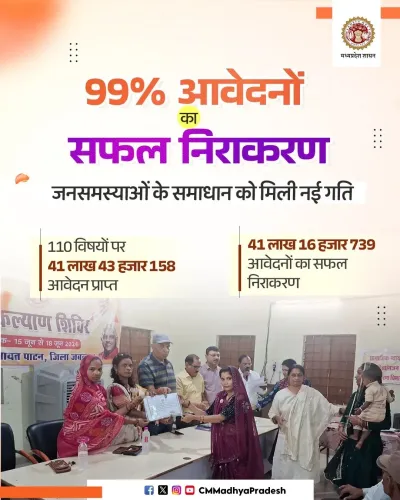
On April 17, the Madhya Pradesh government revealed a remarkable achievement: a 99.9% resolution rate for public grievances under the 'Sankalp Se Samadhan Abhiyan'. This program not only addresses grievances efficiently but also promotes transparency and accountability in governance.
Key Takeaways
99.9% resolution rate for public grievances.
Over 47.68 lakh applications resolved.
Implemented in four phases for systematic execution.
Transparency maintained through an online portal .
Enhanced service delivery via the Sampada system .
Bhopal, April 17 (NationPress) The government of Madhya Pradesh announced on Friday that it has successfully addressed over 47.68 lakh public grievances, achieving an impressive 99.9 percent resolution rate under the ‘Sankalp Se Samadhan Abhiyan’. This milestone signifies a significant advancement in timely grievance resolution.
According to reports, from January 12 to March 31, a total of 47.69 lakh applications were submitted, with 47.68 lakh being resolved within the designated timeframe. This initiative has proven to be an effective mechanism for promoting transparent and accountable governance.
The campaign aimed to extend services directly to the community. Applications were gathered through door-to-door visits in villages and addressed through multiple organized camps.
To uphold transparency, every application was logged and monitored via an online portal. Oversight was facilitated through a dedicated dashboard connected to the Chief Minister Helpline.
The initiative was rolled out in four phases to guarantee systematic implementation.
In the initial phase, applications were gathered at village and ward levels.
The second phase involved organizing local camps to expedite the resolution of cases.
In the third phase, block-level camps tackled both pending and new applications.
The final phase featured district-level camps to ensure the resolution of all outstanding cases and the delivery of benefits to eligible citizens.
A total of 3,659 camps were conducted statewide.
The government emphasized the importance of the ‘Sampada’ system in enhancing service delivery, particularly concerning revenue services.
This digital platform has streamlined processes for obtaining land record copies and property-related services, significantly reducing delays and enhancing transparency.
Under this system, over 8.71 lakh applications for land record copies were submitted, with more than 8.69 lakh resolved.
The campaign also ensured the distribution of welfare benefits, with large numbers of applications regarding construction worker registrations, pensions, farmer credit cards, domicile certificates, and tap water connections being addressed, thereby improving access to essential services.
Point of View
Showcasing their commitment to addressing citizen grievances efficiently. With a success rate of 99.9%, the 'Sankalp Se Samadhan Abhiyan' not only emphasizes transparency but also demonstrates a proactive approach in governance, ensuring that citizens' voices are heard and acted upon.
NationPress
18 Sept 2026
Frequently Asked Questions
What is the 'Sankalp Se Samadhan Abhiyan'?
The 'Sankalp Se Samadhan Abhiyan' is an initiative launched by the Madhya Pradesh government aimed at resolving public grievances efficiently and transparently.
What was the resolution rate achieved by the Madhya Pradesh government?
The Madhya Pradesh government achieved an impressive resolution rate of 99.9% for public grievances under this initiative.
How many applications were resolved during the campaign?
During the campaign, over 47.68 lakh applications were resolved within the stipulated timeframe.
How did the government ensure transparency in the process?
The government ensured transparency by logging all applications and monitoring them through an online portal linked to the Chief Minister Helpline.
What types of services were addressed under this campaign?
The campaign addressed various services, including construction worker registrations, pensions, farmer credit cards, domicile certificates, and tap water connections.