MP CM Office Announces Silk and Silk Tech Park Expansion
Synopsis
The Chief Minister's Office of Madhya Pradesh announced on 27 May 2026 an expansion of silk and silk tech park infrastructure in the state, aiming to modernise sericulture and move the sector toward higher-value processing activities such as reeling, dyeing and product development.
Key Takeaways
The Chief Minister's Office of Madhya Pradesh announced the expansion of silk and silk tech park infrastructure on 27 May 2026 .
Madhya Pradesh has an established sericulture base in districts including Balaghat and Mandla , focused on tussar and mulberry silk.
The move aligns with the central government's Silk Samagra scheme , launched in 2017 , which supports mulberry cultivation, silkworm rearing and reeling units.
Primary beneficiaries include sericulture farmers and silk weavers who may gain access to improved technology and processing facilities.
Similar silk tech park initiatives exist in Karnataka , Tamil Nadu and Assam , and MP's expansion brings it in line with leading silk-producing states.
Specific project cost, location and timeline details have not yet been publicly disclosed.
The Chief Minister's Office of Madhya Pradesh announced on Wednesday, 27 May 2026 an expansion of sericulture and silk technology park infrastructure in the state, signalling a push to modernise and scale up the sector beyond raw cocoon production.
Context
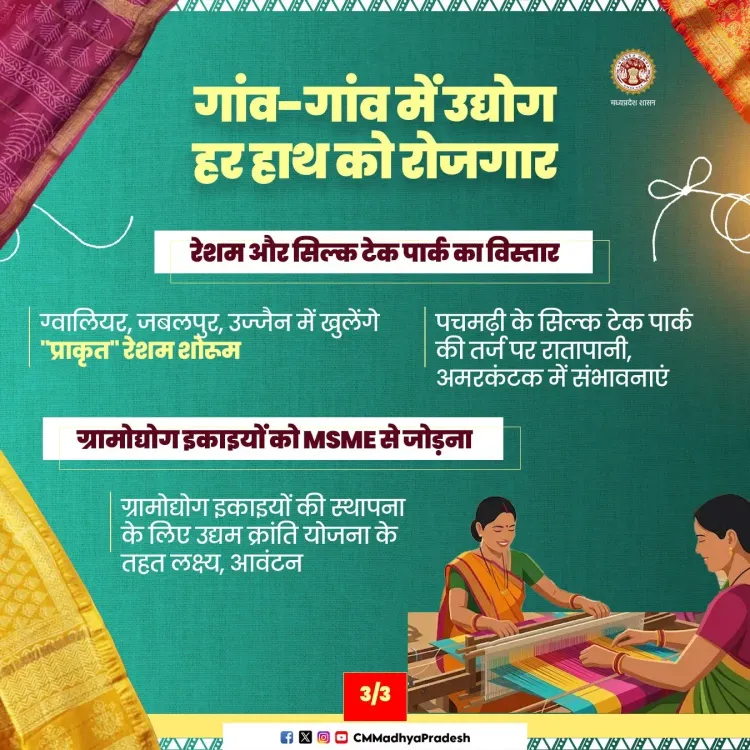
The post, shared from the official @CMMadhyaPradesh account, reads: 'मध्यप्रदेश में रेशम और सिल्क टेक पार्क का विस्तार' — translated as 'Expansion of silk and silk tech park in Madhya Pradesh.' The announcement points to a deliberate effort by the state government to build dedicated infrastructure for the silk value chain.
Madhya Pradesh has an established sericulture base, particularly in districts such as Balaghat and Mandla, where tussar and mulberry silk cultivation has historically been concentrated. A dedicated tech park signals intent to move beyond raw cocoon output toward higher-value activities including reeling, dyeing and finished product development.
Policy Backdrop
The announcement fits within a broader national framework for silk sector development. The Central Silk Board, a statutory body under the Ministry of Textiles, coordinates research, seed production and extension services across silk-producing states. Its programmes have provided the institutional scaffolding for state-level initiatives like this one.
The central government's Silk Samagra scheme, launched in 2017, has been a key funding and support mechanism for mulberry plantation, silkworm rearing and reeling units in participating states, including Madhya Pradesh. The current expansion appears consistent with that policy lineage, extending infrastructure support deeper into the value chain.
Similar technology park and cluster initiatives exist in Karnataka, Tamil Nadu and Assam, reflecting a nationwide pattern of state-level infrastructure investment in sericulture under the broader textile policy framework. Madhya Pradesh's move aligns it more closely with these leading silk-producing states.
Stakeholders and Impact
The primary beneficiaries of an expanded silk tech park would be sericulture farmers and silk weavers across the state, who stand to gain access to improved technology inputs, better post-cocoon processing facilities and potentially stronger market linkages. Modernised infrastructure typically reduces post-harvest losses and improves quality, which in turn supports better price realisation for growers.
A technology-oriented park also creates downstream opportunities in reeling, dyeing and product design, potentially drawing private investment and generating skilled employment in districts where the sector is already active. For weavers, proximity to improved reeling and yarn processing units can reduce input costs and supply-chain delays.
What's Next
Observers will watch for state budget allocations, tender notices for park infrastructure and any new memoranda of understanding with the Central Silk Board or private reeling units in the coming fiscal cycle. Specific details on project cost, precise location and implementation timeline have not yet been disclosed in the public announcement.
The expansion, if executed at scale, could position Madhya Pradesh as a more significant node in India's domestic silk supply chain — reducing the country's dependence on imported silk and raw yarn, which remains a structural challenge for the industry.
Point of View
Rather than supplying raw cocoons to processors in other states. The timing aligns with renewed central government emphasis on textile-sector self-reliance and import substitution in raw silk, where India still relies significantly on imports from China. By investing in technology infrastructure, the state government is signalling a shift from primary production toward value-added manufacturing — a transition that could meaningfully improve incomes for farmers and weavers if implementation follows through. The announcement also positions the ruling dispensation to claim credit for economic modernisation in a sector with deep roots in tribal and rural communities across central India.
NationPress
11 Oct 2026
Frequently Asked Questions
What is the silk tech park expansion in Madhya Pradesh?
The Chief Minister's Office of Madhya Pradesh announced on 27 May 2026 an expansion of silk and silk tech park infrastructure in the state, aimed at modernising sericulture and enabling higher-value activities such as reeling, dyeing and product development.
Which districts in Madhya Pradesh are known for silk production?
Districts such as Balaghat and Mandla in Madhya Pradesh have historically been centres of tussar and mulberry silk cultivation in the state.
What is the Silk Samagra scheme?
Silk Samagra is a central sector scheme launched in 2017 under the Ministry of Textiles that provides support for mulberry plantation, silkworm rearing and reeling units in participating states, including Madhya Pradesh.
Who benefits from a silk tech park in Madhya Pradesh?
Sericulture farmers and silk weavers are the primary beneficiaries, as improved technology infrastructure can reduce post-harvest losses, lower input costs and improve market linkages.
How does Madhya Pradesh compare with other silk-producing states in India?
States like Karnataka, Tamil Nadu and Assam have similar silk technology park and cluster initiatives; Madhya Pradesh's expansion moves it closer to these established sericulture leaders in terms of infrastructure investment.