MP CM Mohan Yadav moves fire safety bill for 2026
Synopsis
The Chief Minister's Office of Madhya Pradesh announced the Madhya Pradesh Fire and Emergency Services Bill, 2026, framing it as a major legislative step toward citizen safety and modernising the state's emergency response framework under CM Dr. Mohan Yadav.
Key Takeaways
The Chief Minister's Office of Madhya Pradesh announced the Madhya Pradesh Fire and Emergency Services Bill, 2026 on 22 July 2026 .
Mohan Yadav is the driving force behind the proposed legislation, which aims to regulate and modernise firefighting and emergency services in the state.
The bill is described as 'nagrik suraksha ki disha mein mahatvapurna kadam' — 'an important step in the direction of citizen safety.' The move aligns with national guidelines from the Ministry of Home Affairs and the broader trend of Indian states updating their fire services legislation.
Key stakeholders include urban residents, fire services personnel , and commercial and residential establishments across Madhya Pradesh .
The bill must still be tabled and passed in the Madhya Pradesh Legislative Assembly before it can be implemented.
The Chief Minister's Office of Madhya Pradesh announced on Wednesday, 22 July 2026 that the state government is advancing the Madhya Pradesh Fire and Emergency Services Bill, 2026 — describing it as a significant step toward citizen safety.
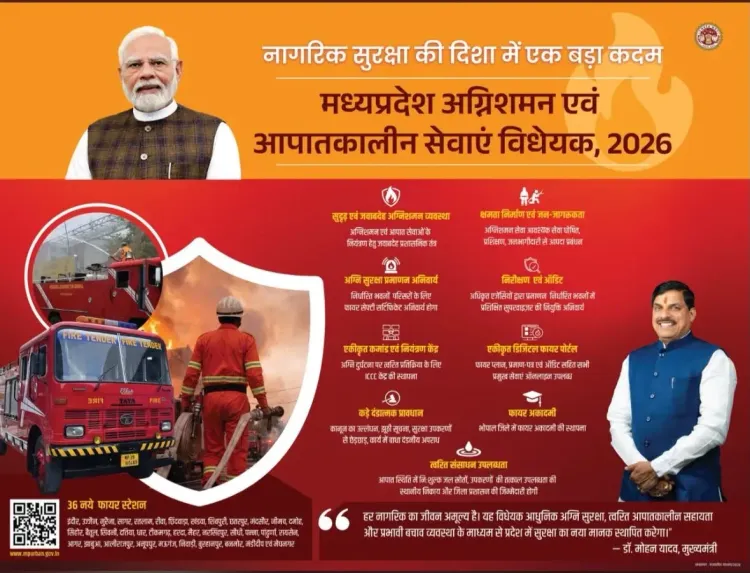
The official post, attributed to Chief Minister Dr. Mohan Yadav, described the proposed legislation as 'nagrik suraksha ki disha mein mahatvapurna kadam' — 'an important step in the direction of citizen safety.' The bill, formally titled the Madhya Pradesh Agnishan Evam Aapatkaaleen Sevaen Vidheyak, 2026, aims to regulate and modernise the state's firefighting and emergency response framework.
Context
Madhya Pradesh, a large central Indian state, has been steadily upgrading its disaster preparedness and urban safety infrastructure under the BJP government led by Dr. Mohan Yadav, who assumed office as Chief Minister in December 2023. The announcement signals a legislative push to place fire and emergency services on a stronger statutory footing. The bill's introduction follows a broader national pattern of states revisiting their fire services laws to address gaps in equipment, training, and rapid response capacity.
Policy Backdrop
India's foundational framework for emergency services rests on the Disaster Management Act, 2005, which established the legal basis for state-level coordination with the National Disaster Management Authority (NDMA). However, fire services have historically been governed by older, piecemeal state legislation — many of which predate modern urban growth and high-rise construction. The Ministry of Home Affairs has periodically issued national guidelines urging states to upgrade their statutory frameworks, particularly following major urban fire incidents across the country.
Several Indian states have enacted or amended dedicated fire services laws in recent years to align with these guidelines. Madhya Pradesh's 2026 bill continues this legislative trend, seeking to consolidate and modernise the legal architecture governing emergency response in the state.
Stakeholders and Impact
The proposed legislation is expected to directly affect urban residents across Madhya Pradesh, particularly in rapidly growing cities such as Bhopal and Indore, where fire safety compliance and emergency response times are critical concerns. Fire services personnel stand to benefit from clearer statutory mandates, potentially including provisions for training standards, equipment procurement, and inter-agency coordination — though specific provisions of the bill have not yet been made public.
Commercial establishments, residential housing societies, and industrial units are also likely stakeholders, as fire services legislation typically includes compliance and inspection requirements for built structures.
What's Next
The bill's next milestone is its formal tabling and passage in the Madhya Pradesh Legislative Assembly. Once enacted, the government would be expected to notify rules for implementation, which would define the operational contours of the new framework. Observers will watch for details on funding allocations for fire service modernisation, penalties for non-compliance, and any new institutional mechanisms the bill may establish.
The move reinforces Chief Minister Dr. Mohan Yadav's administration's stated focus on governance reforms and public safety, and positions Madhya Pradesh among states taking proactive legislative steps on emergency preparedness ahead of monsoon and festival seasons — periods historically associated with elevated fire risk.
Point of View
2026 is a calculated governance signal from CM Dr. Mohan Yadav's administration, coming roughly two and a half years into his tenure and reflecting a push to translate BJP's 'good governance' narrative into concrete legislative outputs. Dedicated fire services legislation has long been a gap in many Indian states, and Madhya Pradesh's move places it in a cohort of states responding to central advisories on emergency preparedness. The timing — mid-monsoon, ahead of festival seasons when fire risks peak — adds policy resonance. How the bill translates into on-ground capacity upgrades, including equipment and trained personnel, will determine whether it becomes a genuine safety reform or a statutory formality.
NationPress
20 Oct 2026
Frequently Asked Questions
What is the Madhya Pradesh Fire and Emergency Services Bill 2026?
The Madhya Pradesh Fire and Emergency Services Bill, 2026 is a proposed state law announced by the Chief Minister's Office of Madhya Pradesh to regulate, modernise, and strengthen the state's firefighting and emergency response services.
Who announced the MP fire services bill?
The announcement was made by the official Chief Minister's Office of Madhya Pradesh on 22 July 2026, attributed to Chief Minister Dr. Mohan Yadav.
Has the Madhya Pradesh fire services bill been passed?
As of the announcement on 22 July 2026, the bill had not yet been tabled or passed in the Madhya Pradesh Legislative Assembly. Its passage and implementation rules are still awaited.
Why is Madhya Pradesh introducing a new fire safety law?
The bill aims to address gaps in equipment, training, and rapid emergency response, aligning with national guidelines from the Ministry of Home Affairs and a broader trend of Indian states modernising their fire services legislation.
Who will be affected by the Madhya Pradesh emergency services bill?
Urban residents, fire services personnel, commercial establishments, residential housing societies, and industrial units across Madhya Pradesh are the primary stakeholders expected to be affected by the new legislation.