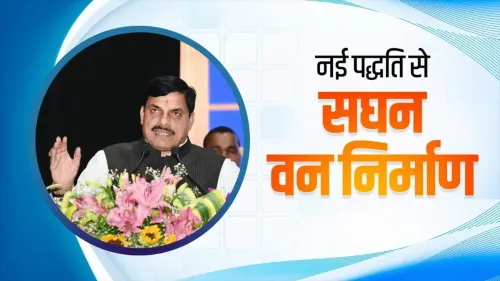
CM Mohan Yadav to develop urban forests in 65 MP cities

Synopsis
Madhya Pradesh's Chief Minister's Office announced the Namo Harit Nagar Yojana on 25 July 2026, pledging urban forests across 65 municipal bodies over five years. The scheme, backed by CM Dr. Mohan Yadav and the Urban Development Department, aligns state policy with national urban forestry missions to integrate conservation into city growth.
Key Takeaways
The Chief Minister's Office of Madhya Pradesh announced the Namo Harit Nagar Yojana on 25 July 2026 .
The scheme aims to develop nagar van (urban forests) in 65 urban local bodies across the state.
Implementation is planned over a five-year period , with the MP Urban Development Department as the nodal agency.
The initiative adapts the central government's Nagar Van Yojana (2020) to a state-level framework.
Mohan Yadav is directly associated with the scheme, signalling high-level political commitment.
The scheme frames urban forest development as integral to, not separate from, urban growth and infrastructure planning.
The Chief Minister's Office of Madhya Pradesh announced on Saturday, 25 July 2026 that the state government will develop urban forests — known as nagar van — across 65 urban local bodies over the next five years under the Namo Harit Nagar Yojana, linking environmental conservation with urban development.
The post, shared from the official handle of the Chief Minister's Office, declared the scheme as a commitment to 'development alongside nature conservation' (prakriti sanrakshan ke saath vikas ka sankalp). Chief Minister Dr. Mohan Yadav and the Madhya Pradesh Urban Development Department were tagged in the announcement, signalling active coordination between the Chief Minister's office and the state's urban planning machinery.
Context
The Namo Harit Nagar Yojana is a state-level initiative designed to expand green cover within Madhya Pradesh's urban limits. The scheme envisions the creation of dedicated forested zones — nagar vans — within city boundaries, bringing ecological breathing spaces into densely populated municipal areas. The announcement positions the scheme as a dual-purpose effort: accelerating urban growth while anchoring it within a conservation framework. The scheme's name and intent align with the broader Nagar Van Yojana, a central government programme launched in 2020 by the Ministry of Environment, Forest and Climate Change to develop 400 urban forests across Indian cities. Madhya Pradesh's initiative represents a state-level adaptation of that national framework, channelling it through local urban bodies.Policy Backdrop
Urban forestry has been a recurring theme in India's environmental governance over the past decade. The centrally-sponsored Nagar Van Yojana (2020) set a national template for integrating forests into city planning. Alongside it, the Atal Mission for Rejuvenation and Urban Transformation (AMRUT), launched in 2015, included components for developing urban green spaces and parks as part of holistic city infrastructure. Madhya Pradesh has progressively aligned its municipal development agenda with these national missions. The Namo Harit Nagar Yojana continues that trajectory, with the state government framing urban forests not as an afterthought but as a core pillar of city planning. The involvement of the Madhya Pradesh Urban Development Department suggests implementation will run through existing municipal governance structures rather than a parallel agency.Stakeholders and Impact
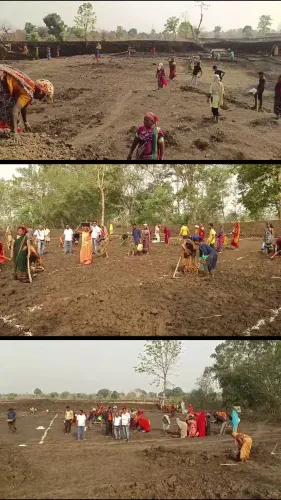
The primary beneficiaries of the scheme are residents of the 65 urban local bodies identified for nagar van development. Urban forests provide measurable public goods: improved air quality, reduced urban heat island effect, stormwater management, and accessible green recreational space. Municipal corporations and town councils within the scheme's ambit will be responsible for land identification, plantation, and long-term maintenance. Environmental groups and urban planners have long argued that Indian cities lag in per-capita green cover relative to global benchmarks. A scheme of this scale, if executed across 65 municipalities over five years, could meaningfully shift green-cover metrics for Madhya Pradesh, one of India's larger states by area with a mix of tier-2 and tier-3 cities.What's Next
The immediate focus will be on the selection and notification of the specific 65 urban bodies to be covered under the scheme, along with phased timelines for land demarcation and plantation drives. Coordination between the Madhya Pradesh Urban Development Department and central ministries overseeing environment and urban affairs will be critical to unlocking potential funding support. How the state balances land availability pressures in fast-growing cities with the scheme's conservation mandate will determine whether the Namo Harit Nagar Yojana delivers lasting ecological value or remains aspirational on paper.Point of View
The announcement signals institutional ownership rather than a symbolic gesture. The scheme's alignment with the Centre's Nagar Van Yojana also positions the state to leverage federal funding, a pattern seen across BJP-governed states seeking to amplify central schemes under state branding. The real test will be in land allocation: urban forests require contiguous, protected land that is perpetually under pressure from competing development interests in growing Indian cities.
NationPress
24 Oct 2026
Frequently Asked Questions
What is the Namo Harit Nagar Yojana in Madhya Pradesh?
The Namo Harit Nagar Yojana is a Madhya Pradesh state government scheme announced in July 2026 to develop urban forests (nagar van) across 65 urban local bodies over five years, combining environmental conservation with urban development goals.
How many cities will get urban forests under the MP scheme?
The scheme targets 65 urban local bodies in Madhya Pradesh, though the specific municipalities have not yet been publicly notified as of the announcement date.
What is the difference between Namo Harit Nagar Yojana and Nagar Van Yojana?
The Nagar Van Yojana is a central government scheme launched in 2020 to create 400 urban forests nationally. The Namo Harit Nagar Yojana is Madhya Pradesh's state-level adaptation of that framework, implemented through the state's urban development department.
Who is responsible for implementing the Namo Harit Nagar Yojana?
The Madhya Pradesh Urban Development Department is the nodal body, working in coordination with Chief Minister Dr. Mohan Yadav's office and local urban bodies.
What are urban forests or nagar van and why do cities need them?
Nagar van are dedicated forested zones within city limits that improve air quality, reduce the urban heat island effect, manage stormwater, and provide green recreational space for residents — benefits that are increasingly critical as Indian cities expand rapidly.