MP's 5 Cities Set to Become Model EV Hubs
Synopsis
The Chief Minister's Office of Madhya Pradesh announced on October 17, 2026 that five cities in the state are being developed as model EV cities, marking a targeted push to accelerate electric vehicle adoption and charging infrastructure aligned with India's national FAME scheme.
Key Takeaways
Five cities in Madhya Pradesh are being developed as model EV cities, as announced by the Chief Minister's Office on October 17, 2026 .
The initiative aligns with India's central government FAME India scheme , first launched in 2015 and expanded under FAME-II in 2019 .
Model EV city status typically accelerates charging infrastructure deployment , last-mile electric transit, and local government incentives.
Indian states have been rolling out city-level EV pilots since 2021 to cut urban air pollution and reduce oil import dependence.
The specific identities of the five cities and detailed rollout timelines have not yet been officially disclosed.
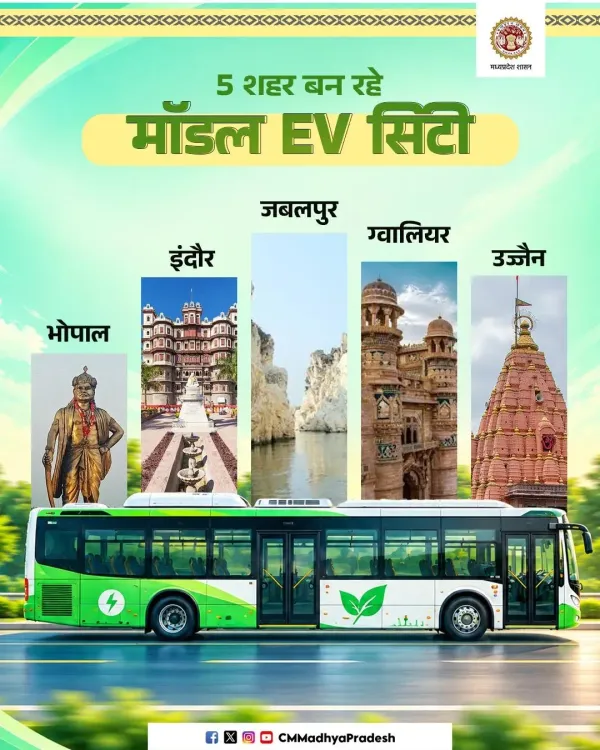
Five cities across Madhya Pradesh are being developed as model EV cities, the Chief Minister's Office of Madhya Pradesh announced on Saturday, October 17, 2026 — a signal that India's heartland state is moving from policy intent to street-level electric mobility transformation.
From Policy Pledge to Pavement: What 'Model EV City' Means
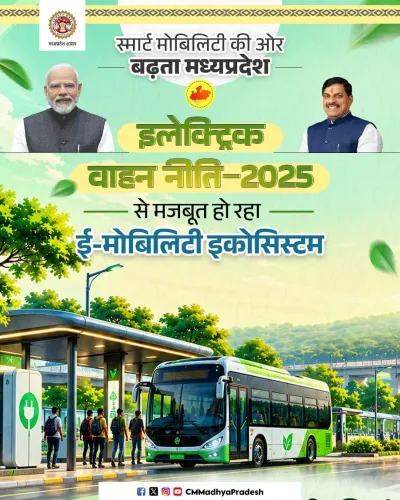
The post, shared by the Chief Minister's Office, states: 'प्रदेश के 5 शहर बन रहे मॉडल EV सिटी' — 'Five cities of the state are becoming model EV cities.' The designation typically signals a coordinated push: preferential charging infrastructure, last-mile electric transit, local government incentives, and potentially ring-fenced zones where EVs receive priority access or reduced permit fees.
The move places Madhya Pradesh firmly within a broader national current. Indian states have been racing to align with central electric mobility goals since 2021, driven by twin pressures — worsening urban air quality and the country's costly dependence on oil imports.
The National Framework Powering State-Level Action
The backdrop here matters. The Centre's FAME India scheme — Faster Adoption and Manufacturing of (Hybrid and) Electric Vehicles — was first launched in 2015, then dramatically scaled up under FAME-II in 2019, pumping subsidies into EV purchases and charging infrastructure across states willing to co-invest.
Madhya Pradesh, a central Indian state with major urban centres and significant two- and three-wheeler traffic, has been pursuing state-level electric mobility initiatives alongside these national programmes. Designating five cities as model EV hubs suggests the state is now moving beyond broad policy into geographically targeted pilots — the kind of concentrated rollout that generates proof points for a wider statewide push.
What the Road Ahead Looks Like for Urban Commuters
The announcement most directly touches urban commuters and EV manufacturers eyeing Madhya Pradesh as a growth market. Model city status usually accelerates charging network deployment and can unlock preferential land allocation for charging depots — the single biggest friction point for EV adoption in tier-2 and tier-3 Indian cities.
The specific identities of the five cities, their rollout timelines, and the exact incentive architecture have not yet been officially detailed. Those announcements will determine whether this initiative becomes a genuine inflection point or a headline without a hardware follow-through.
Five cities. One clear direction. The question Madhya Pradesh now has to answer is how fast the chargers follow the press release.
Point of View
This also carries political currency: visible infrastructure milestones in urban centres ahead of any electoral cycle tend to consolidate a governance-delivery narrative. The real test, however, is execution speed — India's EV city programmes have historically moved faster on declaration than on charger deployment, and the gap between announcement and live infrastructure will define whether this initiative shifts commuter behaviour or remains aspirational.
NationPress
17 Oct 2026
Frequently Asked Questions
Which 5 cities in Madhya Pradesh are becoming model EV cities?
The Chief Minister's Office has announced that five cities in Madhya Pradesh are being developed as model EV cities, but the specific names of those cities have not yet been officially disclosed in the announcement.
What is a model EV city in India?
A model EV city is a designated urban area where the government focuses concentrated investment in electric vehicle charging infrastructure, incentives for EV adoption, last-mile electric transit, and supportive local regulations to accelerate the shift away from petrol and diesel vehicles.
What is the FAME India scheme and how does it relate to this?
FAME India — Faster Adoption and Manufacturing of Electric Vehicles — is a central government scheme launched in 2015 and expanded under FAME-II in 2019 to subsidise EV purchases and fund charging infrastructure. State-level model EV city initiatives like Madhya Pradesh's are typically aligned with and co-funded through this national framework.
Why is Madhya Pradesh developing model EV cities?
Madhya Pradesh is developing model EV cities to align with India's national electric mobility goals, reduce urban air pollution, and cut dependence on costly oil imports — part of a broader trend of Indian states launching city-level EV pilots since 2021.
When was the Madhya Pradesh model EV city announcement made?
The Chief Minister's Office of Madhya Pradesh made the announcement on Saturday, October 17, 2026 , via its official account on X.