Nadda Marks World Polio Day, Vows No Child Left Unprotected
Synopsis
On World Polio Day, Union Health Minister J. P. Nadda highlighted India's WHO-certified polio-free status since 2014 and stressed continued vigilance through the Universal Immunization Programme, Pulse Polio campaigns, and strengthened surveillance to prevent poliovirus importation.
Key Takeaways
India has maintained WHO-certified polio-free status since March 2014 , following its last wild poliovirus case in January 2011 .
Union Health Minister J.
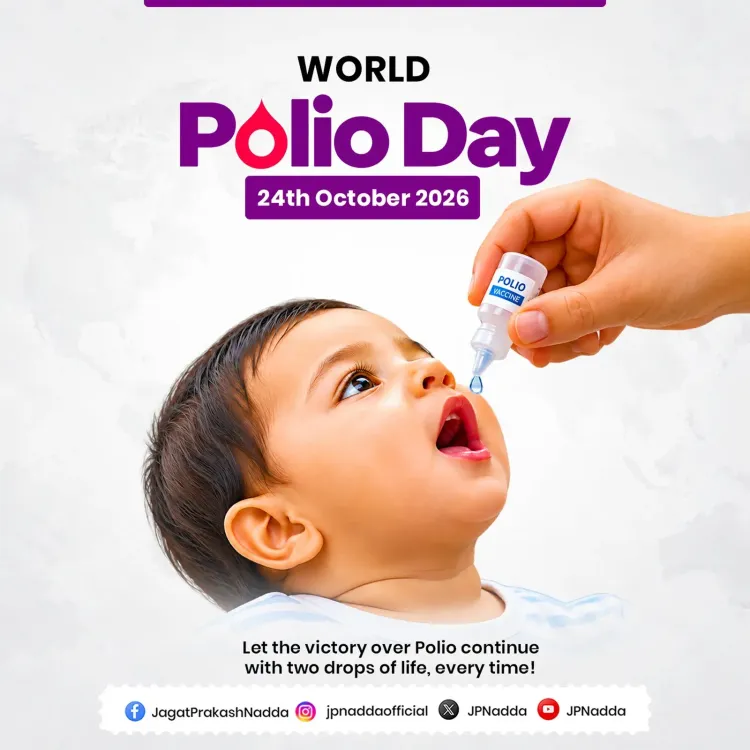
Nadda marked World Polio Day on 24 October 2026 by calling for sustained immunisation vigilance.
The Universal Immunization Programme (UIP) and supplementary Pulse Polio campaigns (launched 1995) together deliver Oral Polio Vaccine doses to all children under five.
Nadda specifically emphasised reaching remote and underserved communities as a priority to maintain high coverage.
The minister flagged poliovirus importation risk as an ongoing concern, calling for stronger surveillance systems.
Twelve years after the World Health Organization stamped India's most hard-won public health certificate, Union Health Minister J. P. Nadda on Saturday, 24 October 2026 — World Polio Day — issued a clear-eyed reminder: the fight is not over. The milestone is real, but so is the threat of poliovirus drifting back across India's borders.
From 2011's last case to a WHO-certified clean slate
The numbers tell a remarkable story. India recorded its last wild poliovirus case in January 2011, and the WHO formally certified the country polio-free in March 2014 — a feat once considered nearly impossible given the country's population density, sanitation challenges, and vast geography. The certification placed India alongside a growing list of nations that have eliminated wild poliovirus, a triumph credited in no small part to the relentless cadre of health workers who canvassed villages, slums, and migrant settlements with dropper bottles in hand.
Nadda's post on X framed the anniversary not as a celebration but as a call to sustained vigilance. 'India's polio-free status, certified by WHO in 2014, is a testament to our sustained commitment to immunisation,' he wrote, adding that the country 'must remain vigilant against the risk of poliovirus importation and strengthen our efforts to protect every child.'
The twin engines: UIP and Pulse Polio campaigns
India's defence rests on two interlocking pillars. The Universal Immunization Programme (UIP) — the country's backbone routine vaccination system — delivers free polio doses to children as part of a scheduled immunization calendar. Alongside it, supplementary immunization drives, rooted in the Pulse Polio programme launched in 1995, push additional doses of the Oral Polio Vaccine (OPV) to all children under five, regardless of prior vaccination history.
The supplementary campaigns are designed precisely for the gaps routine immunization cannot always close — nomadic families, children in flood-affected regions, communities near high-traffic border crossings where importation risk is highest. Nadda specifically flagged 'the most remote and underserved communities' as the focus of continued outreach, signalling that equity in coverage remains a non-negotiable metric.
Why importation risk keeps health planners on edge
A poliovirus does not respect a certificate. As long as wild poliovirus circulates anywhere in the world — and it still does in a small cluster of countries — every nation with an unvaccinated pocket is theoretically vulnerable. High-volume movement across India's land borders makes surveillance at transit and border points a critical early-warning layer. The Global Polio Eradication Initiative tracks exactly these corridors, and India's environmental surveillance systems — testing sewage samples for viral traces — serve as a silent, continuous tripwire.
Nadda's call to 'strengthen surveillance' is not rhetorical. It points to the unglamorous but essential infrastructure that keeps the certification credible: laboratory networks, community health workers trained to spot acute flaccid paralysis, and the rapid-response chains that would activate if a case were ever detected.
A disease that once paralysed hundreds of thousands of Indian children every year now exists here only as a memory and a warning. The health minister's message on World Polio Day is simple and unsparing: keep it that way.
Point of View
Keeping importation risk alive for high-traffic nations like India. His dual emphasis on equity (reaching remote communities) and surveillance signals that India's public health establishment views the 2014 certification not as a finish line but as a floor to defend. The framing also reinforces the BJP-led government's broader health-diplomacy narrative, positioning India as a model for large-scale immunization in the developing world. With annual immunization coverage reports upcoming, the political and public health stakes of maintaining that story are significant.
NationPress
24 Oct 2026
Frequently Asked Questions
When did WHO certify India as polio-free?
The WHO certified India polio-free in March 2014 , three years after the country's last recorded wild poliovirus case in January 2011 .
What is the Universal Immunization Programme in India?
The Universal Immunization Programme (UIP) is India's national routine vaccination system that provides free vaccines, including the Oral Polio Vaccine , to children as part of a scheduled immunization calendar.
What is the Pulse Polio programme and when did it start?
The Pulse Polio programme is a supplementary immunization initiative launched in 1995 that administers extra doses of the Oral Polio Vaccine to all children under five during periodic national drives, complementing routine immunization.
Why is poliovirus importation a risk even for polio-free countries?
As long as wild poliovirus circulates in any part of the world, countries with unvaccinated pockets face the risk of the virus crossing borders through travel and migration, making high immunization coverage and strong surveillance essential even after achieving polio-free status.
What did J. P. Nadda say on World Polio Day 2026?
Union Health Minister J. P. Nadda called for sustained vigilance against poliovirus importation, reaffirmed India's commitment to the Universal Immunization Programme and supplementary OPV campaigns, and stressed the need to reach remote communities and strengthen surveillance so 'no child is left unprotected.'