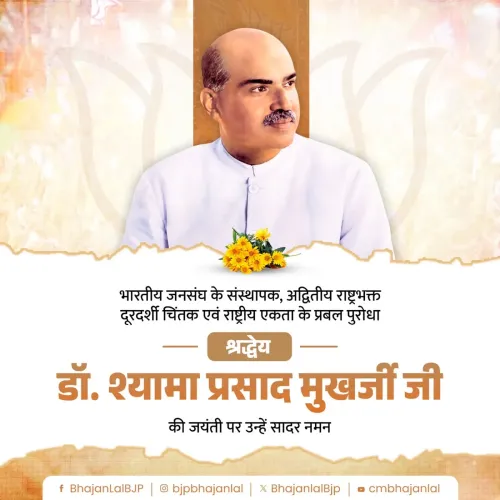
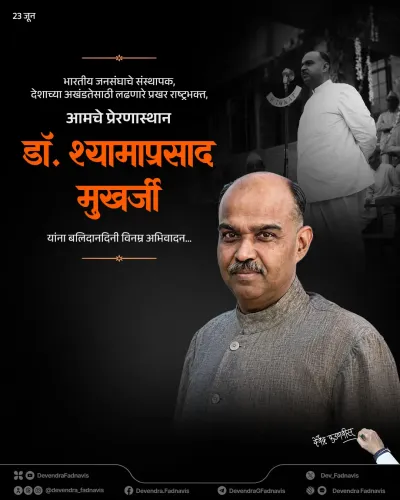
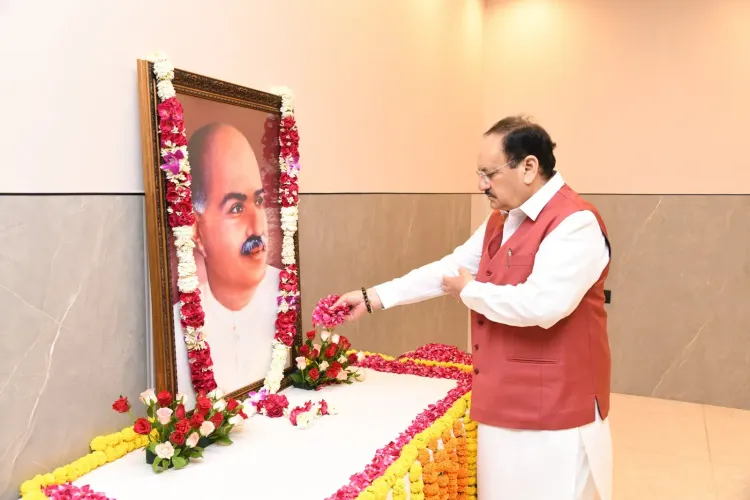
Nadda pays floral tribute to Dr. Shyama Prasad Mookerjee on Balidan Diwas
Synopsis
Union Health Minister and BJP national president J. P. Nadda paid floral tribute to Dr. Shyama Prasad Mookerjee at his portrait in New Delhi on 23 June 2026, the 73rd anniversary of the Jana Sangh founder's death in detention in Srinagar. Nadda credited Mookerjee with championing Jammu and Kashmir's integration and West Bengal's place within India.
Key Takeaways
Nadda paid floral tribute to Dr.
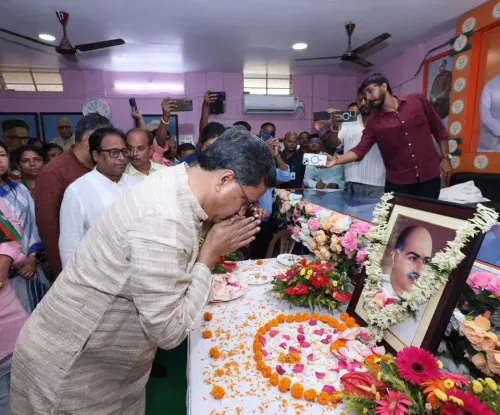
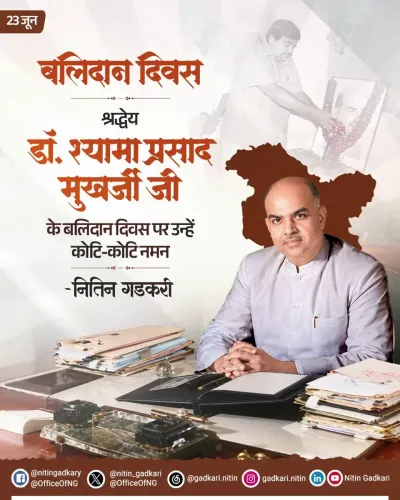
Shyama Prasad Mookerjee at his portrait in New Delhi on 23 June 2026 , the Balidan Diwas (martyrdom anniversary).
Mookerjee died on 23 June 1953 in Srinagar while under detention, having entered Jammu and Kashmir to protest the permit system restricting entry from other Indian states.
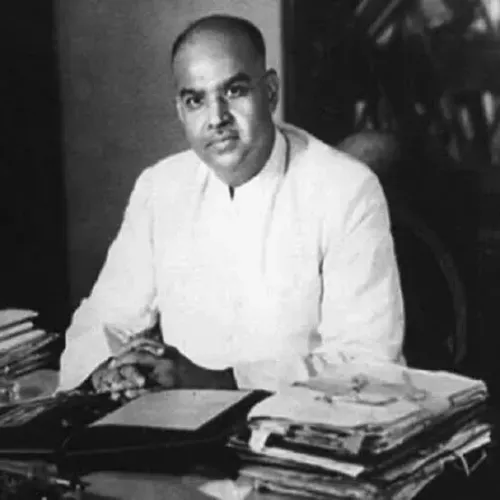
Mookerjee founded the Bharatiya Jana Sangh in 1951 , the ideological predecessor of the BJP , to provide a political platform prioritising national interest.
Nadda credited Mookerjee with a key role in keeping West Bengal within India during post-independence reorganisation debates.
The BJP links Mookerjee's campaign for Jammu and Kashmir 's full integration to the abrogation of Article 370 in 2019 .
Nadda described the BJP as the 'world's largest political organisation' and Mookerjee as an 'inspiration for crores of workers.'
Union Health Minister and BJP national president J. P. Nadda paid floral tribute to Dr. Shyama Prasad Mookerjee at his portrait in New Delhi on Tuesday, 23 June 2026, marking the founder of the Bharatiya Jana Sangh's Balidan Diwas (martyrdom anniversary). Nadda hailed Mookerjee as a 'great thinker, source of inspiration for crores of workers, and a foundational pillar of the world's largest political organisation, the Bharatiya Janata Party.'
Context
Dr. Shyama Prasad Mookerjee died on 23 June 1953 in Srinagar while under detention, having entered Jammu and Kashmir in protest against the permit system that required citizens of other Indian states to obtain a permit before entering the region. His death occurred 73 years before this tribute. Nadda's post, written in Hindi, stated that Mookerjee 'gave up his very life to keep Jammu and Kashmir an integral part of India' — 'जम्मू-कश्मीर को भारत का अभिन्न अंग बनाए रखने के लिए अपने प्राण तक न्यौछावर कर दिए.'
Mookerjee had resigned from the Union Cabinet of Prime Minister Jawaharlal Nehru in 1950 over differences on the treatment of Hindu minorities in East Pakistan and the terms of the Nehru–Liaquat Pact. He went on to found the Bharatiya Jana Sangh in 1951, positioning it as a political platform that placed national interest above regional special arrangements.
Policy Backdrop
The tribute carries explicit policy resonance. Nadda's post also noted that Mookerjee 'played an important role in the ideological and practical struggle to keep West Bengal a part of India' — a reference to his opposition to partition proposals that could have altered the state's status during the post-independence reorganisation period.
The abrogation of Article 370 in August 2019, which revoked the special constitutional status of Jammu and Kashmir, is widely regarded by the BJP as the fulfilment of an ideological demand traceable directly to Mookerjee's campaign and sacrifice. Successive BJP governments have used the 23 June anniversary to reinforce this narrative of territorial integrity and continuity of political purpose from the Jana Sangh era to the present.
Stakeholders and Impact
Nadda's tribute is addressed to the BJP's vast organisational base — a party that claims to be the world's largest political organisation by membership. The post specifically describes Mookerjee as an 'inspiration for crores of workers,' signalling that the commemoration is as much an internal mobilisation moment as a public statement.
Beyond party workers, the tribute invokes Mookerjee's contributions to education and industrial development, areas in which he served as a minister in undivided Bengal and at the Centre. Nadda stated, 'We will forever remain indebted to him for his immense contributions in the fields of national unity and integrity, national welfare, education, and industrial development.'
What's Next
The annual Balidan Diwas commemoration typically prompts a cycle of statements from BJP leaders at the national and state levels, and is often accompanied by party programmes in West Bengal — a state that remains electorally significant for the BJP. Observers will watch whether this year's commemorations are accompanied by fresh policy announcements framed around Mookerjee's legacy in education or industrial development, particularly as the party positions itself ahead of the next general election cycle. The invocation of Mookerjee's role in keeping West Bengal within India also signals continued BJP focus on the state as a political battleground.
Point of View
Nadda — simultaneously the BJP's national president and a senior Union minister — reinforces the ideological thread connecting the Jana Sangh's foundational demands to the BJP's current governance record, most visibly the 2019 abrogation of Article 370. The dual mention of West Bengal and Jammu and Kashmir is not incidental; both remain high-stakes political territories for the party. Framing Mookerjee's legacy around education and industrial development alongside territorial integrity also broadens the tribute beyond its usual nationalist register, signalling the party's intent to claim a wider developmental inheritance from its ideological forebear ahead of future electoral cycles.
NationPress
21 Sept 2026
Frequently Asked Questions
Who was Dr. Shyama Prasad Mookerjee and why is 23 June observed as Balidan Diwas?
Dr. Shyama Prasad Mookerjee was the founder of the Bharatiya Jana Sangh in 1951 and a former Union minister. He died on 23 June 1953 in detention in Srinagar after entering Jammu and Kashmir to protest the permit system that restricted entry by citizens of other Indian states, and the day is observed as his martyrdom anniversary, or Balidan Diwas.
What did J. P. Nadda say about Dr. Mookerjee on Balidan Diwas 2026?
J. P. Nadda described Dr. Mookerjee as a 'great thinker, source of inspiration for crores of workers, and a foundational pillar of the BJP.' He stated that Mookerjee gave up his life to keep Jammu and Kashmir an integral part of India and played a crucial role in keeping West Bengal within India, and that the nation would remain forever indebted for his contributions to unity, education, and industrial development.
What is the connection between Dr. Shyama Prasad Mookerjee and Article 370?
Dr. Mookerjee opposed the special status granted to Jammu and Kashmir under Article 370 and the permit system that treated the region differently from the rest of India. The BJP regards the abrogation of Article 370 in August 2019 as the fulfilment of the ideological demand Mookerjee championed at the cost of his life.
What was the Bharatiya Jana Sangh and how is it related to the BJP?
The Bharatiya Jana Sangh was a political party founded by Dr. Shyama Prasad Mookerjee in 1951 to provide a national-interest-first political alternative. It is the ideological predecessor of the Bharatiya Janata Party (BJP) , which was formed in 1980 after the Jana Sangh merged into the Janata Party and subsequently re-emerged as the BJP.
What role did Dr. Mookerjee play regarding West Bengal?
Dr. Shyama Prasad Mookerjee played a significant ideological and practical role in opposing partition proposals that could have altered West Bengal 's status within India during the post-independence period. The BJP credits him with ensuring the state remained an integral part of the Indian Union.