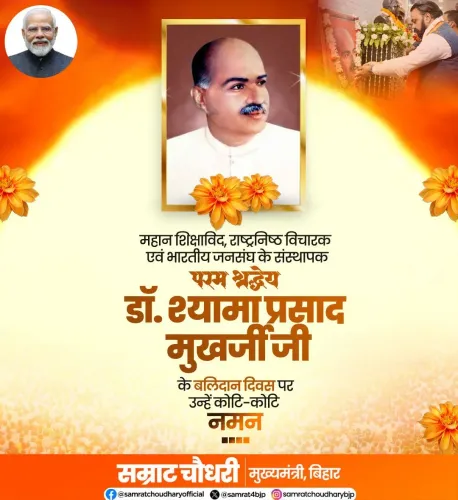
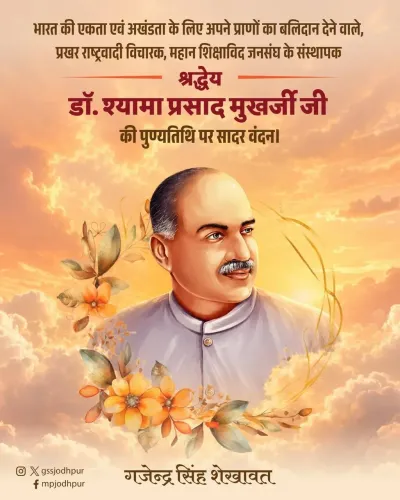
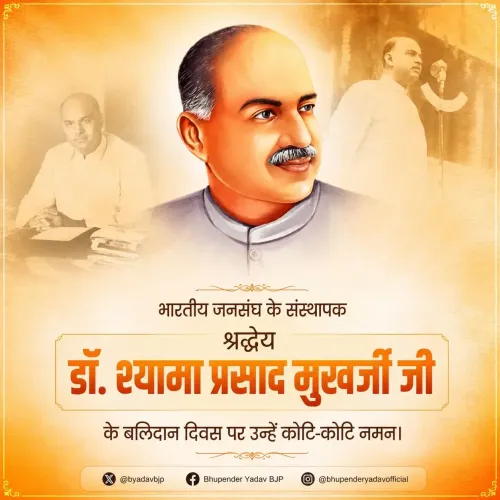
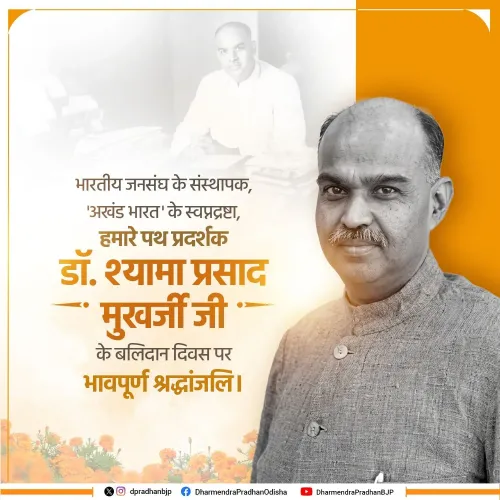
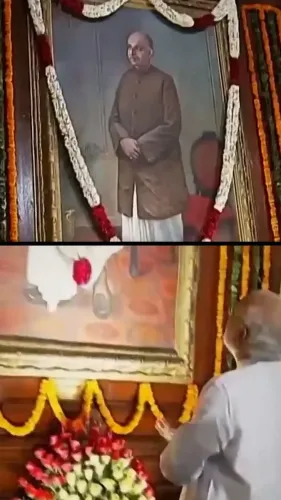
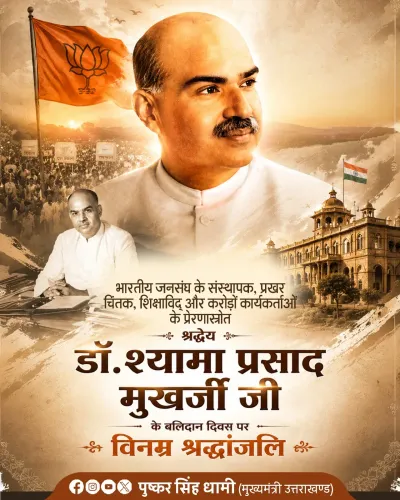
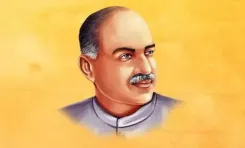
Nadda pays tribute to Jana Sangh founder Shyama Prasad Mukherjee
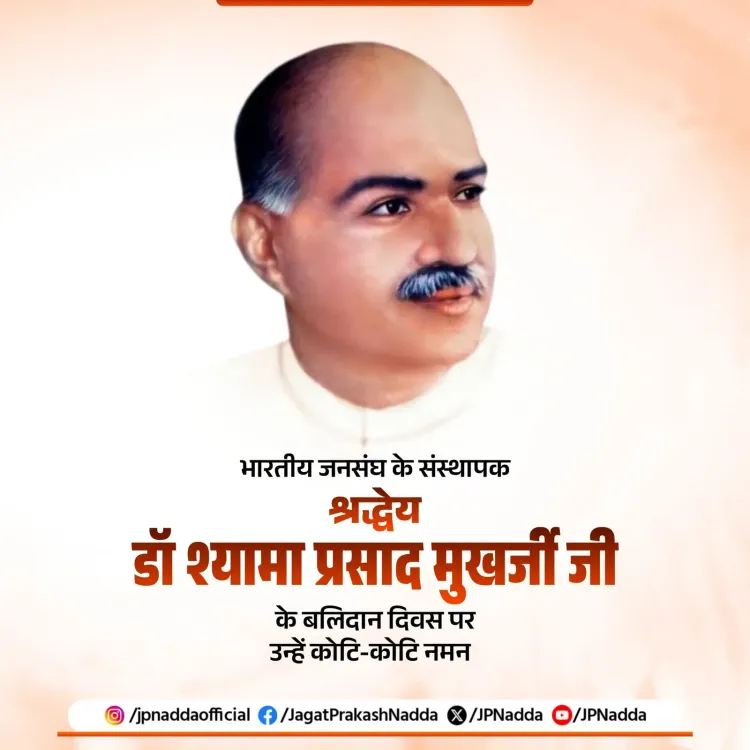
Synopsis
Union Health Minister and BJP president J. P. Nadda paid tribute to Jana Sangh founder Dr. Shyama Prasad Mukherjee on his 2026 martyrdom anniversary, calling him a lighthouse for BJP workers and linking his 'One Nation, One Constitution' vision to the party's present governance record.
Key Takeaways
Nadda , Union Health Minister and BJP national president, paid tribute to Dr.
Shyama Prasad Mukherjee on his martyrdom anniversary, 23 June 2026 .
Nadda invoked Mukherjee's slogan 'Ek Rashtra, Ek Nishan, Ek Vidhan' (One Nation, One Flag, One Constitution) as the cornerstone of his legacy.
Mukherjee founded the Bharatiya Jana Sangh in 1951 and died in detention in 1953 while protesting Jammu and Kashmir's special status.
Parliament abrogated Article 370 in 2019 , which the BJP has consistently described as the fulfilment of Mukherjee's vision.
Nadda described cultural nationalism — from the Jana Sangh to today's BJP — as 'proof of Mukherjee's foresight.' The tribute reinforces the BJP's annual practice of linking its current governance agenda to its founding ideological lineage.
Union Health Minister and BJP national president J. P. Nadda on Tuesday, 23 June 2026 paid tribute to Dr. Shyama Prasad Mukherjee, founder of the Bharatiya Jana Sangh, on his Balidan Diwas (martyrdom anniversary), honouring him as a fervent nationalist thinker and selfless servant of the nation.
Context
Nadda's post, written in Hindi, offered what he described as 'kotishः naman' (countless salutations) to Mukherjee, calling his life 'deshbhakti, tyaag aur atal sankalp ka jeevant udaaharan' — 'a living example of patriotism, sacrifice, and unwavering resolve.' He specifically invoked Mukherjee's celebrated slogan 'Ek Rashtra, Ek Nishan, Ek Vidhan' (One Nation, One Flag, One Constitution), crediting it with making him not merely a thinker but a 'truth-committed servant dedicated to the protection of the nation.'
Nadda also drew a direct ideological line from the Bharatiya Jana Sangh to today's Bharatiya Janata Party, calling cultural nationalism the proof of Mukherjee's foresight and 'the true fruit of genuine loyalty.' He concluded that Mukherjee's teachings and ideals would 'always serve as a lighthouse for crores of BJP workers.'
Policy Backdrop
Dr. Shyama Prasad Mukherjee founded the Bharatiya Jana Sangh in 1951 to champion integral nationalism and resist regional separatism. He died in detention in 1953 while protesting the special constitutional status granted to Jammu and Kashmir under Article 370, a status that required a separate permit for Indians to enter the state — a condition Mukherjee refused to accept.
His slogan 'One Nation, One Constitution' remained a defining demand of the Jana Sangh and its successor, the BJP, for nearly seven decades. In August 2019, Parliament abrogated Article 370, ending Jammu and Kashmir's special status — an act the BJP explicitly framed as the fulfilment of Mukherjee's vision. The Jana Sangh itself was dissolved into the Janata Party in 1977 before its core elements reconstituted as the BJP in 1980.
Stakeholders and Impact
The tribute is directed primarily at BJP workers and nationalist organisations, reinforcing the party's self-image as the ideological heir to Mukherjee's legacy. Annual observances on 23 June serve as an internal party ritual that connects rank-and-file members to the founding narrative of cultural nationalism.
For the broader public, the post reiterates the BJP's governing philosophy — that constitutional uniformity measures adopted since 2014, including the abrogation of Article 370, are not departures from tradition but the culmination of a decades-old ideological commitment. Mukherjee's legacy also resonates with groups advocating a Uniform Civil Code, another long-standing BJP plank.
What's Next
Senior BJP leaders across states are expected to hold commemorative events and issue statements through the day, as is customary on Mukherjee's martyrdom anniversary. Analysts will watch whether his legacy is invoked in upcoming parliamentary debates on federalism or the Uniform Civil Code, both of which carry echoes of his 'one nation' framework. The BJP's continued elevation of Mukherjee's memory signals that cultural nationalism will remain a central organising theme for the party heading into future electoral cycles.
Point of View
One Constitution' slogan on the martyrdom anniversary, the BJP president draws an unbroken line from a 1951 founding moment to the 2019 abrogation of Article 370 and beyond. The ritual serves a dual purpose — energising the party's cadre base while signalling to the broader electorate that the BJP's integration agenda is rooted in historical conviction rather than electoral opportunism. With debates on the Uniform Civil Code and federalism periodically resurfacing in Parliament, keeping Mukherjee's memory alive gives the party a ready ideological anchor. The consistency of these annual observances across the BJP's leadership suggests they are less spontaneous homage and more a structured part of the party's political calendar.
NationPress
23 Jun 2026
Frequently Asked Questions
Who was Dr. Shyama Prasad Mukherjee?
Dr. Shyama Prasad Mukherjee was an Indian politician who founded the Bharatiya Jana Sangh in 1951 to advocate integral nationalism. He died in detention in 1953 while protesting the special constitutional status of Jammu and Kashmir under Article 370.
Why is 23 June observed as Balidan Diwas?
23 June is observed as Balidan Diwas (martyrdom day) because Dr. Shyama Prasad Mukherjee died on this date in 1953 while in detention in Jammu and Kashmir, where he had gone to protest the requirement for a special permit for Indians to enter the state.
What does 'Ek Rashtra, Ek Nishan, Ek Vidhan' mean?
The slogan translates to 'One Nation, One Flag, One Constitution.' It was Dr. Mukherjee's demand that Jammu and Kashmir be fully integrated into India without any special constitutional status, and it became a defining ideological plank of the Jana Sangh and later the BJP.
What is the connection between Jana Sangh and the BJP?
The Bharatiya Jana Sangh , founded by Dr. Mukherjee in 1951 , merged into the Janata Party in 1977 . Its core members reconstituted as the Bharatiya Janata Party in 1980 , carrying forward the Jana Sangh's ideology of cultural nationalism.
What did J. P. Nadda say about Shyama Prasad Mukherjee?
J. P. Nadda called Mukherjee's life 'a living example of patriotism, sacrifice, and unwavering resolve,' described his teachings as a 'lighthouse' for BJP workers, and credited the 'Ek Rashtra, Ek Vidhan' vision with shaping the BJP's cultural nationalist agenda.