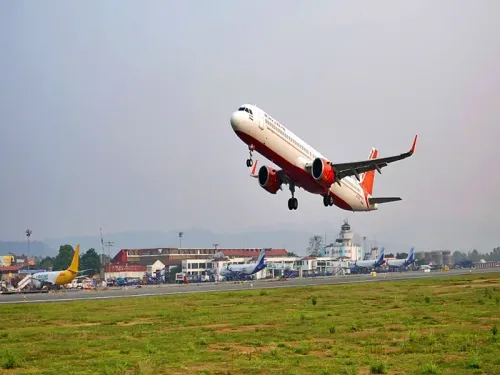
Air India to fly direct from Guwahati to Dubai, Abu Dhabi

Synopsis
Air India will operate direct flights from Guwahati to Dubai and Abu Dhabi, the Chief Minister's Office of Assam announced on 23 June 2026. The routes mark a major connectivity breakthrough for Northeast India, benefiting the Assamese diaspora, migrant workers and the regional trade and tourism sectors.
Key Takeaways
Air India will launch direct flights from Guwahati to Dubai and Abu Dhabi , as announced by the Chief Minister's Office of Assam on 23 June 2026 .
Guwahati is the primary international airport for Northeast India and has until now lacked direct Gulf routes.
The move benefits the Assamese diaspora, migrant workers, students and business travellers currently forced to connect through Delhi or Mumbai .
Air India was acquired by Tata Sons in January 2022 and has since expanded its network to secondary Indian cities.
Exact launch dates, frequencies and aircraft type are yet to be officially confirmed.
The announcement aligns with CM Himanta Biswa Sarma's broader push to integrate Assam into global aviation and trade networks.
The Chief Minister's Office of Assam announced on Tuesday, 23 June 2026 that Air India will launch direct flights connecting Guwahati to Dubai and Abu Dhabi, marking a significant step in expanding international aviation access from Northeast India. The announcement was shared by the official CMO Assam handle on X, signalling the Assam government's active role in brokering the connectivity push.
Context
Guwahati's Lokpriya Gopinath Bordoloi International Airport is the primary gateway to the eight northeastern states but has historically lacked direct long-haul international routes, forcing travellers to connect through Delhi or Mumbai. A direct link to the UAE addresses a long-standing demand from the Assamese diaspora, migrant workers, students and business travellers who must currently make multi-leg journeys to reach the Gulf.
The announcement comes under the watch of Chief Minister Himanta Biswa Sarma, who has consistently championed aviation expansion as a lever for Assam's economic integration with global markets since taking office in May 2021.
Policy Backdrop
India's UDAN regional connectivity scheme, launched in 2016, laid the groundwork for airport development across tier-2 and tier-3 cities in the Northeast, subsidising routes and upgrading infrastructure. While UDAN primarily targeted domestic connectivity, the investments it triggered at airports like Guwahati have made international expansion more viable.
Air India, acquired by Tata Sons in January 2022, has since pursued aggressive network expansion, adding new international destinations from cities beyond the traditional metro hubs. The Guwahati-Gulf routes fit squarely within this post-privatisation strategy of tapping underserved markets with strong passenger demand.
Stakeholders and Impact
The most immediate beneficiaries are the sizeable Assamese and broader Northeast Indian workforce in the UAE, who send remittances home and currently bear the cost and inconvenience of connecting flights. Direct routes are expected to reduce travel time significantly and lower effective fares by eliminating transit costs.
The tourism and trade sectors stand to gain as well. Dubai functions as a global transit and commerce hub, and a direct air bridge could open new channels for Assam's tea, silk and horticultural exports while drawing Gulf-based tourists to the Northeast's natural and cultural attractions. Abu Dhabi's expanding bilateral aviation ties with India further reinforce the strategic timing of this announcement.
What's Next
Exact launch dates, flight frequencies and aircraft type for the new routes have not yet been officially confirmed. Stakeholders and travellers will be watching for Air India's formal schedule release, including fare structures that will determine whether the routes are commercially accessible to migrant workers and not just premium travellers.
The broader question is whether this marks the beginning of a wider Gulf connectivity push from Northeast airports. Routes from Dibrugarh and Imphal have been discussed in policy circles, and a successful Guwahati-Dubai-Abu Dhabi launch could accelerate those conversations. For Assam, direct international flights represent more than convenience — they are a statement of the state's growing economic ambition.
Point of View
Not just a commercial airline. For CM Himanta Biswa Sarma, securing direct UAE routes serves a dual purpose: it delivers a tangible win for the Assamese diaspora while repositioning the Northeast as a connected, investable region rather than a landlocked periphery. The timing — mid-2026, well ahead of the next Assam assembly election cycle — suggests the government is keen to bank visible infrastructure gains. The real test will be whether Air India prices the routes accessibly enough to serve migrant workers, the demographic with the greatest need, or whether the flights cater primarily to business and premium travellers.
NationPress
23 Jun 2026
Frequently Asked Questions
When will Air India start direct flights from Guwahati to Dubai and Abu Dhabi?
The exact launch date has not yet been officially confirmed. The Chief Minister's Office of Assam announced the plan on 23 June 2026 ; Air India's formal schedule, including start dates and frequencies, is awaited.
Which airport in Guwahati will operate these international flights?
Lokpriya Gopinath Bordoloi International Airport in Guwahati is the city's sole commercial airport and will handle the new Dubai and Abu Dhabi routes.
Why is a direct Guwahati-Dubai flight significant for Northeast India?
Travellers from Northeast India currently have no direct Gulf route and must connect through Delhi or Mumbai , adding time and cost. A direct service will benefit the large Assamese diaspora, migrant workers, students and the region's trade and tourism sectors.
Who owns Air India and why is it expanding to smaller cities?
Air India was acquired by Tata Sons in January 2022 . As part of its post-privatisation strategy, the carrier has pursued fleet modernisation and network expansion to underserved cities with strong latent demand, including Guwahati .
What is Assam CM Himanta Biswa Sarma's role in the Air India Guwahati-Gulf route?
Chief Minister Himanta Biswa Sarma has been a vocal advocate for improving aviation connectivity in Assam since taking office in May 2021 . His office's announcement of the Air India routes reflects the state government's active engagement in lobbying for and publicising new international air links.