Nadda Unveils Bhavya Rasayan Park Plan for $1 Trillion Chemical Market
Synopsis
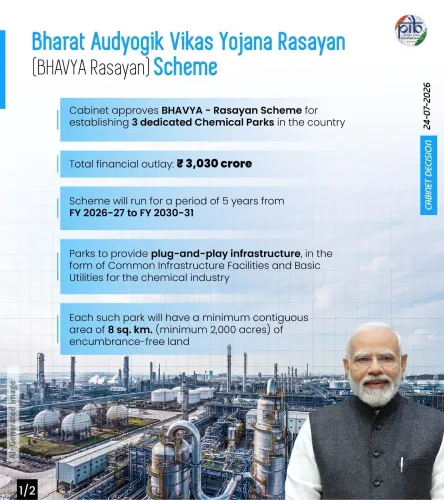
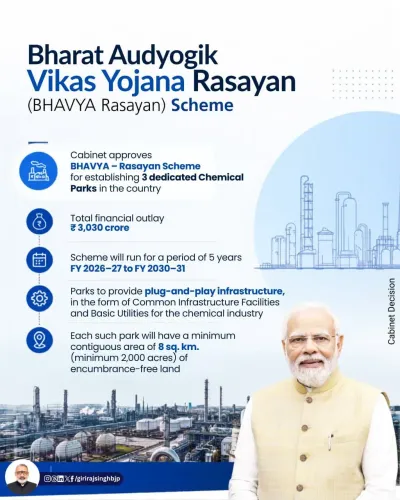
Union Minister J. P. Nadda unveiled the Bhavya Rasayan Park scheme, committing up to ₹1,000 crore from the Centre and ₹500 crore from states per park, with a 2,000-acre land minimum and a target to build a $1 trillion Indian chemical market by 2040.
Key Takeaways
The Bhavya Rasayan Park scheme envisages up to ₹1,000 crore central investment and at least ₹500 crore state investment per park.
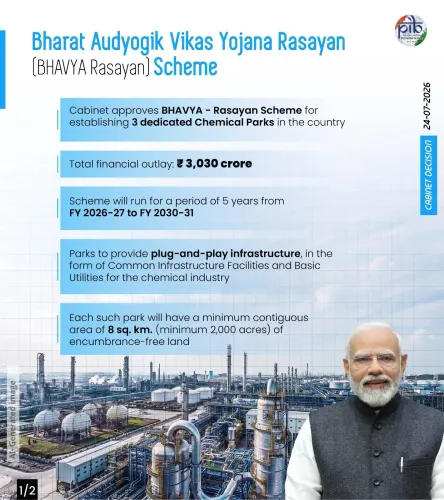
Each park must have a minimum land footprint of 2,000 acres with strong connectivity infrastructure.
The scheme targets building India into a $1 trillion chemical market by 2040 .
The Central Government will assist industries by facilitating environmental clearances .
The scheme builds on the logic of the PCPIR policy (2007) , which promoted integrated investment regions for the chemical sector.
State governments are co-investors, making them financial stakeholders alongside the Centre.
A ₹1,500 crore combined central-state investment, a minimum of 2,000 acres of dedicated land per park, and a hard deadline of 2040 — Union Minister of Chemicals and Fertilizers J. P. Nadda has laid out the structural blueprint of the Bhavya Rasayan Park scheme, positioning it as the cornerstone of India's ambition to build a $1 trillion chemical market within the next fifteen years.
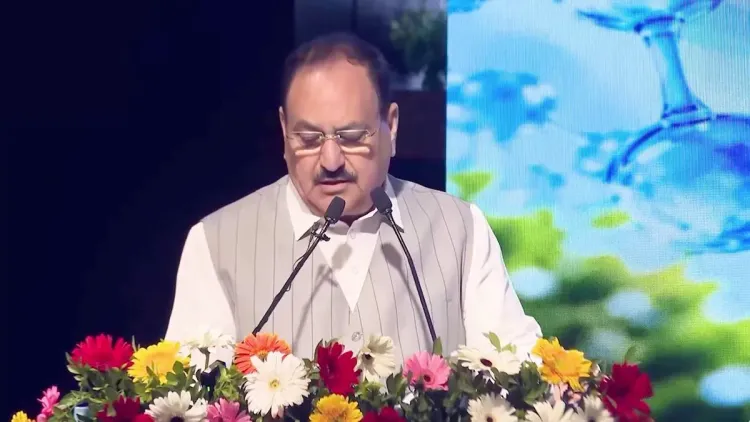
In a post on X on Thursday, October 22, 2026, Nadda detailed the financing architecture: the Central Government will invest up to ₹1,000 crore per park, while the state government partner commits a minimum of ₹500 crore. Beyond capital, the Centre has pledged active support in securing environmental clearances — historically one of the sharpest bottlenecks slowing industrial park development in India.
The $1 Trillion Target and What It Demands
India's chemicals sector is already among the world's largest, but scaling it to a $1 trillion market by 2040 demands a step-change in infrastructure, not just policy intent. The Bhavya Rasayan Park scheme attempts precisely that: purpose-built parks with strong connectivity — road, rail, and port access — so that raw material in and finished product out stops being an operational liability for manufacturers.
The 2,000-acre minimum land footprint signals that these will not be small industrial estates. They are conceived as full-scale investment regions — echoing the logic of the Petroleum, Chemicals and Petrochemicals Investment Regions (PCPIR) policy first notified in 2007, which sought to cluster chemical activity at scale to drive competitiveness. The Bhavya Rasayan Park scheme appears to iterate on that foundation, adding a more defined central funding commitment and a sharper 2040 market-size anchor.
Central-State Co-investment as the Operating Model
The ₹1,000 crore central + ₹500 crore state formula is significant in design. It makes state governments genuine financial stakeholders — not just land providers — while keeping the Centre in the driver's seat on environmental approvals, which often require coordination across multiple central agencies. For chemical manufacturers, the promise of clearance facilitation could be as valuable as the capital subsidy itself.
Successive governments have pushed dedicated industrial infrastructure — from investment regions to chemical corridors — as the mechanism to reduce India's dependence on imported chemicals and intermediates, and to embed the country deeper into global chemical value chains. The Bhavya Rasayan Park scheme carries that lineage forward with explicit fiscal commitments on both sides of the federal balance sheet.
What Determines Whether the Parks Actually Deliver
Announcement and execution are different animals in Indian industrial policy. The critical variables now are which states sign on first and how quickly they identify and transfer the 2,000-acre parcels required. Environmental clearance timelines — even with central facilitation — have historically run long, and the chemical sector's regulatory complexity means the Centre's promise of 'favourable environment' will be tested early.
Budget disbursement sequencing and the conditions tied to the ₹1,000 crore central tranche will also shape industry interest. If the parks attract anchor tenants from specialty chemicals, agrochemicals, and petrochemicals — sectors where India already has manufacturing depth — the 2040 target starts to look less aspirational and more achievable.
Fifteen years is a short runway to build a trillion-dollar industry. The parks are the land. The real race is filling them.
Point of View
Binding state governments into co-ownership rather than passive hosts. By anchoring the scheme to a $1 trillion market target by 2040, Nadda frames industrial park infrastructure as a national economic mission — not a departmental line item. The PCPIR experience shows that land and capital alone do not guarantee uptake; the real test is whether the environmental clearance facilitation promise translates into measurable timeline reductions. If it does, the scheme could genuinely shift India's position in global chemical value chains.
NationPress
22 Oct 2026
Frequently Asked Questions
What is the Bhavya Rasayan Park scheme?
The Bhavya Rasayan Park scheme is a central government initiative to develop large chemical industrial parks across India, with the Centre investing up to ₹1,000 crore and state governments contributing at least ₹500 crore per park, each covering a minimum of 2,000 acres.
What is India's chemical market target by 2040?
Under the scheme, India aims to build a $1 trillion chemical market by 2040, with the Bhavya Rasayan Parks serving as key infrastructure to attract large-scale investment.
Who announced the Bhavya Rasayan Park scheme?
Union Minister of Chemicals and Fertilizers J. P. Nadda announced the scheme's investment structure and targets on October 22, 2026.
How will the Central Government help with environmental clearances for chemical parks?
The Central Government has pledged to assist industries in obtaining environmental clearances to ensure a smoother regulatory environment within the Bhavya Rasayan Parks.
What is the PCPIR policy and how does it relate to Bhavya Rasayan Parks?
The Petroleum, Chemicals and Petrochemicals Investment Regions (PCPIR) policy, notified in 2007, established the concept of integrated investment regions for India's chemical sector. The Bhavya Rasayan Park scheme builds on this lineage with more defined central-state co-funding commitments.