Cabinet Approves BHAVYA Rasayan Scheme for 3 Chemical Parks
Synopsis
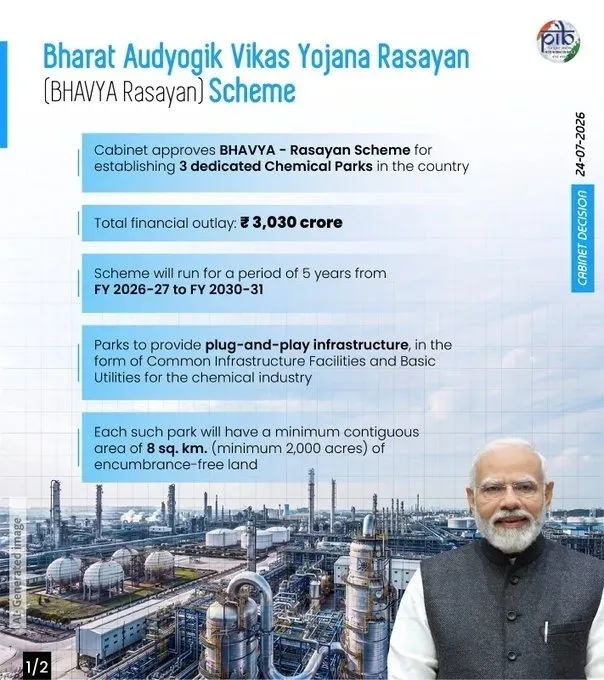
The Union Cabinet has approved the BHAVYA Rasayan Scheme with a ₹3,030 crore outlay to establish three dedicated Chemical Parks in India, aiming to build plug-and-play infrastructure, attract investment, boost exports, and advance the Atmanirbhar Bharat and Viksit Bharat 2047 goals.
Key Takeaways
The Union Cabinet, chaired by Prime Minister Narendra Modi , approved the BHAVYA Rasayan Scheme on 25 July 2026 .
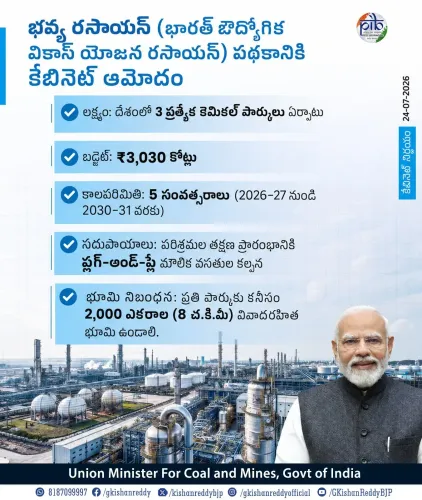
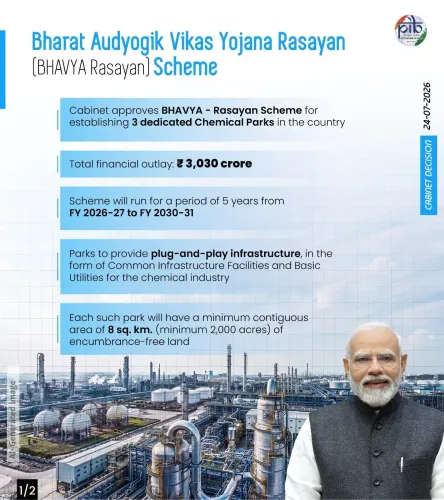
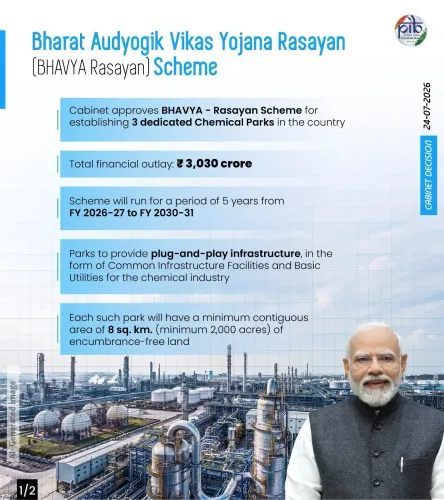
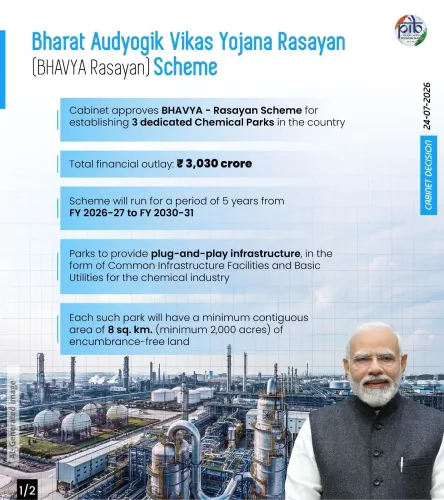
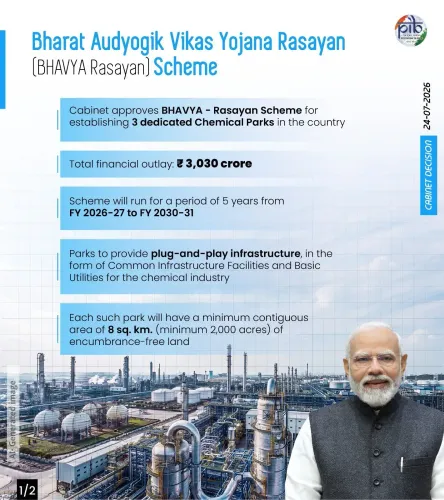
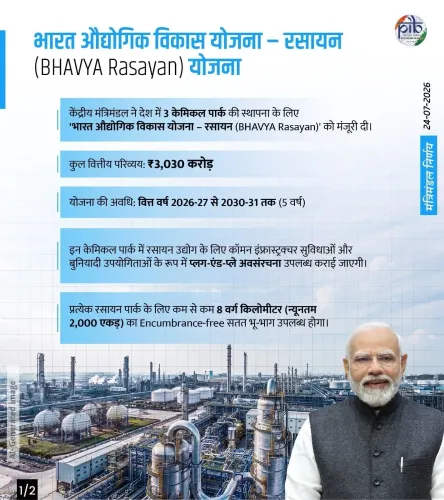
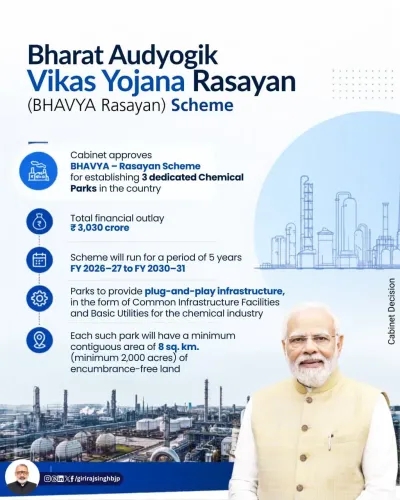
The scheme carries a total financial outlay of ₹3,030 crore for establishing 3 dedicated Chemical Parks across India.
The parks will offer plug-and-play infrastructure , reducing entry barriers for chemical manufacturers including small and medium enterprises.
Key objectives include import substitution , export promotion, employment generation, and integration with global value chains .
The scheme explicitly links to the Atmanirbhar Bharat self-reliance initiative and the Viksit Bharat 2047 long-term development vision.
Site selection for the three parks and implementation guidelines from the Department of Chemicals and Petrochemicals are the immediate next steps.
Union Coal and Mines Minister G. Kishan Reddy announced on Friday, 25 July 2026 that the Union Cabinet, chaired by Prime Minister Narendra Modi, has approved the BHAVYA Rasayan Scheme — a dedicated initiative to establish three Chemical Parks across India with a total financial outlay of ₹3,030 crore.
Context
The Cabinet decision, shared by the minister on social media, positions BHAVYA Rasayan as a flagship instrument to build 'world-class plug-and-play infrastructure' for chemical manufacturing in India. The scheme is designed to attract investments, boost exports, generate employment, and promote environmentally sustainable industrial growth, according to the minister's post.
Kishan Reddy noted that the scheme would 'foster the development of upstream, downstream and ancillary industries, improve logistics efficiency, and enhance India's integration with global value chains' — language that signals an intent to embed Indian chemical producers within international supply networks rather than operate in isolation.
Policy Backdrop
India's push for dedicated chemical industrial zones has a long policy lineage. The Petroleum, Chemicals and Petrochemicals Investment Regions (PCPIR) policy, notified in 2007, first sought to develop integrated chemical industry clusters. Make in India, launched in September 2014, subsequently accelerated the manufacturing agenda and sought to reduce import dependence across sectors, including chemicals.
The Atmanirbhar Bharat package of May 2020 further extended production-linked incentives and infrastructure support to process industries. BHAVYA Rasayan fits squarely within this lineage, explicitly invoking both Atmanirbhar Bharat and the government's long-term vision of Viksit Bharat 2047 — a target for India to achieve developed-economy status by the centenary of Independence.
India carries a significant import bill in both organic and inorganic chemicals, a structural vulnerability that successive governments have sought to address through cluster-based industrial policy. The emphasis on plug-and-play facilities and logistics integration in BHAVYA Rasayan reflects lessons from earlier schemes where infrastructure gaps slowed private investment uptake.
Stakeholders and Impact
The primary beneficiaries of the scheme are expected to be chemical manufacturers, industrial investors, and export-oriented businesses in the sector. Plug-and-play infrastructure — where utilities, roads, effluent treatment, and logistics are pre-built — lowers the entry barrier for small and medium enterprises that cannot individually finance large-scale common infrastructure.
The scheme's explicit focus on import substitution is aimed at reducing India's dependence on chemical imports, particularly from China, which has dominated global chemical supply chains. Environmental sustainability provisions embedded in the scheme are intended to meet both domestic regulatory standards and the compliance requirements of international buyers.
Employment generation and ancillary industry development are cited as secondary outcomes, suggesting the parks are expected to generate multiplier effects beyond the primary chemical manufacturing units that anchor them.
What's Next
The immediate next steps involve the selection of sites for the three Chemical Parks and the release of detailed implementation guidelines by the Department of Chemicals and Petrochemicals. Site selection will be closely watched by state governments, as hosting a designated Chemical Park carries significant infrastructure investment and long-term employment potential.
Subsequent investment commitments and employment projections from private players will serve as early indicators of scheme traction. If BHAVYA Rasayan succeeds in attracting both domestic and foreign capital, it could mark a meaningful step in repositioning India as a credible alternative hub in global chemical value chains — a goal that has eluded earlier policy frameworks despite sustained effort.
Point of View
Much of it sourced from China. By framing the scheme around plug-and-play infrastructure, the government is tacitly acknowledging that earlier cluster policies stalled because private investors were unwilling to fund common infrastructure themselves. Anchoring the scheme within both Atmanirbhar Bharat and Viksit Bharat 2047 also serves a political function — it embeds a sectoral industrial policy within the government's overarching national narrative, making it harder for future administrations to quietly shelve. The real test will be site selection and whether state governments can move fast enough on land acquisition and clearances to make the parks operational within a credible timeline.
NationPress
22 Oct 2026
Frequently Asked Questions
What is the BHAVYA Rasayan Scheme?
The BHAVYA Rasayan Scheme is a Union Cabinet-approved initiative to establish three dedicated Chemical Parks in India with a total financial outlay of ₹3,030 crore, aimed at creating plug-and-play infrastructure for chemical manufacturing, attracting investment, boosting exports, and promoting import substitution.
How much money has the government allocated for BHAVYA Rasayan?
The government has approved a total financial outlay of ₹3,030 crore for the BHAVYA Rasayan Scheme.
How many Chemical Parks will be built under BHAVYA Rasayan?
Three dedicated Chemical Parks will be established across India under the BHAVYA Rasayan Scheme.
What does plug-and-play infrastructure mean for chemical parks?
Plug-and-play infrastructure means that utilities, roads, effluent treatment facilities, and logistics are pre-built within the park, allowing chemical manufacturers to set up operations without individually financing large-scale common infrastructure.
How does BHAVYA Rasayan relate to Atmanirbhar Bharat?
BHAVYA Rasayan explicitly advances the Atmanirbhar Bharat self-reliance initiative by promoting domestic chemical manufacturing and import substitution, reducing India's dependence on imported chemicals and strengthening the country's position in global value chains.